ABBAO2000-LS25 Laser analyzers
1 Introduction
1.1 General This manual contains information of installation, operation and maintenance of the AO2000- LS25 Laser analyzer. A description of the analyzer and its basic features is also included. Please read sections 3 and 4 carefully before using the analyzer. It is a sophisticated instrument utilizing state-of-the-art electronic and laser technology. Installation and maintenance of the instrument require care and preparation. Failure to do so may damage the instrument and void the warranty.
1.2 Measuring principle The analyzer is an optical instrument for continuous in-situ gas monitoring in stack, pipes, process chambers or similar and is based on tunable diode laser absorption spectroscopy (TDLAS). The analyzer utilizes a transmitter/receiver configuration (mounted diametrically opposite each other) to measure the average gas concentration along the line-of-sight path. The measuring principle is infrared single-line absorption spectroscopy, which is based on the fact that each gas has distinct absorption lines at specific wavelengths. The measuring principle is illustrated in Figure 1-1. The laser wavelength is scanned across a chosen absorption line of the gas to be measured. The absorption line is carefully selected to avoid cross interference from other (background) gases. The detected light intensity varies as a function of the laser wavelength due to absorption of the targeted gas molecules in the optical path between transmitter and receiver. In order to increase sensitivity the wavelength modulation technique is employed: the laser wavelength is slightly modulated while scanning the absorption line. The detector signal is spectrally decomposed into frequency components at harmonics of the laser modulation frequency. The second harmonics of the signal is used to measure the concentration of the absorbing gas. The line amplitude and line width are both extracted from the second harmonics line shape, which makes the measured concentration insensitive to line shape variations (line broadening effect) caused by background gases. NOTE: The analyzer measures the concentration of only the FREE molecules of the specific gas, thus not being sensitive to the molecules bound with some other molecules into complexes and to the molecules attached to or dissolved in particles and droplets. Care should be taken when comparing the measurements with the results from other measurement techniques.
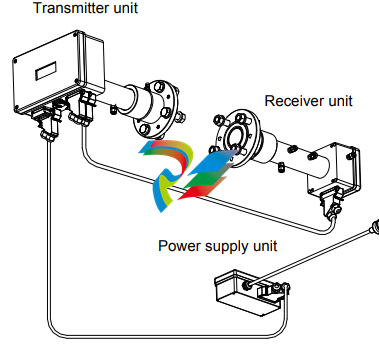
The analyzer consists of 3 separate units (see Figure 1-2):
Transmitter unit with purging
Receiver unit with purging
Power supply unit
The transmitter unit contains the laser module with a temperature stabilized diode laser, collimating optics, and the main electronics in a coated Aluminum box. The receiver unit contains a focusing lens, the photodetector and the receiver electronics in a coated Aluminum box. Both transmitter and receiver units have environmental protection IP66, and the standard optical windows withstand pressures up to 5 bar (absolute pressure). The monitor is installed by assembling the transmitter and receiver units with the supplied purging & alignment units, which in turn are mounted onto the DN50 process flanges (see Figure 3-1). The optical alignment is easy and reliable, and the purging prevents dust and other contamination from settling on the optical windows. A block diagram of AO2000-LS25 is shown in Figure 1-3. The power supply unit transforms 100-240 V AC to 24 V DC (if 24 VDC is available it can be supplied directly to the transmitter unit). The power supply box is connected to the transmitter box with a cable. The 4–20 mA input signals from external gas temperature/pressure sensors can be connected to the screw terminals inside the power box or directly to the cable connector on the transmitter unit. The receiver electronics is connected with the transmitter electronics with a cable. The detected absorption signal from the photodetector is amplified and transferred to the transmitter unit through this cable. The same cable transfers the required power from the transmitter unit to the receiver unit. The transmitter Al box contains the major part of the electronics. The CPU board performs all instrument control and calculation of the gas concentration. The main board incorporates all electronics required for instrument operation such as diode laser current and temperature control and analogue-to-digital signal conversion. A display (LCD) continuously displays the gas concentration, laser beam transmission and instrument status. The RS-232 port can be used for direct serial communication with a PC. The optional Ethernet board provides TCP/IP communication via LAN (local area network), which can be used instead of serial communication. All cable connectors are Phoenix VARIOSUB type and waterproof
1.4 Software Software for the analyzer consists of 2 programs: 1. A program hidden to the user and integrated in the CPU electronics, running the micro controller on the CPU card. The program performs all necessary calculations and selfmonitoring tasks. 2. A Windows based program running on a standard PC connected through the RS-232 connection. The program enables communication with the instrument during installation, service and calibration. The operator will need to use the PC based program only during installation and calibration and not during normal operation of the instrument. See Section 4 for more details.
1.5 Laser classification and warnings The diode lasers used in the analyzer operate in the near infrared (NIR) range between 700 and 2400 nm depending on the gas to be measured. Laser Class 1M for sample component O2 Laser Class 1 for all other sample components according to IEC 60825-1. NOTE: The lasers emit invisible light! WARNING: Class 1M Laser Product – Do not open when energized! Do not view directly with optical instruments! WARNING: Class 1 Laser Product – Do not open when energized!
2.1 Tools and other equipment The following equipment is necessary to install and calibrate the equipment:
2 pcs open-end spanners for M16 bolts
1 pcs Allen key 5 mm for the locking screws on flanges
1 pcs PC (386 or higher). Used during installation and calibration
1 pcs flat screwdriver 2.5 mm for electrical connections
Flow conditions at measuring point When deciding the placement of the analyzer in the process, we recommend a minimum of 5 stack diameters of straight duct before and 2 stack diameters of straight duct after the point of measure.
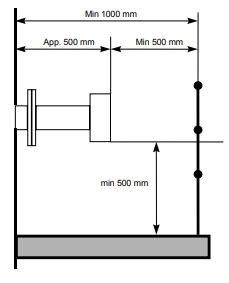
Monitor placement Both the transmitter and receiver units should be easily accessible. A person should be able to stand in front of either the transmitter unit or the receiver unit and adjust the M16 fixing bolts using two standard spanners. For the receiver unit there should be at least 1 m free space measured from the flange fixed to the stack and outwards as shown in Figure 2-1.
power is disconnected or switched off before connecting any cable. Please note that the power plug is the disconnecting device (no separate mains switch on instrument) and should be placed easily accessible for the operator. To install the instrument on the process follow the steps below.
Install transmitter alignment and purging unit (5) onto the stack flange with 4 pcs. M16x60 bolts (ref. Figure 3-4). All 4 bolts on either side must be tightened firmly to compress the large O-ring. Adjust the 4 locking screws prior to mounting the unit, to assure good alignment of the unit and a uniform compression of the O-ring. 2. Install pressurized instrument purging as described in Section
1.2. 3. Open the purging. Refer to Section 3.1.2 for details. 4
. Put the window adapter ring (4) on the alignment unit. Make sure that the O-ring on the alignment unit is tight and greased. The guiding pin on the alignment unit must fit the hole in the adapter ring.
. Affix an O-ring (not greased) to the adapter ring and connect the transmitter unit to the alignment unit. The guiding pin on the adapter ring must fit the hole in the transmitter window. Tighten the transmitter-mounting nut.
. Repeat steps 1-5 for the receiver unit.
. Connect the transmitter and receiver units with the corresponding cable (refer to Figure 6-1 for location of receiver connection on transmitter unit). All connectors are coded with small red pins on the inside.
. Connect external 4–20 mA temperature and pressure probes (ref. Section 6.3 and 6.5). This is optional as some instruments operate without probes. Input signals are connected to the terminals in the power supply unit or directly to the terminals in the main power connector at the transmitter unit. If connected to the power connector the factory-mounted wires should be removed from the terminals in question.
. Connect the transmitter and power supply units with the corresponding cable. The analyzer can now be switched on. This procedure is described in Section 3.2.
Air purging of flanges The instrument windows are kept clean by setting up a positive flow of air through the flanges and into the stack. This purging will prevent particles from settling on the optical windows and contaminating them. The purge gas must be dried and cleaned. We recommend using instrument air for purging. If instrument air is not available a separate blower is needed. A purge flow of approximately 20–50 l/min (process dependent) is sufficient for most installations. Alternatively, the initial velocity of the purge flow in the flanges is set to 1/10 of the gas velocity in the duct. After completion of the installation the purge flow is optimized as described in Section 5.3. The air quality should conform to standard set by ISO 8573.1, Class 2-3. This means particles down to 1 micron should be removed, including coalesced liquid water and oil, and a maximum allowed remaining oil aerosol content of 0.5 mg/m3 at 21C (instrument air). Note that some instruments require nitrogen purging, e.g. O2 instruments for high temperature or pressure applications, some H2O instruments etc.
Purging of transmitter and receiver units For applications where purging of transmitter and receiver units is required the direction of flow is illustrated in Figure 3-3. Since there are optical surfaces inside these units, the cleanness of the gas should be ensured and additional filtering may be necessary. Note that so called “instrument air” may contain some oil and water. If receiver and transmitter are purged with such air they can be permanently damaged after a short time. It is highly recommended to use nitrogen as a purge gas. The purge flow must not be high to avoid pressure build-up inside the units. We recommend reducing the flow to less than 0.5 l/min. If the flow is blocked the units can hold the gas to better than 99.5% during one hour
Isolation flanges For toxic gas and highly corrosive applications especially in combination with high pressure the first flange has to be an isolation flange which isolates the process from the analyzer. In these cases a shut-off valve is always necessary in order to do maintenance on the flange. The isolation flange has to be “custom tailored” for the individual process. The isolation flange may be purged if necessary as described in Section 3.1.2. Due to the additional windows a certain loss of transmission is to be expected. The analyzer will be mounted on the isolation flang
Before dismounting the isolation flange make sure the process is either turned off and safe or the volume between the nearly closed shut-off valve and the flange is purged thoroughly to make sure no harmful gas may leak out.
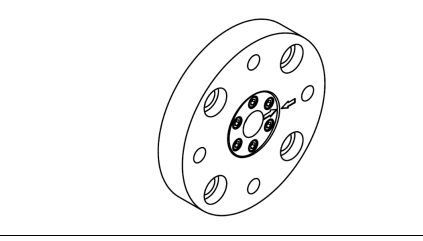
Leave the instrument switched ON, and disconnect both the transmitter and receiver units from their alignment units by loosening the corresponding mounting nuts. The laser beam from the transmitter is not visible. Avoid looking directly into the transmitter!
2. Remove the adapter ring (no. 4 in Figure 3-1) from the transmitter alignment & purging unit.
3. Mount the red laser alignment jig on the transmitter side using the supplied mounting nut and locate the laser beam on the receiver side using the target. Loosen the adjustment screws shown in Figure 3-4 on the transmitter unit purging flange and move it carefully from side to side and up and down to locate the laser beam in the receiver hole. (You may need two persons.)
4. Having found the laser beam, move the beam to the center of the hole by carefully adjusting the adjustment screws on the transmitter side. Lock the alignment by tightening the locking screws on the transmitter side and check that the alignment has not changed.
5. The laser beam is now centered, but not necessarily parallel with the optical axis of the receiver unit. The following section describes the procedure for aligning the receiver unit to maximize the signal of the analyzer. 3.3.2 Alignment of receiver unit
1. Remove the adapter ring (no.4 in Figure 3-1) from the receiver alignment & purging unit.
2. Disconnect the red laser alignment jig from the transmitter side and mount it on the receiver side. Locate the laser beam on the transmitter side. Loosen the adjustment screws shown in Figure 3-4 on the receiver unit purging flange and move it carefully from side to side and up and down to locate the laser beam in the transmitter hole. (You may need two persons.)
3. Having found the laser beam, move the beam to the center of the hole by carefully adjusting the adjustment screws on the receiver side. Lock the alignment by tightening the locking screws on the receiver side and check that the alignment has not changed. Having completed the previously described operations successfully, the transmitter and receiver should be re-mounted. Check the transmission reading on the transmitter unit LCD. Proceed to Section 3.4, where tuning for maximum transmission using a voltmeter is described.
Tuning for maximum transmission Fine alignment of the transmitter and receiver unit to ensure maximum signal is accomplished by measuring the alignment voltage with a voltmeter and the supplied cable with miniature power plug. The alignment voltage varies from 0V at 0% transmission to −3V (typically) at 100% transmission. The alignment voltage is measured by connecting a voltmeter to the alignment jack on the transmitter unit. This jack is located on Phoenix connector of the transmitter-to-receiver cable as shown in Figure 3-6. A similar alignment jack is found on the receiver unit
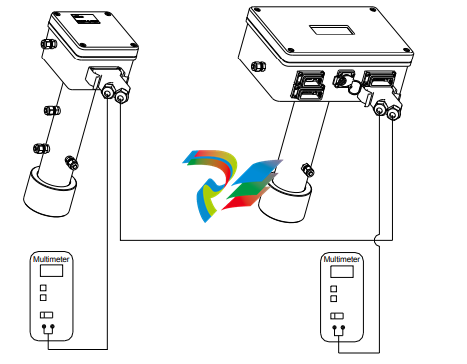
The fine-tuning procedure is as follows:
Connect a voltmeter with floating inputs (battery powered) and measure the alignment voltage from the receiver unit.
2. Maximize the voltmeter reading by carefully adjusting the adjustment screws on the receiver side.
3. Connect a voltmeter with floating inputs (battery powered) and measure the alignment voltage from the transmitter unit.
4. Maximize the voltmeter reading by carefully adjusting the adjustment screws on the transmitter side.
5. Repeat steps 1-2 and 3-4 until no further improvements in voltmeter readings.
6. Tighten the locking screws and check that the alignment has not changed.
7. Disconnect the voltmeter Having completed the previously described operations successfully, the installation and process parameters need to be set correctly using a PC and the analyzer software to enable correct measurements. Setting of these parameters is explained in Section 4
-
 AEROTECH Automation1 SI4 Stepper Interface
 -
AEROTECH Automation1 XI4 Servo Interface
-
 AEROTECH AEROTECH Automation1 iXI4 Servo Interface with Motion Controller
 -
 AEROTECH Automation1 XC6e Enhanced, High-Power PWM Servo Drive
 -
 AEROTECH Automation1 iXC6e Enhanced, High-Power PWM Servo Drive with Motion Controller
 -
 AEROTECH Automation1 XC2 Compact PWM Servo Drive
 -
 AEROTECH Automation1 XC4 PWM Servo Drive
 -
 AEROTECH Automation1 GL4 Galvo Laser Scan Head Linear Drive
 -
 AEROTECH Automation1 XC2e Enhanced, Compact Servo Drive with PWM+
 -
 AEROTECH Automation1 XC4e Enhanced, PWM Servo Drive
 -
 AEROTECH Automation1 XR3 Multi-Axis Servo Drive Rack
 -
 AEROTECH Automation1 iXR3 Multi-Axis Servo Drive Rack with Motion Controller
 -
 AEROTECH Automation1 iXC2 Compact PWM Servo Drive with Motion Controller
 -
 AEROTECH Automation1 iXC2e Enhanced, Compact PWM+ Servo Drive with Motion Controller
 -
 AEROTECH Automation1 iXC4 PWM Servo Drive with Motion Controller
 -
 AEROTECH Automation1 iXC4e Enhanced, PWM Servo Drive with Motion Controller
 -
 AEROTECH Automation1 iPC Industrial PC with Motion Controller
 -
 AEROTECH EPICS & TANGO Drivers for Distributed Control Systems
 -
 AEROTECH .NET, C, Python & LabVIEW APIs Custom Application Develotpmen
 -
 AEROTECH Automation1 Industrial Ethernet Support
 -
 AEROTECH Automation1 iSMC Intelligent, Software-Based Motion Controller
 -
 AEROTECH Automation1 iXA4 1- 2- or 4-Axis PWM Servo Drive with Motion Controller
 -
 AEROTECH Automation1 XA4 1- 2- or 4-Axis PWM Servo Drive
 -
 CTI 2500-ADP2-DISC Discrete Wiring Adapter for Series 500
 -
 CTI 2500-ADP1 Analog Wiring Adapter for Series 500
 -
 CTI 2500C-RADP-RS485 Remote Base Controller Adapter for Series 500
 -
 CTI 2500C-RADP-RBC Profibus RBC Adapter for Series 500
 -
 CTI 2500C-PADP-120V 120VAC 50W Power Supply for Series 500
 -
 CTI 2500-RADP RBC Adapter for Series 500
 -
 CTI 2500-R4500 520/530/DBC Adapter for Series 500 - MATURE
 -
 CTI 2500-PADP Power Supply Adapter for Series 500
 -
 CTI 2500-IADP I/O Adapter for Series 500
 -
 CTI 2500-VP15A-N4-W7 15" Flat-Panel PC with Windows® 7 Embedded
 -
 CTI 2500S-27-1750 Slice I/O, Ethernet, RS232/485. 900MHz, 2DIO / 4UAI / 2AI
 -
 CTI 2500S-26-1750 Slice I/O, Ethernet, RS232/485. 900MHz, 8DIO / 2UAI
 -
 CTI 2500S-23-1750 Slice I/O, Ethernet, RS232/485. 900MHz, 4DI / 4DO / 2UAI / 2AO
 -
 CTI 2500S-27-1550 Slice I/O, RS232/485. 2DIO / 4UAI / 2AI
 -
 CTI 2500S-26-1550 Slice I/O, RS232/485. 8DIO / 2UAI
 -
 CTI 2500S-23-1550 Slice I/O, RS232/485. 4DI / 4DO / 2UAI / 2AO
 -
 CTI 2500S-27-1050 Slice I/O, Ethernet, 2DIO / 4UAI / 2AI
 -
 CTI 2500S-26-1050 Slice I/O, Ethernet, 8DIO / 2UAI
 -
 CTI 2500S-23-1050 Slice I/O, Ethernet, 4DI / 4DO / 2UAI / 2AO
 -
 CTI 2500C-32F-CJC 32-Pin Field Wiring Connector with Cold Junction Compensation
 -
 CTI 2500C-32F 32-Pin Field Wiring Connector
 -
 CTI 2500C-8-TC Eight Thermocouple Inputs
 -
 CTI 2500C-8-RTD Eight RTD Inputs
 -
 CTI 2500C-8-RL-FC 8 Form-C Relay Outputs
 -
 CTI 2500C-8-IDO-24V 8 Isolated 24VDC Outputs
 -
 CTI 2500C-8-IDO-120V 8 Isolated 120VAC Outputs
 -
 CTI 2500C-16-DO-24V Sixteen 24VDC Digital Outputs
 -
 CTI 2500C-16-DO-120V Sixteen 120VAC Digital Outputs
 -
.png) CTI 500C-16-IDI-24V Sixteen Isolated 24V AC/DC Digital Inputs
CTI 500C-16-IDI-24V Sixteen Isolated 24V AC/DC Digital Inputs -
 CTI 2500C-16-IDI-120V Sixteen Isolated 120V AC/DC Digital Inputs
 -
 CTI 2500C-16-DIDO-SIM Sixteen Digital Input and Output SImulator
 -
 CTI 2500C-16-DI-24V Sixteen 24V AC/DC Digital Inputs
 -
 CTI 2500C-16-DI-120V Sixteen 120V AC/DC Digital Inputs
 -
 CTI 2500C-RBC-RS485 RS485 Remote Base Controller
 -
 CTI 2500C-RBC-PRF Profibus Remote Base Controller
 -
 CTI 2500C-PS-24V-35 35-Watt DC Power Supply
 -
 CTI 2500C-PS-120V-35 35-Watt AC Power Supply
 -
 CTI 2500C-R8 Eight-Slot Base
 -
 CTI 2500C-R4 Four-Slot Base
 -
 CTI 2500C-R16 Sixteen-Slot Base
 -
 CTI 2500C-2572-B Fast Ethernet TCP/IP Adapter
 -
 CTI 2500C-J750 Compact Janus PAC with 3MB Project Memory
 -
 CTI 2500C-C300 CPU with 512K User Memory
 -
 CTI 2500C-C200 CPU with 256K User Memory
 -
 CTI 2500C-C100 CPU with 128K User Memory
 -
 CTI 2500C-8-AO 8 Analog Outputs
 -
 CTI 2500C-8-AI 8 Analog Inputs
 -
 CTI 2559-FCAL Precision Calibration Connector
 -
 CTI 2559-FPC 40-Position Screw-Terminal Connector
 -
 CTI 2500-RFC PLC to RF Modem Cable
 -
 CTI 2500-40F 40-Position Standard Screw-Terminal Connector
 -
 CTI 2505 Vibration Sensor Interface Module
 -
 CTI 2554-A 4-Channel Isolated High Speed Counter Module
 -
 CTI 2553-A 2-Channel Mag Meter Input Module
 -
 CTI 2502 2-Channel High Speed Counter Input Module
 -
 CTI 2559-TC 8-Channel Thermocouple Input Module
 -
 CTI 2556-A 16-Channel Isolated Thermocouple Input Module
 -
 CTI 2556 16-Channel Isolated Thermocouple Input Module
 -
 CTI 2551-A 8-Channel Isolated Thermocouple Input Module
 -
 CTI 2559-RTD 8-Channel RTD Input Module
 -
 CTI 2557-A 16-Channel RTD Input Module
 -
 CTI 2557 16-Channel RTD Input Module
 -
 CTI 2552-A 8-Channel Isolated RTD Input Module
 -
 CTI 2534 8-Point Form-C Relay Output Module
 -
 CTI 2532 16-Point Form-A Relay Output Module
 -
 CTI 2531 32-Point Form-A Relay Output Module
 -
 CTI 2530 8-Point Form-C Relay Output Module
 -
 CTI 2562 8-Channel Analog Output Module
 -
 CTI 2560-A 8-Channel Isolated Analog Output Module
 -
 CTI 2501 8in/4out Analog Module
 -
 CTI 2558 8-Channel Analog Input Module
 -
 CTI 2555-A 16-Channel Analog Input Module
 -
 CTI 2550-A 8-Channel Isolated Analog Input Module
 -
 CTI 2599 8/16/32-Point AC Output Module
 -
 CTI 2598-8 8-Point AC Output Module
 -
 CTI 2598 8/16-Point AC Output Module
 -
 CTI 2597 8/16/32-Point DC Output Module
 -
 CTI 2596-8 8-Point DC Output Module
 -
 CTI 2596 8/16-Point DC Output Module
 -
 CTI 2595 16-Point TTL/Word Output Module
 -
 CTI 2591-EF 16-Point Isolated 11-146 VDC Output with Front Panel Accessible Fuses
 -
 CTI 2591-A 16-Point Isolated 11-146 VDC Output Module
 -
 CTI 2590-EF 16-Point Isolated 20-132 VAC Output with Front Panel Accessible Fuses
 -
 CTI 2590-A 16-Point Isolated Discrete 20-132 VAC Output Module
 -
 CTI 2589-B 8/16/32-Point Universal Discrete Input Module
 -
 CTI 2589-A 8/16/32-Point Universal Discrete Input Module
 -
 CTI 2588-8 8-Point Universal Discrete Input Module
 -
 CTI 2585 16-Point TTL/Word Input Module
 -
 CTI 2582 16-Point Isolated 125 VDC Input Module
 -
 CTI 2581 16-Point Isolated 12-56 VDC Input Module
 -
 CTI 2580 16-Point Isolated 95-132 VAC Input Module
 -
 CTI 2500-TAP RS485 Network Tap
 -
 CTI 2500-RIO-B RS485 Remote Base Controller
 -
 CTI 2500-RIO-A RS485 Remote Base Controller
 -
 CTI 2500-RBC Profibus Remote Base Controller
 -
 CTI 2515-A 100-Watt AC/DC Power Supply with Redundancy Support
 -
 CTI 2515 100-Watt AC Power Supply (MATURE - replaced by 2515-A)
 -
 CTI 2513-A 75-Watt DC Power Supply with Redundancy Support
 -
 CTI 2513 75-Watt 24VDC Power Supply
 -
 CTI 2512-A 75-Watt AC/DC Power Supply with Redundancy Support
 -
 CTI 2512 75-Watt AC/DC Power Supply
 -
 CTI 2510 125 VDC Power Supply
 -
 CTI 2500-SSB Single Slot Blank Front Panel
 -
 CTI 2500-R11-A Eleven-Slot Redundant Base
 -
 CTI 2500P-R16 Sixteen-Slot Base with High-Speed Channel