Woodward 85018V1 Turbine Control Parameters
Turbine Control Parameters
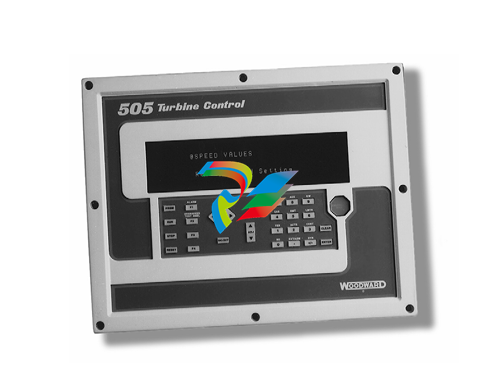
The 505E interfaces with two control valves (HP & LP) to control two parameters
and limit an additional parameter, if desired. These two controlled parameters are
typically speed (or load) and extraction/admission pressure (or flow), however,
the 505E could be utilized to control or limit: turbine inlet pressure or flow,
exhaust (back) pressure or flow, first stage pressure, generator power output,
plant import and/or export levels, compressor inlet or discharge pressure or flow,
unit/plant frequency, process temperature, or any other turbine related process
parameter. Refer to Volume 2 for details on applications.
Communications
The 505E can communicate directly with plant Distributed Control Systems
and/or CRT based operator control panels, through two Modbus® *
communication ports. These ports support RS-232. RS-422. or RS-485
communications using ASCII or RTU MODBUS transmission protocols.
Communications between the 505E and a plant DCS can also be performed
through hardwired connections. Since all 505E PID setpoints can be controlled
through analog input signals, interface resolution and control is not sacrificed.
*—Modbus is a trademark of Schneider Automation Inc.
Additional Features
The 505E also provides the following features: First-Out Trip Indication (5 total
trip inputs), Critical Speed Avoidance (2 speed bands), Auto Start Sequence (hot
& cold starts), Dual Speed/Load Dynamics, Zero Speed Detection, Peak Speed
Indication for Overspeed trip, and Isochronous Loadsharing between units.
Using the 505E
The 505E control has two normal operating modes, the Program Mode and the
Run Mode. The Program Mode is used to select the options needed to configure
the control to your specific turbine application. Once the control has been
configured, the Program Mode is typically never again used, unless turbine
options or operation changes. Once configured, the Run Mode is used to operate
the turbine from start-up through shutdown. In Addition to the Program and Run
modes, there is a Service Mode which can be used to enhance system operation
while the unit is running. Refer to Volume 2 for information on the Service Mode.
505E Inputs and Outputs
Control Inputs
Two speed inputs which are jumper configurable for MPU (magnetic pickup units)
inputs or proximity probes.
Six analog inputs are available. One is dedicated as the extraction/admission
input. The remaining five are configurable. The sixth analog input has isolation
circuitry and should be used for a self-powered signal that is not isolated.
Sixteen contact inputs are available. Four are dedicated for shutdown, reset,
raise speed setpoint, and lower speed setpoint. Another two contact inputs must
be dedicated for generator breaker and utility tie breaker if the control is used in a
generator application. Ten additional contact inputs can be configured. If the unit
is not used in a generator application, then twelve additional contact inputs can
be configured.
Four function keys on the front panel of the control. F1 and F2 are dedicated to
alarm and overspeed test, respectively. F3 and F4 can be used to enable or
disable various functions of the control.
Control Outputs
Two actuator outputs with linearization curves for the HP and the LP valve
outputs.
Six 4–20 mA outputs, for meters or other readouts.
Eight Form-C relay contact outputs, six that are configurable. The two dedicated
relay outputs are for shutdown and alarm indication.
Control Communications
Two Modbus ports, to be used as control interfaces. The protocol can be either
ASCII or RTU and the communications can be RS-232. RS-422. or RS-485.
One computer (PC) port to be used for program configuration storage.
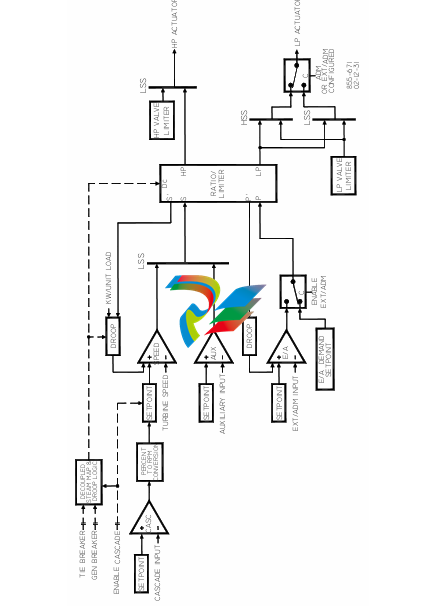
An overview of the 505E functions is shown in Figure 1-1. Use this block diagram
to match the control features to the site-specific application required.
The 505E Digital Governor is designed to control extraction, extraction/
admission, or admission steam turbines. The difference between these turbines
is the capability of the turbine to allow low pressure steam, which is at a lower
pressure than the inlet, to enter and/or exit the turbine. An extraction turbine
allows the lower pressure (extraction) steam to exit the turbine only and will have
a non-return valve in the extraction header/line to prevent steam from entering
the turbine. An admission turbine (also called induction) will allow excess header
steam to enter the turbine through the low pressure inlet. An extraction/admission
turbine will allow low pressure header steam to enter or exit the turbine
depending on system pressures. A turbine with admission capability will have a
stop valve or trip-and-throttle valve in the low pressure line to prevent steam from
entering the turbine when the unit is tripped. The type of turbine used will depend
on the system requirements and must be designed by the turbine manufacturer
to perform the functions required.
The 505E has two independent control channels available, the speed/load and
auxiliary controllers. The outputs of these two controllers are low-signal-selected
(LSS) to provide to speed/load demand signal to the ratio/limiter. In addition to
these channels, the speed/ load controller can be manipulated by another
controller, the cascade controller. The cascade controller is ‘cascaded’ into the
speed controller, whereby the speed controller setpoint is changed directly by the
cascade controller output. The auxiliary controller can act as either a control
channel or as a limiting channel. All three of these PID controllers have the
option of utilizing an analog input signal to remotely position their setpoints.
Additional features of the 505E include frequency control, isochronous
loadsharing, critical speed avoidance, idle/rated control, and an automatic start
sequence. There are two serial communications ports which can be used to
monitor and control the turbine using Modbus protocol.
Extraction Turbines
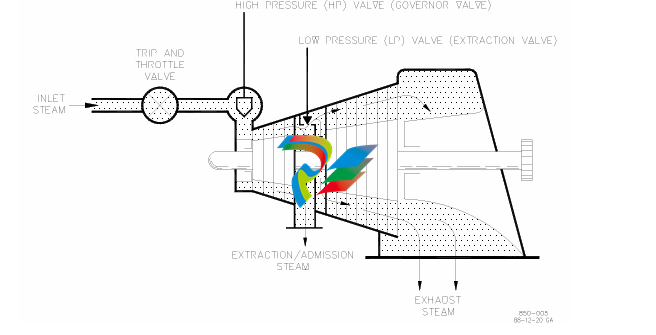
The 505E control can be configured to operate single automatic extraction
turbines by controlling the interaction of the governor (HP or high pressure) valve
and the extraction (LP or low pressure) valve. (The 505E can also operate the
governor valve and the first extraction valve of multiple extraction turbines).
Single automatic extraction turbines have a high pressure stage and a low
pressure stage, each controlled by a valve. Steam enters the turbine through the
HP valve (see Figure 1-2). At the downstream end of the HP turbine stage and
before the LP valve, steam can be extracted. The LP valve controls the entry of
steam into the LP turbine stage, and the diverting of steam through the extraction
line. As the LP valve is opened, more steam enters the LP stage and less is
extracted.
In most cases, the operator of an extraction turbine needs to maintain both
turbine speed/ load and extraction pressure/flow at constant levels. Changing the
position of either the HP valve or the LP valve affects both turbine speed/load
and extraction. If either the load on the turbine or the extraction demand
changes, both the
Admission Turbines
The 505E control can be configured to operate single automatic admission
turbines by controlling the interaction of the governor (HP or high pressure) valve
and the extraction (LP or low pressure) valve.
Single automatic admission turbines have a high pressure stage and a low
pressure stage, each controlled by a valve. Steam enters the turbine through the
HP valve (see Figure 1-3) and at the downstream end of the HP turbine stage,
before the LP valve. The LP valve controls the entry of steam into the LP turbine
stage and through the admission line. As the LP valve is opened, more steam
enters the LP stage.
In most cases, the operator of an admission turbine needs to maintain both
turbine speed/ load and admission pressure/flow at constant levels. Changing the
position of either the HP valve or the LP valve affects both turbine speed/load
and admission. If either the load on the turbine or the admission demand
changes, both the HP valve position and the LP valve position must be changed
to maintain speed/load and admission.
The movement of both valves is automatically calculated by the 505E’s ratioing
logic based on the turbine performance parameters to minimize valve/process
interaction.
Extraction and Admission Turbines
The 505E control can be configured to operate single automatic extraction and
admission turbines by controlling the interaction of the governor (HP or high
pressure) valve and the extraction (LP or low pressure) valve.
Single automatic extraction and admission turbines have a high pressure stage
and a low pressure stage, each controlled by a valve. Steam enters the turbine
through the HP valve (see Figure 1-2). At the downstream end of the HP turbine
stage and before the LP valve, steam can either be extracted or admitted
(inducted) into the LP turbine stage. The LP valve controls the entry of steam into
the LP turbine stage. As the LP valve is opened, more steam enters the LP stage
and less is extracted.
In most cases, the operator of an extraction turbine needs to maintain both
turbine speed/ load and extraction or admission pressure/flow at constant levels.
Changing the position of either the HP valve or the LP valve affects both turbine
speed/load and extraction or admission. If either the load on the turbine or the
extraction / admission demand changes, both the HP valve position and the LP
valve position must be changed to maintain speed/ load and extraction/
admission. The movement of both valves is automatically calculated by the
505E’s ratioing logic based on the turbine performance parameters to minimize
valve/process interaction.
Speed Control
The speed control receives a turbine speed signal from one or two magnetic
pickups or proximity probes. The speed PID (proportional, integral, derivative)
control amplifier then compares this signal to the speed setpoint to generate an
output signal to the ratio/ limiter (through a low signal select bus).
-
 HIRSCHMANN RS20-0400M2T1SDAPHC08.0.01 Managed Switch
 -
 MACH1130 Hirschmann Industrial Switch
 -
 HIRSCHMANN 943824-002 SPIDER 5TX Industrial Ethernet Switch
 -
 HIRSCHMANN RS30-0802O6O6SDAEHC09.1.00 Managed Industrial Switch
 -
 HIRSCHMANN RS20-0400M2M2TDAEHC04.0.01 Industrial Switch
 -
 HIRSCHMANN BRS20-0600Z6Z6-STCZ99HHSES Industrial Switch
 -
 HIRSCHMANN MACH104-20TX-FR-L3P Industrial Ethernet Switch
 -
 HIRSCHMANN RS40-0009CCCCEDBPHH06.0.01 Industrial Switch
 -
 HIRSCHMANN RS2-3TX/2FX EEC Industrial Ethernet Switch
 -
 Hirschmann MACH 1020/1030 Fast/Gigabit Rack Mount Switches
 -
 HIRSCHMANN RS20-0800M2M2SDAPHC09.0.14 Industrial Switch
 -
 HIRSCHMANN RS20-1600T1T1SDAEHC09.0.04 Industrial Switch
 -
 HIRSCHMANN RSB20-0800T1T1EAABHH Industrial Switch
 -
 HIRSCHMANN MACH4002-48+4G-L3E Industrial Backbone Switch
 -
 HIRSCHMANN RS20-0400S2T1SDAE Industrial Managed Switch
 -
 HIRSCHMANN RS20-0800S2T1SDAUHC Industrial Switch
 -
 HIRSCHMANN RS20-2400S4S4SDAEHC09.0.14 industrial switch
 -
 HIRSCHMANN OS20-001200T5T5T5- TBBZ999HHNE3S 08.1.00 industrial switch
 -
HIRSCHMANN OS20-001200T5T5T5- TBBZ999HHNE3S 08.1.00 industrial switch
-
 HIRSCHMANN RS40-0009CCCCSDAEHH09.0.14 switch
 -
 Hirschmann RS20-1600T1T1SDAUHC Management-type Ethernet Switch
 -
 Hirschmann M1-8SFP Switche
 -
Hirschmann Industrial Ethernet Ruggedized Switch MACH1000 Family
-
 Basler Electric, Solid State Protective Relay, BE1-60
 -
BASLER ELECTRIC SR4A-2B15B3A Static Voltage Regulator
-
.png) BASLER ELECTRIC EXCITER DIODE MONITOR EDM-200
BASLER ELECTRIC EXCITER DIODE MONITOR EDM-200 -
.png) BASLER ELECTRIC DECS125-15-B2C5 DIGITAL EXCITATION CONTROL SYSTEM V 2.0.9
BASLER ELECTRIC DECS125-15-B2C5 DIGITAL EXCITATION CONTROL SYSTEM V 2.0.9 -
 BASLER ELECTRIC BE1-851 OVERCURRENT PROTECTION RELAY MECHANISM
 -
 Basler Electric BE1-51A / BE151A
 -
 Basler Electric BE1-40Q Loss of Excitation Relay
 -
 Basler Electric BE1-87G Variable Percentage Differential Relay
 -
 Basler Electric BE1-11 Protection System I5A3M2P2N0EA00
 -
 BASLER ELECTRIC DECS-200-1C Digital Excitation Control System
 -
 Basler Electric / Kohler BE1-11g Generator Protection Relay G5A3M2J2N0E000
 -
BASLER ELECTRIC DECS125-15 DIGITAL EXCITATION CONTROL SYSTEM
-
 BASLER ELECTRIC BE1-951 OverCurrent Protecton System
 -
Basler Electric DECS-200-1L Digital Excitation Control System
-
 Basler Electric DGC-2020HD-5NS1DNSBA Digital Genset Controller -
 -
 BASLER ELECTRIC BE1-81T1EE1WA0N1F / BE181T1EE1WA0N1F
 -
 BASLER ELECTRIC BE1-25M1EA6PN5R1F / BE125M1EA6PN5R1F
 -
 BASLER ELECTRIC DECS-250-LN1SN1N DIGITAL EXCITATION CONTROL SYSTEM
 -
Basler Electric DECS-250-CN2CN 1N Digital Excitation Control System Unit
-
 BASLER ELECTRIC DECS-300-C0N0 DIGITAL EXCITATION CONTROL SYSTEM
 -
 BASLER ELECTRIC BE1-87T-A1E-A1J-D0S1F / BE187TA1EA1JD0S1F
 -
BASLER ELECTRIC BE1-11-G6D1M0J2P0E000 Protection System
-
 BASLER ELECTRIC BE1-GPS100-E4N1H1N GENERATOR PROTECTION SYSTEM
 -
 Jaquet Relay card (Auxiliary module) FTV 3090 377Z-03985
 -
 Jaquet Trip Chain Control card FTBU 3034 377Z-05030
 -
 Jaquet with input card -E04 FTFU 3024 -E04 377Z-05855
 -
 Jaquet with input card -E03 FTFU 3024- E03 377Z-03983
 -
 Jaquet FTFU 3024- E02 377Z-03982 with input card -E02
 -
 Jaquet FTFU 3024-E01 377Z-03981 with input card -E01
 -
 Hirschmann RS20-2400T1T1SDAE Industrial Managed Ethernet Switch
 -
 Hirschmann BELDEN EAGLE30-04022O6TT999SCCV9HSE3F
 -
 Hirschmann MM3-2FXS2/2TX MICE Media Module
 -
 Hirschmann RS20-1600M2M2SDAPHC08.0.05 Industrial Managed Switch
 -
 Hirschmann OZD Profi 12M G12-1300 PRO Fieldbus Repeater
 -
 Hirschmann SPIDER 4TX/1FX-ST EEC Industrial Ethernet Switch
 -
 Hirschmann MM2-2FXM3/2TX1 MICE Media Module
 -
 Hirschmann RS20-2400M2M2SDAPHC09.0.14 Industrial Switch
 -
 Hirschmann RS20-0400M2M2SDAEHC07.1.05 OpenRail Switch
 -
 Hirschmann OZD Profi 12M G12-EEC Fieldbus Repeater
 -
 HIRSCHMANN MDA422-1/2-3.5c-23/46 sensor
 -
Hirschmann RS30-2402T1T1SDAUHC Managed Industrial Switch
-
 Hirschmann OZD GENIUS G12 Industrial Switche
 -
 Hirschmann OZD 485 G12-1300 PRO Fieldbus Repeater
 -
 Hirschmann MM2-2FXM2 MICE Media Module
 -
 Hirschmann RS20-1600S2T1SDAUHC Managed Industrial Switch
 -
 Hirschmann MS20-0800SAAEHH04.2.04 MICE Switch
 -
 Hirschmann SPIDER 4TX/1FX EEC Unmanaged Industrial Switch
 -
 HIRSCHMANN MS4128-L3P EEC Managed Industrial Ethernet Switch
 -
 HIRSCHMANN RS20-0400M2T1SDAPHC08.0.01 Managed Switch
 -
 ETEL EA-S0M-400-40/80A-0000-00 AccurET Modular Power Supply
 -
 ETEL EA-B0I-0-0-0000-00 Backplane Interface Board
 -
 ETEL EA-P2M-400-15/40A-0100-00 Position Controller
 -
ETEL EA-P2M-400-15/40A-0000-00 Position Controller
-
 ETEL EA-P2M-400-10/20A-0100-01 Position Controller
 -
 ETEL EA-P2M-400-10/20A-0000-01 Position Controller
 -
 ETEL EA-P2M-400-5/10A-0100-01 Position Controller
 -
 ETEL EA-P2M-048-2.5/5A-0000-01 Modular Position Controller
 -
 ETEL EA-S0M-300-40/80A-0000-00 Power Supply Module
 -
 ETEL EA-P2M-300-07/15A-0100-01 Position Controller
 -
 ETEL EA-P2M-300-07/15A-0000-01: Modular Position Controller
 -
 ETEL EA-P2M-300-4/7.5A-0100-01 Overview
 -
 Basler Electric MOC2. Motor Operated Potentiometer
 -
 Basler Electric BE1-11 RTD Module, Resistance Temperature Detector
 -
 Basler Electric RDP-110C, Remote Display Panel
 -
 Basler Electric VRM-2020. Voltage Regulation Module
 -
 Basler Electric IDP-1500. Interactive Display Panel
 -
 Basler Electric AEM-2020. Analog Expansion Module
 -
 Basler Electric IDP-2020. Interactive Display Panel
 -
 Basler Electric CEM-2020. Contact Expansion Module
 -
 Basler Electric CEM-125. Contact Expansion Module
 -
 Basler Electric BE2000E, Digital Voltage Regulator
 -
 Basler Electric SMC-150. Synchronous Motor Controller
 -
 Basler Electric AVC125-10. Voltage Regulator
 -
 Basler Electric BE1-25. Sync-Check Relay
 -
 Basler Electric DGC-2020ES, Digital Genset Controller
 -
 ETEL EA-P2M-400-5/10A-0000-01 Position Controller
 -
 Basler Electric BE1-64F, Ground Fault Relay
 -
 Basler Electric BE1-79M, Multi Shot Reclosing Relay
 -
 Basler Electric BE1-81O/U, Digital Frequency Relay
 -
 Basler Electric BE1-87B, High Impedance Bus Differential Relay
 -
 Basler Electric BE1-79A, Reclosing Relay
 -
 Basler Electric BE1-27. BE1-59. BE1-27/59. Voltage Relay
 -
 Basler Electric SMC-250. Synchronous Motor Controller
 -
 Basler Electric SGC-250N, Synchronous Generator Controller
 -
 Basler Electric SGC-250. Synchronous Generator Controller
 -
 Basler Electric BE1-50/51 Plug and Play and Retrofit Relays
 -
 Basler Electric DECS-2100. Digital Excitation Control System
 -
 Basler Electric DECS-250E, Digital Excitation Control System
 -
 Basler Electric BE1-700V, Voltage Only Digital Protective Relay
 -
 Basler Electric DECS-250. Digital Excitation Control System
 -
 Basler Electric DECS-450. Digital Excitation Control System
 -
 Basler Electric DECS-150. Digital Excitation Control System
 -
 Basler Electric ES-49. Temperature Relay
 -
 Basler Electric ES-81O/U, ES-81O,ES-81U Overfrequency Relay
 -
Basler Electric ES-74V, DC Voltage Sensing Relay
-
Basler Electric ES-27/59. Under/Overvoltage Relay
-
 Basler Electric ES-27. Undervoltage Relay
 -
 Basler Electric ES-25. Sync-Check Relay
 -
 Basler Electric ES-47, ES-47N Phase Sequence Relay
 -
Basler Electric ES-37.ES-37/51 Undercurrent Relay
-
 Basler Electric ES-32. Reverse Power Relay
 -
Basler Electric ES-59. Overvoltage Relay
-
 Basler Electric ES-55. Power Factor Relay
 -
 Basler Electric DGC-2020HD, Digital Genset Controller
 -
 Basler Electric BE1-FLEX, Protection, Automation, and Control System