schneiderFoxboro Evo™ Process Automation System Product Specifications
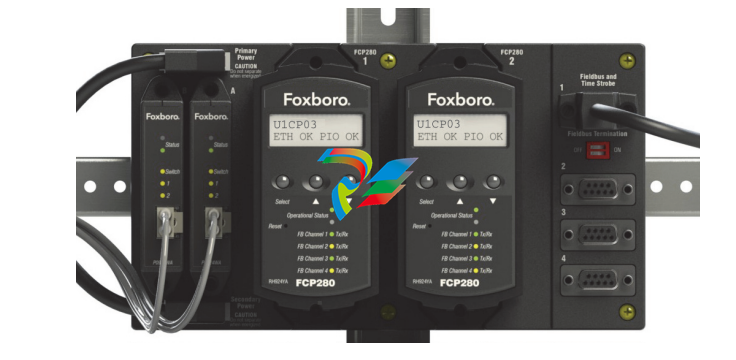
The Field Control Processor 280 is a distributed, optionally fault-tolerant, field-mounted controller that
performs process control and alarming functions according to a user-defined control strategy.
FEATURES
Performs regulatory, logic, timing, and sequential
control together with connected Fieldbus
Modules (FBMs)
Performs data acquisition and alarm detection
and notification
Supports up to 128 Compact or standard
200 Series FBMs, or up to 128 of a combination
of 100 Series FBMs and 200 Series FBMs (with
no more than 64 100 Series FBMs in this
configuration)
No Fieldbus Communication Module is required.
No Fieldbus Expansion Module is required for
Expanded fieldbus support.
Supports self-hosting mode, which allows the
FCP280 to boot itself with a valid control
database even without its host workstation
Offers unique, patented, fault-tolerant operation
using two control modules to greatly improve
reliability relative to other process controllers
Offers on-line image upgrade (OLUG) of a faulttolerant FCP280 without shutting down the
process
Liquid Crystal Display (LCD) displays letterbug
and real-time roles and statuses
Connects to The Mesh control network via
standard fiber optic or copper 100 Mbps
Ethernet cables
Uses a rugged, die cast aluminum housing for
mounting in a non-vented field enclosure
Can operate in Class G3 harsh environments
CE certified for field mounting in enclosures
Each Fieldbus port on FCP280 baseplates
supports either a 2 Mbps or 268 Kbps HDLC
fieldbus exclusively
Uses versatile control algorithms and a wide
variety of FBMs to provide control capabilities for
a broad range of process applications
Supports time synchronization using optional
external time from GPS satellites
Uses soft letterbugs configurable via the keys on
the FCP280 faceplate.
OVERVIEW
The Field Control Processor 280 (FCP280) is a
distributed, optionally fault-tolerant, field-mounted
controller module. The FCP280 performs regulatory,
logic, timing, and sequential control together with
connected Fieldbus Modules. It also performs data
acquisition and alarm detection and notification.
The FCP280 connects to The Mesh control network
via standard fiber optic or copper 100 Mbps Ethernet
cables from network adapters installed on its
baseplate (shown in Figure 1).
The FCP280 requires Foxboro Evo Control Core
Services v9.0 or later. A system with the FCP280 and
this software is called a Foxboro Evo Process
Automation System
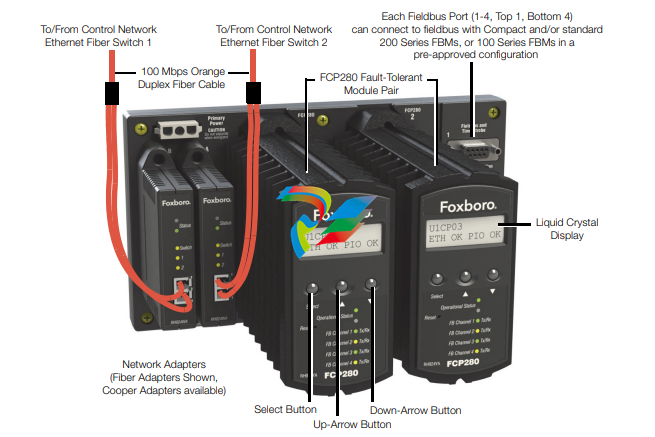
Figure 1. Fault-Tolerant FCP280 Module Pair Mounted on Vertical Mounted 2-Position FCP280 Baseplate
The fault-tolerant version of the FCP280 consists of
two processor modules. These modules are installed
in adjacent FCP280 slots in a baseplate for high
speed communication between the modules.
The FCP280 accepts four PIO channels (that is, four
separate HDLC fieldbuses) via the four Fieldbus ports
on its baseplate. These four Fieldbuses are referred
to collectively as the “Expanded fieldbus.” For a
description of the FCP280 baseplates, refer to DIN
Rail Mounted Modular Baseplates
(PSS 21H-2W6 B4).
The number of FBMs which an FCP280 can support
varies depending on the types of FBMs used:
200 Series FBMs exclusively used with FCP280 -
Each Fieldbus port on the FCP280 baseplate can
connect to a baseplate chain with up to 32
Compact or standard 200 Series FBMs per chain
via the 2 Mbps HDLC fieldbus (up to 128
modules).
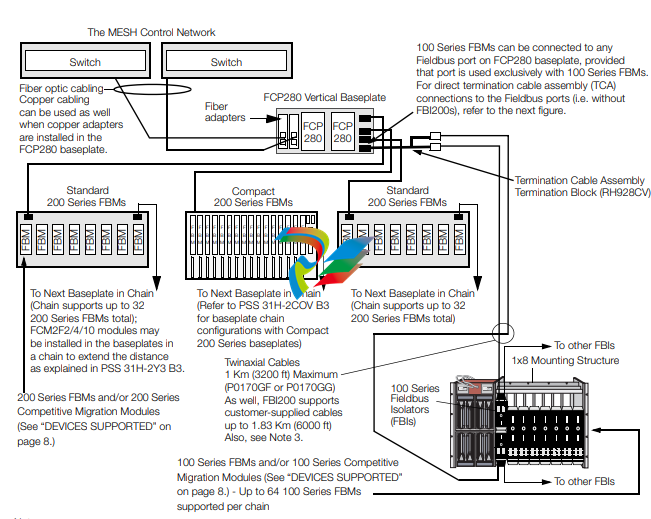
200 Series and 100 Series FBMs (dual baud
configurations) used with FCP280 - The FCP280
can support a total of 64 100 Series FBMs (Ymodule) or competitive devices (such as Foxboro
Evo System migration FBMs) in one or more
baseplate chains, with the remainder of the
FCP280’s 128 module limit being 200 Series
FBMs, depending on the Fieldbus loading of the
FCP280. For example, an FCP280 could support
64 100 Series FBMs and 64 200 Series FBMs (as
128 - 64 = 64). See Figure 2 and Figure 3 below.
NOTE
Certain competitive migration or supported
third-party modules such as DCS Migration
fieldbus Modules and Pepperl+Fuchs™ I/O
modules may increase this 128 module
maximum per FCP280. For the maximum
numbers of each of these migration/thirdparty modules supported by the FCP280,
refer to the supported migration products
books in Field Control Processor 280
(FCP280) User’s Guide (B0700FW).
When supporting 200 Series and 100 Series FBMs,
each Fieldbus port (PIO channel) is dedicated to
supporting either a 268 Kbps HDLC fieldbus (for
100 Series FBMs) or a 2 Mbps HDLC fieldbus (for
200 Series FBMs) - not both.
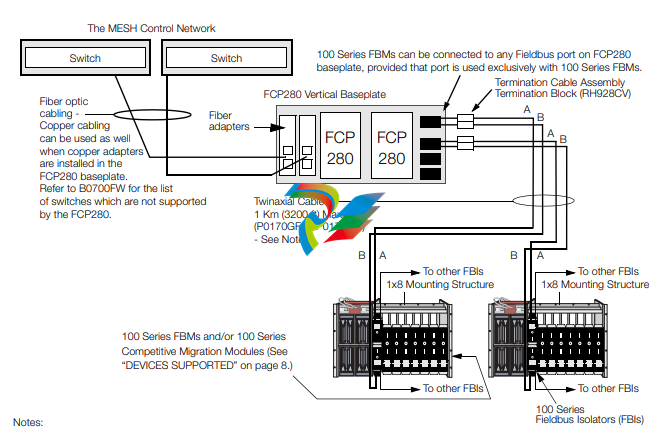
For connections to 100 Series FBMs over 60 m
(198 ft), an FBI200 pair is required to extend
communications up to 1830 m (6000 ft). See
Figure 2 below.
To connect a Fieldbus port to a 268 Kbps HDLC
fieldbus directly, the Fieldbus splitter (RH928CV)
provides a connector for any Fieldbus port on the
FCP280 baseplate, and two Termination Cable
Assembly (TCA) termination blocks for the twinaxial
cabling from the 100 Series FBMs.
The FCP280 can also communicate with serial and
Ethernet devices, such as PLCs, via Field Device
System Integrators. This allows you to connect to
new device interfaces without any changes to the
controller software.
To estimate the FCP280’s processor load, refer to
Field Control Processor 280 (FCP280) Sizing
Guidelines and Excel Workbook (B0700FY)
FIBER AND COPPER NETWORK ADAPTERS
FCP280 modules connect to a pair of fiber or copper
adapters (see Figure 4) which each connect to one
Ethernet switch in The Mesh control network. The
FCP280 baseplate passes inbound traffic from either
of the two switches to both FCP280s, and pass
outbound traffic from the primary FCP280 module to
either switch.
Figure 4. Fiber Optic and Copper Network Adapters
The fiber or copper adapters mount on the FCP280
baseplate as shown in Figure 1 on page 2. They
receive their power from the baseplate.
REMOTE MOUNTING
The FCP280 simplifies the Foxboro Evo Process
Automation System architecture, maintaining control
while only requiring housing (via field enclosures),
host workstations with Foxboro Evo Control Core
Services v9.0 or later, and Ethernet switches for
communication via The Mesh control network
architecture, described in PSS 21H-7C2 B3.
The field-mounted FCP280 is an integral part of the
highly-distributed control network where controllers
are closely aligned to specific process units mounted
in close proximity to their I/O and the actual
equipment being controlled. Coordination between
process units takes place via a fiber optic 100 Mbps
Ethernet network.
The FCP280 and its network adapters are packaged
in a rugged, die cast aluminum housing that does not
require venting due to its efficient design. The
FCP280 and its network adapters are CE certified,
and it can be mounted without expensive special
cabinets to prevent electronic emissions. The
FCP280, network adapters, and baseplate can be
mounted in Class G3 harsh environments.
ENHANCED RELIABILITY (FAULTTOLERANCE)
The unique and patented fault-tolerant operation of
the FCP280 improves reliability relative to legacy
process controllers. The fault-tolerant version of the
FCP280 consists of two modules operating in
parallel, with two Ethernet connections to The Mesh
control network. The two FCP280 modules, married
together as a fault-tolerant pair, provide continuous
operation of the controller in the event of virtually any
hardware failure occurring within one module of the
pair.
Both modules receive and process information
simultaneously, and faults are detected by the
modules themselves. One of the significant methods
of fault detection is comparison of communication
messages at the module external interfaces.
Messages only leave the FCP280 when both
FCP280s agree on the message being sent (bit for
bit match). Upon detection of a fault, self-diagnostics
are run by both modules to determine which module
is defective. The non-defective module then assumes
control without affecting normal system operations.
This fault-tolerant solution has the following major
advantages over controllers that are merely
redundant:
No bad messages are sent to the field or to
applications using controller data because no
message is allowed out of the controller unless
both modules match bit for bit on the message
being sent.
The secondary controller is synchronized with the
primary one, which ensures up to the moment
data in the event of a primary controller failure.
The secondary controller will have latent flaws
detected prior to any switchover because it is
performing exactly the same operations as the
primary controller.
UPGRADE OPTIONS
Multiple options are available for replacing existing
control processors with the FCP280. A fault-tolerant
FCP280 may replace a fault-tolerant FCP270 or
ZCP270. It may import the CP database from the
CP270 it is replacing, for compatibility and minimal
configuration time.
As well the FCP280 provides an increase in
performance and block processing capacity over the
CP270s. When replacing FCP270s, the FCP280
eliminates the need for FEM100 hardware.
For ease of replacement, the fault-tolerant or nonfault-tolerant FCP280 in its baseplate has the same
dimensions as the fault-tolerant or non-fault-tolerant
FCP270 in its baseplate.
Cabling the 100 Series FBMs or Migration products
to an FCP280 baseplate consists of extending the
remote 268 Kbps fieldbus between enclosures. This
is accomplished using termination cable assemblies
(TCAs) and Fieldbus Isolators (FBIs) to provide
connections between primary and extended fieldbus
segments.
The optional FBI200 can extend the 2 Mbps HDLC
fieldbus between 200 Series FBMs from 60 m (198 ft)
up to 305 m (1000 ft). As well, it can extend the
268 Kbps HDLC fieldbus between 100 Series FBMs
from 60 m (198 ft) up to 1830 m (6000 ft).
As with earlier generations of control processors, up
to 64 100 Series FBMs (including expansion
modules) attach to Fieldbus ports through Fieldbus
Isolators. (Up to 24 100 Series FBMs, excluding
expansion modules, can connect to each isolator.
However, the expansion modules are considered
100 Series FBMs in this “64 100 Series FBMs”
maximum discussed in this PSS.)
Available upgrade scenarios are available in Field
Control Processor 280 (FCP280) User’s Guide
(B0700FW).
FBI200 FIELDBUS ISOLATOR/FILTER
The FBI200 Fieldbus Isolator/Filter extends the length
of the 268 Kbps module Fieldbus from the FCP280
to 100 Series FBMs and similar competitive migration
modules up to 1830 m (6000 ft) over a twinaxial
Fieldbus cable. See Figure 2 on page 4.
It can also extend the 2 Mbps HDLC fieldbus to
200 Series FBMs up to 305 m (1000 ft).
For more information on the FBI200, refer to FBI200
Fieldbus Isolator/Filter (PSS 21H-2Y18 B4).
FIRMWARE UPGRADES WHILE ON-LINE
For fault-tolerant FCP280 modules, on-line image
upgrade replaces the executable image (operating
system) of a running FCP280 with a newer image
without having to shut down the equipment being
controlled by the FCP280.
TIME SYNCHRONIZATION, SOE, TDR/TDA
The Foxboro Evo Process Automation System
supports time synchronization using either an
externally maintained optional source of Universal
Coordinated Time (UTC) from GPS satellites or an
internal source using proprietary software. FCP280s
that receive time updates via the external time source
synchronize their FBMs to 1 ms. For more
information on time synchronization, refer to Time
Synchronization Overview (PSS 21S-1C2 B3).
Time stamping is used for alarm messages, values
sent to the historian, and the Sequence Of Events
(SOE) and Transient Data Recorder (TDR), and
Transient Data Analyzer (TDA) features.
SOE data are discrete points that are time stamped at the FBM, optionally to 1 ms, and sent to the workstation on a change basis. TDR/TDA data are analog or digital points that are time stamped at the FBM and sent to the workstation every 10 ms. These features are supported by client software in the workstation. For information on this new software, refer to Field Control Processor 280 (FCP280) Integrated Control Software (PSS 31S-3B3 B3). SOFTWARE CONTROL FEATURES The FCP280 performs regulatory, logic, timing, and sequential control, as well as data acquisition, alarm detection, and alarm notification. Process variables are controlled using time-proven algorithms (mathematical computations performing specific functions). The algorithms are contained in functional control blocks, which on-site process engineers configure to implement the desired control strategies. The versatility of the algorithms, coupled with the variety of FBMs available, provides control capabilities suited to a broad range of process applications. Control strategies ranging from simple feedback and cascade loops to highly sophisticated feedforward, nonlinear, and complex characterization control schemes are readily implemented. The FCP280 also supports the following features: Setting and reading the FCP280 letterbug via the buttons on the faceplate Alarm enhancements to function blocks: re-alarming on changes to alarm priority, re-alarming based upon a configurable time delay deadband, and alarm suppression based upon time Optional UTC external time synchronization Improved controller performance Optional self-hosting mode allows the FCP280 to start up and run, executing its configured control scheme using the checkpoint file stored in flash memory. This allows the FCP280 to boot itself with a valid control database even if its host workstation is not present. Support for high speed capabilities such as ladder logic, Motor Driven Actuator Controller (MDACT), and Distributed Proportional Integral Derivative functionality (DPIDA) DEVICES SUPPORTED The FCP280 supports the following devices on the 2 Mbps fieldbus: All Compact and standard 200 Series FBMs (FBM201, FBM202, and so forth), which can support many types of intelligent field devices, including those on FOUNDATION fieldbus, PROFIBUS, HART, and DeviceNet networks Field Device Systems Integrator (FDSI) modules Intrinsically Safe I/O Subsystem (ISCM) - refer to PSS 21H-2Y6 B4). DCS Migration fieldbus Modules for Siemens APACS+ Systems DCS Migration fieldbus Modules for Westinghouse WDPF® Systems DCS Migration fieldbus Modules for Fisher's PROVOX® Series 20 Migration with HART DCS Migration fieldbus Modules for Honeywell® TDC 2000 Systems with HART. The FCP280 supports the following devices on the 268 Kbps fieldbus: 100 Series FBMs (FBM01, FBM02, and so forth) SPECTRUM™ Migration Integrators SPEC 200™ Control Integrators SPEC 200 MICRO™ Control Integrators SPEC 200 CCM Control Integrators
-
 DEIF RMF-112D Frequency relay
 -
 DEIF RMC-142D Current relay
 -
 DEIF RMC-132D Current relay
 -
 DEIF RMC-131D Current relay
 -
 DEIF RMC-122D Current relay
 -
 DEIF RMC-121D Current relay
 -
 DEIF RMC-111D Current relay
 -
 DEIF MVR-V211 Busbar Protection
 -
 DEIF MVR-T257 Transformer Differential Protection
 -
 DEIF MVR-T256 Transformer Differential Protection
 -
 DEIF MVR-T216 Transformer Differential Protection
 -
DEIF MVR-T215 Transformer Protection
-
 DEIF MVR-M257 Motor Differential Protection
 -
 DEIF MVR-M255 Motor Protection
 -
 DEIF MVR-M215 Motor Protection
 -
 DEIF MVR-M210 Motor Protection
 -
 DEIF MVR-G257 Generator Differential Protection
 -
 DEIF MVR-G215 Generator Protection
 -
 DEIF MVR-F255 Directional Feeder Protection
 -
 DEIF MVR-F215 Directional Feeder Protection
 -
DEIF MVR-F210 Feeder Protection
-
 DEIF MVR-F205 Directional Feeder Protection
 -
 DEIF MVR-F201 Basic Feeder Protection
 -
DEIF MVR-200 series Medium Voltage Relay
-
 DEIF MDR-2 Multi-differential relay
 -
 DEIF LMR-122D Loss of mains relay
 -
 DEIF LMR-111D Loss of mains relay
 -
 DEIF APU-4 Advanced G59 and G99 protection unit
 -
 DEIF iE 650 PLC - The most robust programmable automation controller available
 -
 DEIF iE 350 PLC - Programmable Automation PLC Controller
 -
 DEIF iE 250 PLC Versatile and modular intelligent energy PLC controller
 -
 DEIF PPM-3 EDG Protection and Power Management
 -
 DEIF AGC 3X 4198000234E AUTOMATIC GENSET CONTROLLER
 -
 SAUTER ASF123 Damper actuator with spring return
 -
SAUTER ASF122 Damper actuator with spring return
-
SAUTER ASF113F122 Damper actuator with spring return
-
SAUTER ASF113F120 Damper actuator with spring return
-
SAUTER ASF112F122 Damper actuator with spring return
-
SAUTER ASF112F120 Damper actuator with spring return
-
 SAUTER ASM 124/134 series - ASM134F130 Damper actuator
 -
SAUTER ASM 134 series - ASM134SF132 Damper actuator
-
SAUTER ASM 124/134 series - ASM124SF132 Damper actuator
-
SAUTER ASM 124/134 series - ASM124F122 Damper actuator
-
SAUTER ASM 124/134 series - ASM124F120 Damper actuator
-
 SAUTER Valve actuator ASM 105S/115S series ASM115SF152
 -
SAUTER Valve actuator ASM 105S/115S series ASM105SF152
-
SAUTER Valve actuator ASM 105S/115S series ASM115SF132
-
SAUTER Valve actuator ASM 105/115 series ASM105SF132
-
 SAUTER Valve actuator ASM 105/115 series ASM115F122
 -
SAUTER Valve actuator ASM 105/115 series ASM115F120
-
SAUTER Valve actuator ASM 105/115 series ASM105F122
-
SAUTER Valve actuator ASM 105/115 series ASM105F120
-
SAUTER Valve actuator ASM 105/115 series ASM105F10
-
 SAUTER AKF113S Rotating actuator AKF 112/113 series
 -
SAUTER AKF113F122 Rotating actuator AKF 112/113 series
-
SAUTER AKF113F120 Rotating actuator AKF 112/113 series
-
SAUTER AKF112F122 Rotating actuator AKF 112/113 series
-
SAUTER AKF112F120 Rotating actuator AKF 112/113 series
-
 SAUTER AKM115SAF332: Smart Actuator for ball valve, BACnet/IP
 -
 SAUTER AKM115SAF232 Rotating Actuator AKM 115SA Smart Actuator
 -
 SAUTER AKM115SF152 Rotating Actuator AKM 105S/115S Series
 -
SAUTER AKM115SF132 Rotating Actuator AKM 105S/115S Series
-
SAUTER AKM105SF132 Rotating Actuator AKM 105S/115S Series
-
 SAUTER AKM115F122 Rotating actuator AKM 105/115 series
 -
 SAUTER Rotating actuator AKM 105/115 series AKM115F120
 -
SAUTER Rotating actuator AKM 105/115 series AKM105F122
-
SAUTER Rotating actuator AKM 105/115 series AKM105F120
-
 SAUTER Continuous actuator for unit valves, with stroke AXS215S
 -
 SAUTER Linear valve actuator AXT/AXS series AXT211
 -
SAUTER Linear valve actuator AXT/AXS series AXT201
-
 SAUTER Linear valve actuator AXM/AXF series AXF217S
 -
SAUTER Linear valve actuator AXM/AXF series AXM217S
-
SAUTER AXM217SF404 is an electric actuator for unit valves.
-
SAUTER AXM217SF402 is an electric actuator for unit valves.
-
SAUTER Linear valve actuator AXM/AXF series AXM217
-
 SAUTER Linear valve actuator AVF 124/125 series AVF125S
 -
SAUTER Linear valve actuator AVF 124/125 series AVF124S
-
SAUTER Linear valve actuator AVF 124/125 series AVF124S
-
 SAUTER AVM322S-R Linear valve actuator AVM 234S series
 -
SAUTER AVM322-R Linear valve actuator AVM 234S series
-
SAUTER AVM322SF132 Linear valve actuator AVM 234S series
-
 SAUTER AVM321SF132 Linear Valve Actuator
 -
 GE Power Conversion P112-6053 Advanced Micro Controller (AMC2)
 -
GE Power Conversion P111-6053 Advanced Micro Controller (AMC2)
-
 GE Power Conversion P110-6053 Advanced Micro Controller (AMC2)
 -
 GE Power Conversion P122-6052 Advanced Micro Controller (AMC2)
 -
GE Power Conversion P121-6052 Advanced Micro Controller (AMC2)
-
 GE Power Conversion P112-6152 Advanced Micro Controller (AMC2)
 -
GE Power Conversion P110-6152 Advanced Micro Controller (AMC2)
-
GE Power Conversion P112-6052 Advanced Micro Controller (AMC2)
-
GE P106-6052 AMC2 Advanced Micro Controller Unit
-
SAUTER AVF234SF232 Linear valve actuator AVM 234S series
-
SAUTER AVF234SF132 Linear valve actuator AVM 234S series
-
 SAUTER Linear valve actuator AVM 234S series AVM234SF132-6
 -
SAUTER Linear valve actuator AVM 234S series AVM234SF132-5
-
SAUTER Linear valve actuator AVM 234S series AVM234SF132
-
SAUTER Linear valve actuator AVM215SF132-7
-
SAUTER Linear valve actuator AVM215SF132R
-
 Linear valve actuator AVM 115SA Smart Actuator AVM115SAF332
 -
Linear valve actuator AVM 115SA Smart Actuator AVM115SAF232
-
 SAUTER Linear valve actuator AVM 105S/115S series AVM115SF132
 -
SAUTER Linear valve actuator AVM 105S/115S series AVM105SF132
-
 SAUTER AVM115F901 Linear Valve Actuator
 -
SAUTER AVM115F122 Linear Valve Actuator
-
SAUTER AVM115F120 Linear Valve Actuator
-
SAUTER AVM105F122 Linear Valve Actuator
-
 SAUTER AVM105F120 Linear Valve Actuator
 -
 SAUTER AVM105F100 Linear Valve Actuator
 -
 AEROTECH SM Series High-Performance Stepper Motors
 -
 AEROTECH BLMSC Series Linear Motors
 -
 AEROTECH Custom Linear Motors
 -
 AEROTECH BMS Series Brushless, Slotless Rotary Motors
 -
 AEROTECH BM Series Brushless Rotary Motors
 -
 AEROTECH BLMX Series Linear Motors
 -
 AEROTECH BLMH Series Linear Motors
 -
 AEROTECH BLM Series Linear Motors
 -
 AEROTECH BLMC Series Linear Motors
 -
 AEROTECH BLMUC-143 Linear motor forcer with thermistor
 -
AEROTECH BLMUC-111 Linear motor forcer with thermistor
-
AEROTECH BLMUC-95 Linear motor forcer with thermistor
-
AEROTECH BLMUC-79 Linear motor forcer with thermistor
-
AEROTECH BLMUC Series Linear Motors
-
 AEROTECH Automation1 FLEX Distributed Amplifier Multi-Axis Servo Control System
 -
 AEROTECH Automation1 HXA4 6-Axis Hexapod Servo Drive
 -
 AEROTECH Automation1 iHXA4 6-Axis Hexapod Servo Drive with Motion Controller
 -
 AEROTECH Modular System Control Console
 -
 AEROTECH TV Series Transformers
 -
 AEROTECH TM Series Transformers