SHINKAWAVM-5 SERIES MONITOR MODEL VM-5K DUAL VIBRATION MONITOR INSTRUCTION MANUAL
7-2 BASIC KEY OPERATIONS
• (SET) key : Used to change the display mode of the LCD display and to
finalize input.
• (UP) key : Used to change parameters and increment set values.
• (DOWN) key : Used to change parameters and decrement set values.
• (RESET) key : Used to reset alarms set to self-holding.
• Alarm reset is not possible until the output condition has been released.
• An alarm lamp set flashing by the First-out Display function cannot be reset.
(Reset by shorting between the RES and COM terminals.)
• (CHECK) key : The CHECK key is used to adjust the gain while changing set
values with the UP and DOWN keys.
For example, if the CHECK key is pressed while the value 0.1
appears on the MEAS 2 LED display, a value corresponding to the
measurement range × 0.1 can be set.
• Each operation of the CHECK key will multiply the multiplier by 10.
: When the CHECK key is pressed during normal monitoring, the
monitor will go through self-diagnosis in the following sequence :
(1) LCD, LED display test (all lamps light)
(2) Self-diagnosis
(3) Display of diagnosis result (Normal) (Abnormal)
• The diagnosis result for CH1 is indicated on the MEAS 1 display and that for CH2 on
the MEAS 2 display.
• If an abnormality is found as a result of self-diagnosis, the error content is displayed
after approx. 3 seconds.
• In case of more than one abnormality, error contents are displayed at 3-second
intervals.
Error content display
Check items Display
CH1 OK (input abnormal) alarm HIGH
CH2 OK (input abnormal) alarm HIGH
CH1 OK(input abnormal) alarm LOW
CH2 OK(input abnormal) alarm LOW
CH1 A/D input 5V side over
CH2 A/D input 5V side over
CH1 A/D input 0V side over
CH2 A/D input 0V side over
For safe operation.....
Thank you for using our VM-5 Series Monitor. SHINKAWA Sensor Technology applies strict quality control
and inspections to ensure the high reliability of its products.
This instruction manual contains descriptive information, specifications, and operating, setting, and adjusting
procedures.
Please study the contents of this manual and related manuals thoroughly before installing or operating the
equipment, and keep it handy for future reference.
"Safety Conventions"
Please thoroughly study the following section entitled "Safety Conventions" before operating the
equipment.
The safety symbols explained in this section are placed outside the left margin next to the text to which they
apply.
This unit is designed for use by specialists or persons thoroughly familiar with the field.
Make sure that the end user receives the Instruction Manual delivered with this unit.
Before use.....
When the unit is received, inspect it for damage suffered in transport and check
whether it is the item you ordered. In the unlikely event that it was damaged in transport
or does not function according to specifications, please contact the SHINKAWA Office
or dealer nearest you.
Store the unit under the ambient conditions given in the specification.
Avoid places where it is exposed to high humidity or corrosive gases.
Make it a rule to follow the instructions given in this manual.
This manual contains important information designed to prevent personal injury and property damage, and
ensure safe operation of the equipment.
Familiarize yourself with the signs and symbols explained below before proceeding to read the manual, and
observe the instructions given.
■ Explanation of signs
Symbols Explanation
WARNING Indicates a potentially hazardous situation which, if not avoided, could result in death
or serious injury.
CAUTION Indicates a potentially hazardous situation which, if not avoided, may result in minor
or moderate injury. It may also be used to permit for property-damage-only accidents.
◊ "Serious injury" refers to such injuries as loss of eyesight, injuries, burns (due to heat or cold), electric
shock, fractures, and poisoning, that have permanent aftereffects and require hospitalization or long-term
outpatient treatment.
◊ "Moderate or minor injury" refers to such injuries as burns and electric shock that do not require
hospitalization or long-term outpatient treatment. "Property-damage-only accidents" refers to
consequential damage related to destruction of property and damage to the equipment.
■ Explanation of symbols
Symbols Explanation
Indicates a prohibited action.
Details are given in the text next to the symbol.
Indicates a mandatory action.
Details are given in the text next to the symbol.
To ensure safe use of this equipment, strictly observe the safety precautions provided in this manual, as well
as installation methods and methods of use stipulated by laws and regulations. SHINKAWA Sensor
Technology will not be liable for damage, etc. due to methods of use contravening to the instructions provided
here.
■ Safe use
WARNING
Make sure to ground.
May cause electric shock or malfunction.
Make sure to turn the power off before any wiring work.
Will cause electric shock.
CAUTION
Connect the input signal within the voltage range described in the
specification to the input terminals.
Will cause damage and malfunction of the instrument.
Install the monitor unit and its relay module unit in the same location in the
instrument rack.
Will cause damage to the instrument and malfunction of the turbine monitoring system.
A printed circuit board and electronic products may receive damage with
the static electricity of a human body.
Touch the metal part once and discharge your static electricity before
dealing with it.
Will cause damage and malfunction of the instrument.
Do not touch parts and soldered surfaces of the monitor unit.
Will cause damage and malfunction of the instrument.
The monitor unit is a precision instrument.
Take care not to expose it to excessive shock or vibration.
Do not change the parameter settings during operation.
May cause unexpected alarm output.
Do not pull out the face plate during operation.
Will cause damage to the instrument and malfunction of the turbine monitoring system.
Do not measure insulation resistance and dielectric strength other than
those at places specified.
Will cause damage to the instrument.
Do not remodel this monitor unit without permission.
Otherwise the guarantee can not be made.
■ EMC(Electro-magnetic compatibility)
The EMC of each VM-5 Series monitor is evaluated by various noise tests.
However, its characteristics may vary with on environmental conditions such as the magnitude of noise,
ambient temperature, humidity and the arrangement of equipment.
For the above reason, when operating the monitor, please observe the following CAUTION.
CAUTION
The monitor unit should be operated by specialists or personnel who have
knowledge of it.
When a shielded cable is used, the length of the unshielded cable section
should be less than 100mm (3.937in REF.).
For each relay used near this monitor unit, devices related to this monitor
unit or signal cables connecting the monitor unit and these devices, install
a surge killer.
Firmly tighten each screw used for mounting each unit. In additional,
always close the face plate for the monitor unit, then fix it with knurled
screws.
In order to prevent the system from its malfunction when the monitor unit
fails, provide the systematic interlock function.
Do not wire input signal cables in parallel with control and power cables.
It is recommended that separated wire ducts be used for these cables.
Do not use any radio equipment near the monitor unit.
■ Noise filter
Noise transmitted through in each cable may be rejected to some extent by inserting a ferrite core in the cable
(note 1).
If the cable passes through noisy surroundings, it is recommended that such a noise prevention device is used.
GENERAL INFORMATION
OVERVIEW
This is a highly reliable dual channel vibration monitor which monitors the shaft vibration of
rotating machinery.
Both a 10-slot rack mounting type and a single-unit independent type with a built-in power supply
are available so that it can respond flexibly to any system design from medium and small scale
rotating machinery to TSI. The monitor accepts signals detected by a transducer and displays them
on LCD.
It is also possible to set ALERT and DANGER alarm levels independently to detect machine
failures early on and inform the operator of these failures. It has a built-in self-diagnostic function
to inform the operator of input transducer failures, thereby preventing rotating machinery from
false shutdowns.
FEATURES
• Conforms to API St’d 670
• The monitor is available as a single unit independent type or a rack mounting type.
• Has a self-diagnostic function.
• Allows the operator to change each setting even in the field.
• Important information such as measured value, alarm set value and gap voltage is normally
displayed.
• Can isolate recorder output (option).
• LED display / contact output (DANGER / ALERT alarm).
• LED display / contact output (Input abnormal alarm).
• For alarm output wiring proceed as described in the instruction manuals for the
VM-5G Single Unit Instrument Rack and VM-5Y Relay Module Unit used in
combination with this monitor unit.
• If megger test is made on the signal cable between transducer and monitor,
disconnect the cable from transducer and monitor.
Be sure to discharge the charged electric load before connecting the cable to the
transducer and monitor.
If this caution is not adhered to, the transducer and monitor could be damaged.
FIRSTOUT DISPLAY
• Installation in VM-5H3, 5W1 Instrument Rack
Causes the alarm lamp of the channel that first output alarm to flash.
• Installation in VM-5G Single Unit Instrument Rack
Causes the lamp of the alarm first output to flash.
For details refer to 7. PARAMETER SETTING on page 19.
• An alarm lamp set flashing by the First-out Display function cannot be reset by
pressing the RES (RESET) key.
Reset by shorting between the RES and COM terminals.
• It is necessary to keep short circuit of the terminals for more than one (1) second to
operate these functions.
5-9 SEQUENCE FUNCTION
To prevent alarm output due to excessive vibration generated during starting and stopping of the
machine, this function expands the DANGER alarm and ALERT alarm set ranges by shorting
between the SEQ. and COM terminals.
• The machine is not protected if the alarm set value exceeds 110% of the monitor
range due to operation of the sequence circuit.
• It is necessary to keep short circuit of the terminals for more than one (1) second to
operate these functions.
5-10 BYPASS FUNCTION
Used to disable alarm output while setting the alarm parameters, or during maintenance/inspection
work. The alarm BYPASS lamp flashes or lights during this operation. Set by turning the BYPASS
switch to ON.
• While BYPASS FUNCTION is in operation, the machine is not protected.
5-10-1 DANGER BYPASS
Cuts off DANGER alarm. While cut off, the DANGER alarm and BYPASS lamps are flashing.
This function is activated by means of the DANGER BYPASS switch. For details refer to 7.
PARAMETER SETTING on page 19.
• If mounted in the VM-5H3 or VM-5W1 Instrument Rack, all units in the instrument
rack can be set collectively to DANGER BYPASS.
For details refer to VM-5H3 or VM-5W1 Instrument Rack instruction manual.
5-10-2 CH1 BYPASS
DANGER alarm, ALERT alarm, OK alarm, display and recorder output of CH1 are cut off.
While cut off, the OK lamp goes off and the BYPASS lamp lights.
This function can be activated by means of the CH1 BYPASS switch.
For details refer to 7. PARAMETER SETTING on page 19.
5-10-3 CH2 BYPASS
DANGER alarm, ALERT alarm, OK alarm, display and recorder output of CH2 are cut off.
While cut off, the OK lamp goes off and the BYPASS lamp lights.
This function can be activated by means of the CH2 BYPASS switch.
For details refer to 7. PARAMETER SETTING on page 19.
5-11 POWER ON TIMER MODE
Operates for approx. 5sec. after the power is turned on. (for approx. 25 sec. in case of pk-pk
detection). In this mode, all alarm functions are disabled and the BYPASS and OK lamps flash.
5-12 ALARM RELAY MODE
Each alarm contact can be set to either normally de-energized or normally energized.
Alarm contact operation
Monitor power Monitor power ON
OFF Normal state Alarm state
NO contact NORMALLY DE-ENERGIZED OPEN OPEN CLOSE
NO contact NORMALLY ENERGIZED OPEN CLOSE OPEN
NC contact NORMALLY DE-ENERGIZED CLOSE CLOSE OPEN
NC contact NORMALLY ENERGIZED CLOSE OPEN CLOSE
For details refer to 7. PARAMETER SETTING on page 19.
5-13 ALARM RESET MODE
The automatic reset of all alarm output and alarm lamps can be set when the measured value or
input signal return to normal. In addition to above, the self-holding function can be also set for
each alarm output that holds the alarm condition until reset by setting RES key (inside of the front
panel) or by shorting between RES and COM terminal.
• Alarm reset is not possible until the output condition has been released.
• It is necessary to keep short circuit of the terminals for more than one (1) second to
operate these functions.
For details refer to 7. PARAMETER SETTING on page 19.
5-14 MONITOR OUTPUT
For vibration analysis, the vibration waveform signal is output from the BNC connector on the
monitor front panel and buffer output terminal on the rear panel (VM-5G Single Unit Instrument
Rack, VM-5Y Relay Module Unit) via a buffer amplifier.
5-15 RECORDER OUTPUT
An analog signal proportional to the vibration value is output from the terminal block.
5-16 SELF-DIAGNOSTIC FUNCTION
Any failures in the input system, such as sensor short-circuit or imperfect connections, are detected,
then an OK alarm is contact-output and (simultaneously), the OK lamp flashes.
5-17 POWER SEQUENCE
If mounted in the VM-5G Single Unit Instrument Rack, the secondary power supply can be cut off
by shorting between the P-S (POWER SEQUENCE) and COM terminals.
• This function can be used for pulling out or pulling in the monitor unit at the
emergency time. However, do not use for long time shorting of more than one (1)
minute or turning on and off repeatedly.
Also, the parallel connection for the two (2) or more monitors should not be allowed.
5-18 TIMED OK CHANNEL DEFEAT
When on setting, when OK alarm is output, DANGER alarm, ALERT alarm, display, and recorder
output are disabled. DANGER ALERT, display and recorder output are not disabled, in case of
excessive signal input from sensor.
For details refer to 7. PARAMETER SETTING on page 19.
5-19 SUPPRESSION FUNCTION
This function can suppress the measurement around zero measurement point of the monitor by the
effect of the piping vibration or electric noise, etc. during the machine stopping.
The suppression can be set at 0.0 to 10.0 % (0.1% step) of the monitor range.
ex.) If the suppression is set at 2.0%, monitor measurement less than 2.0% shall be output as 0.0%
2 DESCRIPTION OF PARTS 1 LCD display This LCD display serves for display of measured values, alarm set values, sensor set gap voltage value and other set values. 2 DANGER alarm lamp Lit when DANGER alarm is output. 3 ALERT alarm lamp Lit when ALERT alarm is output. 4 OK lamp Flashes (steady light in normal condition) when OK (input abnormal) alarm is output. 5 BYPASS lamp Flashes during DANGER bypass and lights during CHANNEL bypass. 6 Monitor output connector This is a BNC output connector for connection of an oscilloscope to observe the waveform, or for output to other devices such as an analyzer. The input signals from the transducers are output through a buffer amplifier. • Make sure to insulate the monitor output against earth. If not insulated, a 2-point earth system results, which may cause noise interference. 7 Name plate 8 Tag, Ser. No. plate The TAG NO. and SER.NO. are entered on this plate. 9 LCD board 10 Slide frame 11 Main board frame 12 Main board 13 DIN connector (64pin) Connector for connection to the VM-5G Single Unit Instrument Rack or VM-5H3 or VM-5W1 Instrument Rack.
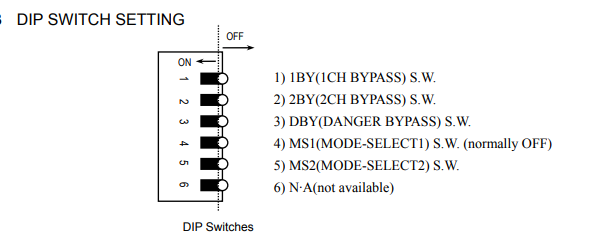
1) 1BY (CH1 BYPASS) Switch
"ON" To select CH1 BYPASS function.
"OFF" Normal monitoring
2) 2BY (CH2 BYPASS) Switch
"ON" To select CH2 BYPASS function.
"OFF" Normal monitoring
3) DBY (DANGER BYPASS) Switch
"ON" To select DANGER BYPASS function.
"OFF" Normal monitoring
4) MS1 (MODE-SELECT1) Switch (normally OFF)
• Set normally to “OFF”. Parameter setting mode is disabled.
5) MS2 (MODE-SELECT2) Switch
“ON”
For setting the alarm reset mode, alarm delay time, alarm relay mode, first-out display,
and timed OK channel defeat.
Also enables setting the address when used in combination with the VM-5H3 or 5W1
Instrument Rack and VM-5P1,2 Communication/Phase Marker Unit or VM-53 Dual
Communication Unit. To PARAMETER SETTING 1.
“OFF”
For changing the set values for DANGER alarm and ALERT alarm, and GAP ALARM,
and adjusting measured value and recorder output zero span.
To PARAMETER SETTING 2.
-
 DEIF RMF-112D Frequency relay
 -
 DEIF RMC-142D Current relay
 -
 DEIF RMC-132D Current relay
 -
 DEIF RMC-131D Current relay
 -
 DEIF RMC-122D Current relay
 -
 DEIF RMC-121D Current relay
 -
 DEIF RMC-111D Current relay
 -
 DEIF MVR-V211 Busbar Protection
 -
 DEIF MVR-T257 Transformer Differential Protection
 -
 DEIF MVR-T256 Transformer Differential Protection
 -
 DEIF MVR-T216 Transformer Differential Protection
 -
DEIF MVR-T215 Transformer Protection
-
 DEIF MVR-M257 Motor Differential Protection
 -
 DEIF MVR-M255 Motor Protection
 -
 DEIF MVR-M215 Motor Protection
 -
 DEIF MVR-M210 Motor Protection
 -
 DEIF MVR-G257 Generator Differential Protection
 -
 DEIF MVR-G215 Generator Protection
 -
 DEIF MVR-F255 Directional Feeder Protection
 -
 DEIF MVR-F215 Directional Feeder Protection
 -
DEIF MVR-F210 Feeder Protection
-
 DEIF MVR-F205 Directional Feeder Protection
 -
 DEIF MVR-F201 Basic Feeder Protection
 -
DEIF MVR-200 series Medium Voltage Relay
-
 DEIF MDR-2 Multi-differential relay
 -
 DEIF LMR-122D Loss of mains relay
 -
 DEIF LMR-111D Loss of mains relay
 -
 DEIF APU-4 Advanced G59 and G99 protection unit
 -
 DEIF iE 650 PLC - The most robust programmable automation controller available
 -
 DEIF iE 350 PLC - Programmable Automation PLC Controller
 -
 DEIF iE 250 PLC Versatile and modular intelligent energy PLC controller
 -
 DEIF PPM-3 EDG Protection and Power Management
 -
 DEIF AGC 3X 4198000234E AUTOMATIC GENSET CONTROLLER
 -
 SAUTER ASF123 Damper actuator with spring return
 -
SAUTER ASF122 Damper actuator with spring return
-
SAUTER ASF113F122 Damper actuator with spring return
-
SAUTER ASF113F120 Damper actuator with spring return
-
SAUTER ASF112F122 Damper actuator with spring return
-
SAUTER ASF112F120 Damper actuator with spring return
-
 SAUTER ASM 124/134 series - ASM134F130 Damper actuator
 -
SAUTER ASM 134 series - ASM134SF132 Damper actuator
-
SAUTER ASM 124/134 series - ASM124SF132 Damper actuator
-
SAUTER ASM 124/134 series - ASM124F122 Damper actuator
-
SAUTER ASM 124/134 series - ASM124F120 Damper actuator
-
 SAUTER Valve actuator ASM 105S/115S series ASM115SF152
 -
SAUTER Valve actuator ASM 105S/115S series ASM105SF152
-
SAUTER Valve actuator ASM 105S/115S series ASM115SF132
-
SAUTER Valve actuator ASM 105/115 series ASM105SF132
-
 SAUTER Valve actuator ASM 105/115 series ASM115F122
 -
SAUTER Valve actuator ASM 105/115 series ASM115F120
-
SAUTER Valve actuator ASM 105/115 series ASM105F122
-
SAUTER Valve actuator ASM 105/115 series ASM105F120
-
SAUTER Valve actuator ASM 105/115 series ASM105F10
-
 SAUTER AKF113S Rotating actuator AKF 112/113 series
 -
SAUTER AKF113F122 Rotating actuator AKF 112/113 series
-
SAUTER AKF113F120 Rotating actuator AKF 112/113 series
-
SAUTER AKF112F122 Rotating actuator AKF 112/113 series
-
SAUTER AKF112F120 Rotating actuator AKF 112/113 series
-
 SAUTER AKM115SAF332: Smart Actuator for ball valve, BACnet/IP
 -
 SAUTER AKM115SAF232 Rotating Actuator AKM 115SA Smart Actuator
 -
 SAUTER AKM115SF152 Rotating Actuator AKM 105S/115S Series
 -
SAUTER AKM115SF132 Rotating Actuator AKM 105S/115S Series
-
SAUTER AKM105SF132 Rotating Actuator AKM 105S/115S Series
-
 SAUTER AKM115F122 Rotating actuator AKM 105/115 series
 -
 SAUTER Rotating actuator AKM 105/115 series AKM115F120
 -
SAUTER Rotating actuator AKM 105/115 series AKM105F122
-
SAUTER Rotating actuator AKM 105/115 series AKM105F120
-
 SAUTER Continuous actuator for unit valves, with stroke AXS215S
 -
 SAUTER Linear valve actuator AXT/AXS series AXT211
 -
SAUTER Linear valve actuator AXT/AXS series AXT201
-
 SAUTER Linear valve actuator AXM/AXF series AXF217S
 -
SAUTER Linear valve actuator AXM/AXF series AXM217S
-
SAUTER AXM217SF404 is an electric actuator for unit valves.
-
SAUTER AXM217SF402 is an electric actuator for unit valves.
-
SAUTER Linear valve actuator AXM/AXF series AXM217
-
 SAUTER Linear valve actuator AVF 124/125 series AVF125S
 -
SAUTER Linear valve actuator AVF 124/125 series AVF124S
-
SAUTER Linear valve actuator AVF 124/125 series AVF124S
-
 SAUTER AVM322S-R Linear valve actuator AVM 234S series
 -
SAUTER AVM322-R Linear valve actuator AVM 234S series
-
SAUTER AVM322SF132 Linear valve actuator AVM 234S series
-
 SAUTER AVM321SF132 Linear Valve Actuator
 -
 GE Power Conversion P112-6053 Advanced Micro Controller (AMC2)
 -
GE Power Conversion P111-6053 Advanced Micro Controller (AMC2)
-
 GE Power Conversion P110-6053 Advanced Micro Controller (AMC2)
 -
 GE Power Conversion P122-6052 Advanced Micro Controller (AMC2)
 -
GE Power Conversion P121-6052 Advanced Micro Controller (AMC2)
-
 GE Power Conversion P112-6152 Advanced Micro Controller (AMC2)
 -
GE Power Conversion P110-6152 Advanced Micro Controller (AMC2)
-
GE Power Conversion P112-6052 Advanced Micro Controller (AMC2)
-
GE P106-6052 AMC2 Advanced Micro Controller Unit
-
SAUTER AVF234SF232 Linear valve actuator AVM 234S series
-
SAUTER AVF234SF132 Linear valve actuator AVM 234S series
-
 SAUTER Linear valve actuator AVM 234S series AVM234SF132-6
 -
SAUTER Linear valve actuator AVM 234S series AVM234SF132-5
-
SAUTER Linear valve actuator AVM 234S series AVM234SF132
-
SAUTER Linear valve actuator AVM215SF132-7
-
SAUTER Linear valve actuator AVM215SF132R
-
 Linear valve actuator AVM 115SA Smart Actuator AVM115SAF332
 -
Linear valve actuator AVM 115SA Smart Actuator AVM115SAF232
-
 SAUTER Linear valve actuator AVM 105S/115S series AVM115SF132
 -
SAUTER Linear valve actuator AVM 105S/115S series AVM105SF132
-
 SAUTER AVM115F901 Linear Valve Actuator
 -
SAUTER AVM115F122 Linear Valve Actuator
-
SAUTER AVM115F120 Linear Valve Actuator
-
SAUTER AVM105F122 Linear Valve Actuator
-
 SAUTER AVM105F120 Linear Valve Actuator
 -
 SAUTER AVM105F100 Linear Valve Actuator
 -
 AEROTECH SM Series High-Performance Stepper Motors
 -
 AEROTECH BLMSC Series Linear Motors
 -
 AEROTECH Custom Linear Motors
 -
 AEROTECH BMS Series Brushless, Slotless Rotary Motors
 -
 AEROTECH BM Series Brushless Rotary Motors
 -
 AEROTECH BLMX Series Linear Motors
 -
 AEROTECH BLMH Series Linear Motors
 -
 AEROTECH BLM Series Linear Motors
 -
 AEROTECH BLMC Series Linear Motors
 -
 AEROTECH BLMUC-143 Linear motor forcer with thermistor
 -
AEROTECH BLMUC-111 Linear motor forcer with thermistor
-
AEROTECH BLMUC-95 Linear motor forcer with thermistor
-
AEROTECH BLMUC-79 Linear motor forcer with thermistor
-
AEROTECH BLMUC Series Linear Motors
-
 AEROTECH Automation1 FLEX Distributed Amplifier Multi-Axis Servo Control System
 -
 AEROTECH Automation1 HXA4 6-Axis Hexapod Servo Drive
 -
 AEROTECH Automation1 iHXA4 6-Axis Hexapod Servo Drive with Motion Controller
 -
 AEROTECH Modular System Control Console
 -
 AEROTECH TV Series Transformers
 -
 AEROTECH TM Series Transformers