FOXBORO Fieldbus Communications Module, FCM10Ef
I/ASeries® Hardware
Fieldbus Communications Module, FCM10Ef
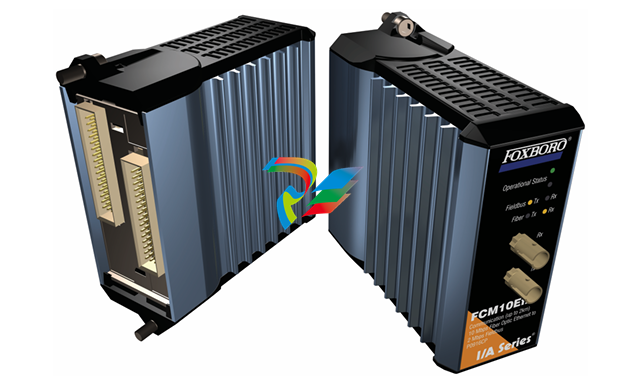
The FCM10Ef Fieldbus Communications Module is a
fiber optic communications interface which allows the
DIN rail mounted Fieldbus Modules (FBMs) to
communicate with the I/A Series control station over
extended distances using fiber optic cabling. The
FCM10Ef modules provide expanded networking,
easy customization, and greater overall cabling
distances in a fiber optic network (see Figure1). This
configuration is ideally suited for sites in which groups
of FBMs are to be spread apart over greater
distances.
FCM10Ef modules are used with multiport fiber optic
converters (hubs), which connect to the I/ASeries
control station via the high-speed, optionally
redundant 10 Mbps Ethernet trunk Fieldbus.
Up to six groupings of baseplate-mounted FCM10Ef
modules and FBMs can be linked to each optionally
redundant multiport fiber optic converter (hub), for a
maximum of 120 FBMs per I/A Series control station
(depending on selected scan periods). To support
redundancy, a pair of FCM10Ef modules must be
used for each FBM grouping. In non-redundant
configurations, only a single FCM10Ef is required for
each grouping.
Signal transmission distances up to 2 km (1.24 mi)
are possible between the FCM10Ef modules and the
multi-port fiber optic converters (hubs), providing for
wide distribution of the FBM equipment groupings.
Extended transmission distances, using fiber optic
cabling, are also possible within the groupings, and
between the multiport fiber optic converter (hub) and
the I/A Series control station. (Refer to
PSS21H-2W1B3. for details.)
FIBER OPTIC CABLING
Unaffected by electrical noise (EMI, RFI, and
lightning), fiber optic cabling provides a versatile,
highly reliable means of extending signal
communications. It can be used in areas containing
rotating machinery, arc welders, and so forth, and can
be installed in cable trays containing high voltage
power lines, or in outdoor areas exposed to lightning
hazards. Its electrical isolation characteristics provide
protection from voltage differentials and ground loops.
Fiber optic cabling used in this configuration is
purchased by the customer. The recommended fiber
optic cable is a multimode, graded-index glass fiber
with a 62.5 micron core and 125 micron cladding with
0.275 NA (numerical aperture).
Maximum allowable signal loss is 1 dB per km at a
wavelength of 1300 nm, and 3.6 dB per km at a
wavelength of 850 nm. Cables with different
characteristics may not be used. Four fiber optic
cables are required for redundancy, two for transmit
and two for receive connections. For this reason, it is
recommended that the customer purchase duplex
cabling, which consists of two fibers intertwined in a
single cable. The cables must be terminated with
ST-type connectors and cable length may not exceed
that specified for the module.
Other cable requirements (such as flexibility, or
durability) depend on the particular application. Check
with your cable vendor/installer for a listing of
application-specific cable characteristics.
FCM10Ef MODULE DESIGN
FCM10Ef modules convert 2 Mbps signals used by
the FBMs, to 10 Mbps fiber optic Ethernet signals
used with fiber optic cabling, and vice versa.
FCM10Ef modules have a compact design, with a
rugged extruded aluminum exterior for physical
protection of the circuits. Enclosures specially
designed for mounting of the FBMs and FCMs
provide various levels of environmental protection for
the FCM10Ef modules, up to harsh environments per
ISA Standard S71.04.
The FCM10Ef can be removed/replaced from the
baseplate without removing power.
Six light-emitting diodes (LEDs) incorporated into the
front of the FCM10Ef indicate the status of network
activity to/from the associated FBMs, and the
FCM10Ef module’s operational status.
FUNCTIONAL SPECIFICATIONS
Regulatory Compliance (Cont.)
INPUT VOLTAGE RANGE (REDUNDANT)
24 V dc +5%, -10%
CONSUMPTION
7 W (maximum) at 24 V dc
HEAT DISSIPATION
7 W (maximum) at 24 V dc
Vibration
0.75 g (5 to 200 Hz)
Calibration Requirements
Calibration of the module is not required.
Regulatory Compliance
ELECTROMAGNETIC COMPATIBILITY (EMC)
European EMC Directive 89/336/EEC
EN 50081-2 Emission standard
EN 50082-2 Immunity standard
IEC 61000-4-2 ESD Immunity
Contact 4 kV, air 8 kV
IEC 61000-4-3 Radiated Field Immunity
10 V/m at 80 to 1000 MHz
IEC 61000-4-4 Electrical Fast Transient/Burst
Immunity
2 kV
IEC 61000-4-5 Surge Immunity
2kV on ac and dc power lines; 1kV on I/O and
communications lines
IEC 61000-4-6 Immunity to Conducted
Disturbances
10 V
IEC 61000-4-8 Power Frequency Magnetic Field
Immunity
30 A/m
IEC 61000-4-11 Voltage Dips, Short Interruptions
and Voltage Variations Immunity
PRODUCT SAFETY
European Low Voltage Directive 73/23/EEC
PRODUCT CERTIFICATION
Underwriters Laboratories (UL)
UL/UL-C listed as suitable for use in UL/UL-C
listed Class I, Groups A-D; Division 2;
temperature code T4 enclosure based systems.
The modules are also UL and UL-C listed as
associated apparatus for supplying non
incendive communication circuits for Class I,
Groups A-D hazardous locations when
connected to specified I/A Series processor
modules as described in the I/A Series DIN Rail
Mounted FBM Subsystem User’s Guide
(B0400FA). Communications circuits also meet
-
 CTI 2559-TC 8-Channel Thermocouple Input Module
 -
 CTI 2556-A 16-Channel Isolated Thermocouple Input Module
 -
 CTI 2556 16-Channel Isolated Thermocouple Input Module
 -
 CTI 2551-A 8-Channel Isolated Thermocouple Input Module
 -
 CTI 2559-RTD 8-Channel RTD Input Module
 -
 CTI 2557-A 16-Channel RTD Input Module
 -
 CTI 2557 16-Channel RTD Input Module
 -
 CTI 2552-A 8-Channel Isolated RTD Input Module
 -
 CTI 2534 8-Point Form-C Relay Output Module
 -
 CTI 2532 16-Point Form-A Relay Output Module
 -
 CTI 2531 32-Point Form-A Relay Output Module
 -
 CTI 2530 8-Point Form-C Relay Output Module
 -
 CTI 2562 8-Channel Analog Output Module
 -
 CTI 2560-A 8-Channel Isolated Analog Output Module
 -
 CTI 2501 8in/4out Analog Module
 -
 CTI 2558 8-Channel Analog Input Module
 -
 CTI 2555-A 16-Channel Analog Input Module
 -
 CTI 2550-A 8-Channel Isolated Analog Input Module
 -
 CTI 2599 8/16/32-Point AC Output Module
 -
 CTI 2598-8 8-Point AC Output Module
 -
 CTI 2598 8/16-Point AC Output Module
 -
 CTI 2597 8/16/32-Point DC Output Module
 -
 CTI 2596-8 8-Point DC Output Module
 -
 CTI 2596 8/16-Point DC Output Module
 -
 CTI 2595 16-Point TTL/Word Output Module
 -
 CTI 2591-EF 16-Point Isolated 11-146 VDC Output with Front Panel Accessible Fuses
 -
 CTI 2591-A 16-Point Isolated 11-146 VDC Output Module
 -
 CTI 2590-EF 16-Point Isolated 20-132 VAC Output with Front Panel Accessible Fuses
 -
 CTI 2590-A 16-Point Isolated Discrete 20-132 VAC Output Module
 -
 CTI 2589-B 8/16/32-Point Universal Discrete Input Module
 -
 CTI 2589-A 8/16/32-Point Universal Discrete Input Module
 -
 CTI 2588-8 8-Point Universal Discrete Input Module
 -
 CTI 2585 16-Point TTL/Word Input Module
 -
 CTI 2582 16-Point Isolated 125 VDC Input Module
 -
 CTI 2581 16-Point Isolated 12-56 VDC Input Module
 -
 CTI 2580 16-Point Isolated 95-132 VAC Input Module
 -
 CTI 2500-TAP RS485 Network Tap
 -
 CTI 2500-RIO-B RS485 Remote Base Controller
 -
 CTI 2500-RIO-A RS485 Remote Base Controller
 -
 CTI 2500-RBC Profibus Remote Base Controller
 -
 CTI 2515-A 100-Watt AC/DC Power Supply with Redundancy Support
 -
 CTI 2515 100-Watt AC Power Supply (MATURE - replaced by 2515-A)
 -
 CTI 2513-A 75-Watt DC Power Supply with Redundancy Support
 -
 CTI 2513 75-Watt 24VDC Power Supply
 -
 CTI 2512-A 75-Watt AC/DC Power Supply with Redundancy Support
 -
 CTI 2512 75-Watt AC/DC Power Supply
 -
 CTI 2510 125 VDC Power Supply
 -
 CTI 2500-SSB Single Slot Blank Front Panel
 -
 CTI 2500-R11-A Eleven-Slot Redundant Base
 -
 CTI 2500P-R16 Sixteen-Slot Base with High-Speed Channel
 -
 CTI 2500P-R8 Eight-Slot Base with High-Speed Channel
 -
 CTI 2500P-R4 Four-Slot Base with High-Speed Channel
 -
 CTI 2541 Redundant Processor Manager Module
 -
 CTI 2577 Profibus DP Slave Adapter
 -
 CTI 2573-MOD Serial Interface Adapter with MODBUS
 -
 CTI 2572-AF Fast Ethernet TCP/IP Adapter with Optical Fiber Connection
 -
 CTI 2572-A Fast Ethernet TCP/IP Adapter
 -
 CTI 2572 Ethernet TCP/IP Adapter
 -
 CTI 2572-B Fast Ethernet TCP/IP Adapter
 -
 CTI 2576 DeviceNet™ Scanner Module (MATURE)
 -
 CTI 2500P-ECC1 Ethernet Communications Coprocessor
 -
 CTI 2500P-JACP Janus Application Coprocessor
 -
 CTI 2500P-ACP1 Application Coprocessor (MATURE - replaced by 2500P-JACP)
 -
 CTI 2500P-J450 Janus PAC with 2MB Project Memory
 -
 CTI 2500-C400 CPU with 3072K User Memory
 -
 CTI 2500-C300 CPU with 512K User Memory
 -
 CTI 2500-C200 CPU with 256K User Memory
 -
 CTI 2500-C100 CPU with 128K User Memory
 -
 CTI 2500P-J750 Janus PAC with 3MB Project Memory
 -
 Shinkawa WHF3006M Displacement Converter
 -
Shinkawa JBP-220 (P-24-94A / P-24-94B) Circuit Board Module
-
 SHINKAWA WKN-142K5 2-WIRE VIBRATION TRANSDUCER
 -
Shinkawa FRP-321 (P-26-54A / P-26-54B) Circuit Board Module
-
 Shinkawa IOP-160 (P-25-72A / P-25-72B) Circuit Board Module
 -
 Shinkawa PK-147B-1 / PK-147A-1 Circuit Board Module
 -
 Shinkawa CPP-91A Circuit Board Module
 -
 Shinkawa FRP-177 PCB Module
 -
 Shinkawa CPP-127 (P-26-74A / P-26-74B) Circuit Board Module
 -
Shinkawa FRP-227 (P-24-86A / P-24-86B) Circuit Board Module
-
 Shinkawa MDP-104 (P-25-83A / P-25-83B) Circuit Board Controller
 -
 Shinkawa VK-143P2 High-precision eddy current sensor driver/signal conditioner
 -
 Shinkawa FRP-226 (P-24-86A / P-24-86B) Circuit Board Module
 -
Shinkawa CPP-107A P-22-99A P-22-99B Circuit Board Module
-
 SHINKAWA VW-202AL-8 Axial Displacement Sensor
 -
Shinkawa VL-202A08L-1A42 Vibration Sensor Transducer Probe
-
Shinkawa VL-202A08L-1A42 Vibration Sensor Transducer Probe
-
 Shinkawa FRP-209A & FRP-206 Wire Bonder Circuit Board Module
 -
 Shinkawa MGP-72 MGP72 P-26-50A P-26-50B Circuit Board Module
 -
 Shinkawa FRP-249 P-25-1A P-25-1B Circuit Board Module
 -
Shinkawa FRP-320 P-26-54A P-26-54B Circuit Board Module
-
Shinkawa FRP-282 P-24-35A P-24-35B Circuit Board Module
-
 Shinkawa FRP-338 P-26-54A P-26-54B Circuit Board Module
 -
 GE IS200AEPBH1B IS200AEPBH1B‑REV‑AA Pitch-Charger Control PCB Board
 -
 GE IS200EDEXG1ADA EX2100 SCR Trigger Control Board
 -
 GE 151X1207CK01SA01 IS200EDEXG1A EX2100 SCR
 -
 GE 151X1233DD02SA02 IS200AEPBH1B - Variant for pitch control charger assembly
 -
 GE 151X1233DB01SA01 IS200AEPBH1B - 10kW Wind Power Converter
 -
 GE 151X1233DB01SA01R | IS200AEPBH1B 10KW Converter
 -
GE 151X1233DD01SA02 Pitch Battery Charger (109W6931P001)
-
GE 151X1233DD01SA02 Pitch Battery Charger Assy IS200AEPBH1B
-
 GE 151X1233DB02SA02 Rev A IS200AEPBH1B Wind Turbine Converter
 -
 GE 151X1207CK02SA02 SCR 4400 V 1850 A IS200EDEXG1ADA General Electric EX2100
 -
 Triconex 3723X 32-Channel TMR Analog Input Module with HART
 -
 SHINKAWA VM-21G SIGNAL CONDITIONER SOCKET
 -
SHINKAWA VM-21R REVOLUTION SIGNAL CONDITIONER
-
SHINKAWA VM-21T DISPLACEMENT INPUT THRUST SIGNAL CONDITIONER
-
SHINKAWA VM-21D 6-WIRE LVDT SIGNAL CONDITIONER
-
 SHINKAWA VM-21P 3-WIRE LVDT SIGNAL CONDITIONER
 -
SHINKAWA VM-21A VIBRATION SIGNAL CONDITIONER
-
SHINKAWA VM-21K DISPLACEMENT INPUT VIBRATION SIGNAL CONDITIONER
-
 SHINKAWA VM-25S01 CONDITION MONITORING SYSTEM
 -
SHINKAWA VM-25 CONDITION MONITORING SYSTEM
-
SHINKAWA VM-772B DEVICE CONFIG
-
SHINKAWA VM-771B MCL VIEW
-
 SHINKAWA VM-76B INSTRUMENT RACK
 -
SHINKAWA VM-75B POWER SUPPLY MODULE
-
 SHINKAWA VM-742B NETWORK COMMUNICATION MODULE
 -
 SHINKAWA VM-741B LOCAL COMMUNICATION & PHASE MARKER MODULE
 -
SHINKAWA VM-722B 9-CHANNEL RELAY MODULE
-
SHINKAWA VM-707B AERODERIVATIVE GAS TURBINE MONITOR MODULE
-
 SHINKAWA VM-706B ROD DROP MONITOR MODULE
 -
 SHINKAWA VM-705B 18-CHANNEL TEMPERATURE MONITOR MODULE
 -
SHINKAWA VM-704B TEMPERATURE MONITOR MODULE
-
 SHINKAWA VM-702B ABSOLUTE VIBRATION MONITOR MODULE
 -
SHINKAWA VM-701B VIBRATION / DISPLACEMENT MONITOR MODULE
-
 SHINKAWA MODEL VM-5X INTERFACE UNIT
 -
 SHINKAWA MODEL VM-5W2 DUAL POWER SUPPLY INSTRUMENT RACK
 -
 SHINKAWA MODEL VM-5H4 INSTRUMENT RACK (for VM-5Z5.6.7)