ABB AC160Industrial Networks Connecting Controllers via OPC
Abstract
In order to modernize their infrastructure and keep up with the state
of the art, ABB Power Systems decided to replace the older controller
AC450 with a new generation of controllers called AC800M. Just like i
ts predecessor, its main task is to work as a sequencer in an otherwis
e mostly unchanging topology. Although the new controller AC800M
provides modern communication features and a sophisticated applica
ion development system, it lacks of a communication interface compa
tible with the residing controllers AC160. A hardware approach addres
sing this problem is in development, but not available at this point of t
ime. Thus the decision was made to realize the connection using OPC,
a widely spread and open software communication interface standard
with a high potential of reusability. In addition, it was aimed at gainin
g additional knowledge about the OPC interface, which is commonly u
sed in industry. In this thesis, we evaluate adequate hardware and sof
tware to realize this connection and we have programmed the controll
ers with applications to evaluate its performance and integrity. In add
ition, we are making considerations about redundancy that is vital in
automation business in order to increase reliability and availability. W
e have shown that it is possible to interconnect controllers using OPC
with satisfactory average performance results. Due to high maximum
round trip times and high complexity when realizing redundancy, it is
recommended to use such a system for testing purposes or non-critica
l operational applications, but not for critical systems. In this thesis we
also identify and judge several alternative ways of connection.
Acknowledgements
First of all, I would like to thank Prof. Dr. Bernhard Plattner of the Computer
Engineering and Networks Laboratory TIK at the Swiss Federal Institute of Technology ETH Zurich for supporting and supervising this Master’s Thesis. Special
thanks go to my advisors Rainer Baumann and Bernhard Tellenbach of TIK for
their straightforward and helpful support during my work.
Secondly I would like to thank Dr. Esther Gelle and Pascal Aebli of ABB for
enabling this Master’s Thesis in the first place as well as providing aid throughout
this thesis. Special thanks also to Stephan Egli for supporting me with the first
steps, Swen Woldau for numerous hints concerning AC160 and AF100 as well as
Juerg Beck for AC800M tips and tricks. Finally I would like to thank everyone else
at PSPD for the provided aid and making my work so convenient not only in a
technical but also in a human manner.
Baden, June 2007
Martin Pfister
Introduction
This chapter will provide a rough overview of the problem treated by this Master’s
Thesis. All technical devices and expressions will be explained more precisely in
the next chapter. Please note that since this is a public thesis, it does not contain
sensitive company-internal data.
ABB Power Systems
ABB Power Systems is one of the world’s leading providers of infrastructure for
controlling combined cycle power stations and waste-to-energy plants. Such a
plant control infrastructure includes several hardware parts consisting of controllers,
input/output-boards and communication devices as well as many software components to engineer, run, observe and analyze the power plant. A power plant control
system has to satisfy a broad variety of different needs, from the efficient and reliable control of the turbines and associated supporting functions (such as lube oil)
to easy configuration and operation as well as to sophisticated analysis functions
addressing technical and economical aspects.
Problem Statement
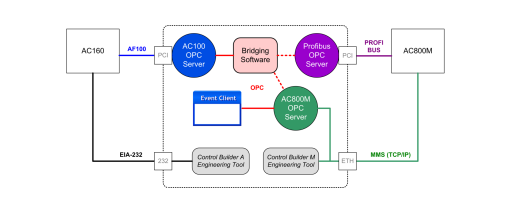
Due to high investment costs, the technical management of power plants is a slowgoing business with long life-cycles. Thus, a considerable amount of hardware devices currently in use are tens of years old. For future applications within ABB Power Systems it will be necessary to connect a controller of the newest series used within ABB, Control IT AC800M, with an older controller of the type Advant Controller 160 (AC160). The problem is that these two controllers do not share a fast communication interface of similar type and therefore cannot communicate directly. The standard communication intended for AC160 is Advant Fieldbus 100 (AF100). However, AC800M can support a whole range of buses except for AF100. As a consequence, the communication must be implemented using some relaying technique.

1.2.1 The Use of OPC
It was decided in advance to realize the relaying connection using OPC. This solution was chosen because OPC is an open standard and very common in process and automation industry. Furthermore, this solution offers a high potential to be used for similar problems, since a lot of devices support this specification. However, OPC is normally not used for fast controller-to-controller communication but for slower visualization and logging purposes and there is no performance data available for this kind of connection. The use of OPC is therefore both challenging as well as interesting to gain more insights and know-how. It is also to mention that a hardware solution addressing our problem is not available yet. It is therefore necessary to have an alternative way using already available parts, also for testing purposes.
1.3 Goals
The goals of this Master’s Thesis are stated as follows:
• Setup and evaluation of a test environment
• Setup of test systems
• Theoretical and practical evaluation of the test systems concerning performance, availability and reliability.
• Identification of improvements and different approaches
• Comparison with alternatives As a starting point for the performance requirements, the current implementation was taken. The corresponding quantity and type of variables are displayed in Table 1.1 with 32-bit floating point values (floats) as analog in- and outputs and 1-bit boolean values as so-called status and command bits. In the current configuration with AC450 and AC160, all variables are written to the AF100 fieldbus with a cycle time of 256 milliseconds. Therefore we determined the minimum requirement for round-trip times from one controller to the other to exactly this time. In agreement with the advisors, instead of elaborating the optional extension stated in the task description (Appendix C), we spent more time on trying out a
1.4 Structure
For the reader’s convenience this Master’s Thesis is structured thematically starting with an overview of components and terms
(2) in the next chapter. The following chapters inform about the test system setup
(3), the evaluations that were made
(4) and finally the results
(5). In a subsequent chapter the subject redundancy is treated
(6) before the thesis comes to an end with the conclusion and outlook
(7). Additional information as well as a CD-ROM containing more detailed data is
located in the appendix of this thesis.
Chapter 2
Components and Terms
In this chapter, hardware and software parts as well as terms used for our test
system and evaluations will be described. Some additional devices and programs
concerning redundancy are introduced not until the chapter according. Information
on the version numbers can be found in Appendix B.
2.1 Basic Terms
• Performance, in this thesis, refers to the capability of a communication component in means of speed and throughput.
• Availability is the term for the probability that a system will perform its specified functions when used under stated conditions. A common mathematical definition of operational availability is Ao = MT BF/(MT BF + MDT), whereas MTBF is the “mean time between failure” and MDT the “mean down time” [2]. However, in this thesis, availability is used in a more general manner, since the basis for mathematical operations is not available
• Reliability means the probability of a device remaining failure free during a specified time interval, e.g. the maintenance interval: R = e λt
• Redundancy is the implementation of extra components in addition to the ones needed for normal operation. Thus, redundancy normally increases reliability and availability
2.2 OPC
OPC, originally short for “OLE for Process Control”, is an open, standardized
software communication interface specification launched in 1996 by a task force of
different automation companies, later forming the OPC Foundation. As the former
name indicates, OPC is an adaption of Microsoft’s Object Linking and Embedding
OLE1
to the process control business, which used to be highly proprietary at that
point of time. Thus it was almost impossible to efficiently combine products of
different vendors. By providing so-called OPC servers with their devices, buses and
software, vendors open their products to any OPC compliant client able to connect
to the server for data exchange. Usually, an OPC server can handle several clients
at once, while these clients—e.g. visualization or calculation applications—can connect to different servers in order to obtain their needed information.
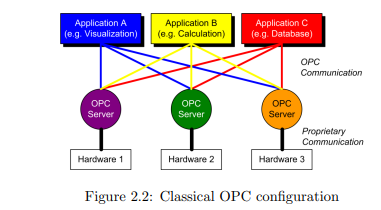
Over the years, the OPC Foundation has been adding eight additional specifications to the original one, therefore the name OPC was freed from its original meaning and is now used as an umbrella term [3]. Some important specifications are quickly explained in the following:
•DA (Data Access) is the original and most widely used standard of OPC. Its purpose is the cyclic polling of real time data, for example for visualization purposes.
• HDA (Historical Data Access), in contrary, specifies the access to already stored data.
• AE (Alarms and Events) describes the non-cyclic, event-based exchange of alarms and events.
• Data eXchange is a specification from 2002 which regulates the direct communication between two OPC servers
For this Master’s Thesis it was made use both of the DA specification for the main purpose of communication as well as the AE specification in order to display and log round-trip times. Unfortunately, the promising Data eXchange specification is almost inexistent in practice and could therefore not be used in our thesis. The underlying technique to exchange data is the component object model COM of Microsoft Windows, therefore OPC can only run on Windows operating systems
[4]. A new generation of OPC specifications recently published is called OPC Unified Architecture (OPC UA) and is independent of COM, thus being able to run on more operating systems as well as embedded devices [5].
2.2.1 OPC Data Acces
OPC DA is organized in the hierarchical structure server, group and item. Items
correspond to variables and can be read and written. Furthermore, a quality and
time stamp is provided with each of them. When reading items, the value usually
comes from the OPC server’s cache, which is updated periodically with the values
of the device (or bus, component). However, it is usually possible to force a read
directly from the device. Clients organize their items in groups, which for example
share the same access method and update rate. Each OPC server has an unique
name, some vendors even offer the operation of multiple servers for the same device.
OPC DA provides different methods to access items, first of all synchronous and
asynchronous read and write operations. More important to us, there is also a
subscription mechanism, which is commonly used by modern clients in order to
reduce communication. That is, the client group subscribes to the server which
then “pushes” values towards the client only if they changed respectively exceed a
pre-defined dead-band. The client can force an update of all these values by issuing
a refresh call, which corresponds to an asynchronous read for all items of a group
[6].
2.3 Programmable Logic Controllers
This section informs about the two controllers involved and about the controller
that has to be replaced. Please notice that we use the term controller equivalent
to programmable logic controller (PLC) throughout our Master’s Thesis.
2.3.1 Advant Controller 160 (AC160)
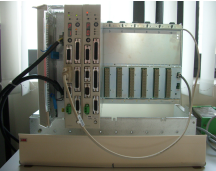
The AC160 series was launched in 1997 to meet high speed requirements in turbine control. To this day its outstanding performance is needed for fast closed loop control (CLC). For our work, we were provided with a rack RF616 for the physical mounting of the controller parts. The rack also delivers power to each device and includes the BIOB Backplane Input/Output Bus which, among other tasks, processes the communication between the processor module and the communication interface. The tests in this Master’s Thesis were done with processor modules of the type PM665 (containing a Motorola MPC8240 processor) and the AF100 communication interface CI631, both supporting redundancy [7]. To program the processor module, its built-in EIA-232 interface was connected to the engineering PC.
2.3.2 Advant Controller 450 (AC450)
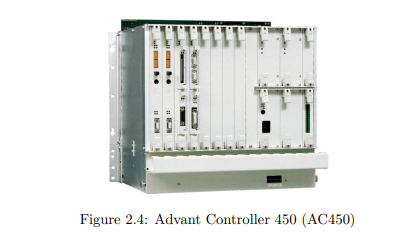
AC450 is the controller to be replaced by the new generation. Its processor module
is built up around a Motorola 68040 microprocessor running at 25 MHz [8]. While its
performance is quite limited, AC450 also lacks of modern communication interfaces
and standards like Ethernet, which become more and more important.
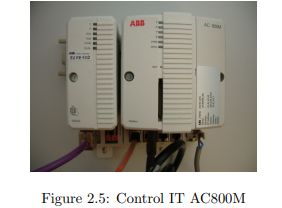
2.3.3 Control IT AC800M
Control IT AC800M is the most current controller series used within all of ABB,
introduced in 2001 [9]. It strikes with its small outline and offers modern communication interfaces. For our tests we were provided with a processor module
PM864A which contains a Motorola MPC862 microprocessor running at 96 MHz
[10]. In addition to two EIA-232 interfaces, the processor module of AC800M offers
two built-in 10 Mbit/s standard Ethernet ports, used for instance to connect to the
engineering computer.
The communication interface CI854A is a sophisticated device to establish
PROFIBUS communication. The device even offers an own web interface which
allows e.g. the surveillance of the cycle time. The device is directly coupled to the processor module via the Communication Extension Bus (CEX) [11]. At this point of time, CI854A can only act as a PROFIBUS master, but not as slave. As a consequence, communication partners must be slaves.
2.4 Bus and Network Communication
This section describes the different communication approaches used in our system
2.4.1 Advant Fieldbus 100 (AF100)
AF100 is a high performance fieldbus system with time synchronization and the most popular fieldbus used within ABB,
common to almost all platforms. Although the name Advant Fieldbus 100 is ABB proprietary, it complies to IEC standard
61375-3 as well as US-standard IEEE 1473 and is widely used in railways under the name of MVB. AF100 works over tw
isted pair, coaxial and optical media at a rate of 1.5 Mbit/s. For our system we made use of the first method only. Bus ma
ster responsibility is shared by all communication interfaces with administrator
Diplomarbeit ABB Schweiz AG
Power Systems / Power Generation
Industrielle Netzwerke Leistung – Verfügbarkeit – Zuverlässigkeit
Es sollen die bestehenden Strukturen von industriellen Netzwerken und Bussystemen für die Kraftwerksautomation basierend auf dem ABB Leitsystem 800xA analysiert werden. Dabei sollen verschiedene Fragestellungen in den Bereichen Verfügbarkeit, Leistung und Sicherheit bearbeitet werden.
Das ABB Control-System welches zur Steuerung von Hochleistungs-Gasturbinen eingesetzt wird, soll mit den neuesten Technologien punkto offener Schnittstellen, Anbindung an TCP/IP Netzwerke und Unterstützung von Device Management Tools etc. ausgerüstet werden. Hierzu soll der bestehende „Kopf-Rechner“ Advant Controller 450 durch einen Controller der neuesten Generation, einen AC800 M Controller ersetzt werden.
Die Aufgabe besteht darin, den AC800 M Controller an einen Advant Controller 160 über das bestehende Interface AF100 OPC Server anzukoppeln. Es ist eine Lösung zu erarbeiten, welche zyklischen Datenaustausch des AC800 M Controllers mit dem AC160 Controller unter Einhaltung des geforderten Datendurchsatzes, der Verfügbarkeit und der Zuverlässigkeit ermöglicht. Dabei sind die zurzeit verfügbaren Produkte und Technologien der Plattform zu nutzen.
Die Bearbeitung der oben aufgeführten Fragestellungen beinhaltet sowohl einen theoretischen als auch einen praktischen Teil. Dabei sollen Daten für die Leistung, Verfügbarkeit und Zuverlässigkeit der erarbeiteten Lösung theoretisch hergeleitet, sowie ein System aufgebaut werden. Am aufgebauten System soll anhand von durchgeführten Tests Verbesserungsvorschläge resp. Änderungen an der System-Architektur evaluiert werden können.
Die technischen Spezifikationen des Control-Systems sind soweit möglich einzuhalten resp. Abweichungen entsprechend zu dokumentieren.
Eine optionale Ausweitung der Aufgabenstellung besteht in folgender Leistung. Das System 800xA basiert seit der Einführung vor mehreren Jahren auf OPC. In der Vergangenheit wurden solche Systeme immer in einem eigenen Netzwerk und eigener Windows Domäne realisiert. Heutige Kundenanforderungen zielen immer häufiger darauf ab, dass sich OPC Server und OPC Client in unterschiedlichen Netzwerken resp. Domänen befinden. Im Rahmen der Diplomarbeit soll geklärt werden, welche Einbussen in der Übermittlungsleistung in Kauf genommen werden müssen, wenn Server und Client in unterschiedlichen Domänen liegen resp. welche Massnahmen ergriffen werden können, damit die Leistungseinbussen möglichst gering bleiben.
-
 AEROTECH SM Series High-Performance Stepper Motors
 -
 AEROTECH BLMSC Series Linear Motors
 -
 AEROTECH Custom Linear Motors
 -
 AEROTECH BMS Series Brushless, Slotless Rotary Motors
 -
 AEROTECH BM Series Brushless Rotary Motors
 -
 AEROTECH BLMX Series Linear Motors
 -
 AEROTECH BLMH Series Linear Motors
 -
 AEROTECH BLM Series Linear Motors
 -
 AEROTECH BLMC Series Linear Motors
 -
 AEROTECH BLMUC-143 Linear motor forcer with thermistor
 -
AEROTECH BLMUC-111 Linear motor forcer with thermistor
-
AEROTECH BLMUC-95 Linear motor forcer with thermistor
-
AEROTECH BLMUC-79 Linear motor forcer with thermistor
-
AEROTECH BLMUC Series Linear Motors
-
 AEROTECH Automation1 FLEX Distributed Amplifier Multi-Axis Servo Control System
 -
 AEROTECH Automation1 HXA4 6-Axis Hexapod Servo Drive
 -
 AEROTECH Automation1 iHXA4 6-Axis Hexapod Servo Drive with Motion Controller
 -
 AEROTECH Modular System Control Console
 -
 AEROTECH TV Series Transformers
 -
 AEROTECH TM Series Transformers
 -
 AEROTECH UFM Noise Filter Module
 -
 AEROTECH MFM Motor Filter Module
 -
 AEROTECH MPG Handwheel Pendant
 -
 AEROTECH Automation1 Multi-Axis Joystick
 -
 AEROTECH ETM Enhanced Throughput Module
 -
 AEROTECH Automation1 XL4s High-Speed, Single-Phase Linear Servo Drive
 -
 AEROTECH Automation1 XL2e Enhanced, Compact Linear Servo Drive
 -
 Automation1 iXL2e Enhanced, Compact Linear Servo Drive with Motion Controller
 -
 AEROTECH Automation1 XL5e Enhanced, Linear Servo Drive
 -
 AEROTECH Automation1 iXL5e Enhanced Linear Servo Drive with Motion Controller
 -
 AEROTECH Automation1 GI4 Laser Scan Head Controller
 -
 AEROTECH Automation1 SI4 Stepper Interface
 -
AEROTECH Automation1 XI4 Servo Interface
-
 AEROTECH AEROTECH Automation1 iXI4 Servo Interface with Motion Controller
 -
 AEROTECH Automation1 XC6e Enhanced, High-Power PWM Servo Drive
 -
 AEROTECH Automation1 iXC6e Enhanced, High-Power PWM Servo Drive with Motion Controller
 -
 AEROTECH Automation1 XC2 Compact PWM Servo Drive
 -
 AEROTECH Automation1 XC4 PWM Servo Drive
 -
 AEROTECH Automation1 GL4 Galvo Laser Scan Head Linear Drive
 -
 AEROTECH Automation1 XC2e Enhanced, Compact Servo Drive with PWM+
 -
 AEROTECH Automation1 XC4e Enhanced, PWM Servo Drive
 -
 AEROTECH Automation1 XR3 Multi-Axis Servo Drive Rack
 -
 AEROTECH Automation1 iXR3 Multi-Axis Servo Drive Rack with Motion Controller
 -
 AEROTECH Automation1 iXC2 Compact PWM Servo Drive with Motion Controller
 -
 AEROTECH Automation1 iXC2e Enhanced, Compact PWM+ Servo Drive with Motion Controller
 -
 AEROTECH Automation1 iXC4 PWM Servo Drive with Motion Controller
 -
 AEROTECH Automation1 iXC4e Enhanced, PWM Servo Drive with Motion Controller
 -
 AEROTECH Automation1 iPC Industrial PC with Motion Controller
 -
 AEROTECH EPICS & TANGO Drivers for Distributed Control Systems
 -
 AEROTECH .NET, C, Python & LabVIEW APIs Custom Application Develotpmen
 -
 AEROTECH Automation1 Industrial Ethernet Support
 -
 AEROTECH Automation1 iSMC Intelligent, Software-Based Motion Controller
 -
 AEROTECH Automation1 iXA4 1- 2- or 4-Axis PWM Servo Drive with Motion Controller
 -
 AEROTECH Automation1 XA4 1- 2- or 4-Axis PWM Servo Drive
 -
 CTI 2500-ADP2-DISC Discrete Wiring Adapter for Series 500
 -
 CTI 2500-ADP1 Analog Wiring Adapter for Series 500
 -
 CTI 2500C-RADP-RS485 Remote Base Controller Adapter for Series 500
 -
 CTI 2500C-RADP-RBC Profibus RBC Adapter for Series 500
 -
 CTI 2500C-PADP-120V 120VAC 50W Power Supply for Series 500
 -
 CTI 2500-RADP RBC Adapter for Series 500
 -
 CTI 2500-R4500 520/530/DBC Adapter for Series 500 - MATURE
 -
 CTI 2500-PADP Power Supply Adapter for Series 500
 -
 CTI 2500-IADP I/O Adapter for Series 500
 -
 CTI 2500-VP15A-N4-W7 15" Flat-Panel PC with Windows® 7 Embedded
 -
 CTI 2500S-27-1750 Slice I/O, Ethernet, RS232/485. 900MHz, 2DIO / 4UAI / 2AI
 -
 CTI 2500S-26-1750 Slice I/O, Ethernet, RS232/485. 900MHz, 8DIO / 2UAI
 -
 CTI 2500S-23-1750 Slice I/O, Ethernet, RS232/485. 900MHz, 4DI / 4DO / 2UAI / 2AO
 -
 CTI 2500S-27-1550 Slice I/O, RS232/485. 2DIO / 4UAI / 2AI
 -
 CTI 2500S-26-1550 Slice I/O, RS232/485. 8DIO / 2UAI
 -
 CTI 2500S-23-1550 Slice I/O, RS232/485. 4DI / 4DO / 2UAI / 2AO
 -
 CTI 2500S-27-1050 Slice I/O, Ethernet, 2DIO / 4UAI / 2AI
 -
 CTI 2500S-26-1050 Slice I/O, Ethernet, 8DIO / 2UAI
 -
 CTI 2500S-23-1050 Slice I/O, Ethernet, 4DI / 4DO / 2UAI / 2AO
 -
 CTI 2500C-32F-CJC 32-Pin Field Wiring Connector with Cold Junction Compensation
 -
 CTI 2500C-32F 32-Pin Field Wiring Connector
 -
 CTI 2500C-8-TC Eight Thermocouple Inputs
 -
 CTI 2500C-8-RTD Eight RTD Inputs
 -
 CTI 2500C-8-RL-FC 8 Form-C Relay Outputs
 -
 CTI 2500C-8-IDO-24V 8 Isolated 24VDC Outputs
 -
 CTI 2500C-8-IDO-120V 8 Isolated 120VAC Outputs
 -
 CTI 2500C-16-DO-24V Sixteen 24VDC Digital Outputs
 -
 CTI 2500C-16-DO-120V Sixteen 120VAC Digital Outputs
 -
.png) CTI 500C-16-IDI-24V Sixteen Isolated 24V AC/DC Digital Inputs
CTI 500C-16-IDI-24V Sixteen Isolated 24V AC/DC Digital Inputs -
 CTI 2500C-16-IDI-120V Sixteen Isolated 120V AC/DC Digital Inputs
 -
 CTI 2500C-16-DIDO-SIM Sixteen Digital Input and Output SImulator
 -
 CTI 2500C-16-DI-24V Sixteen 24V AC/DC Digital Inputs
 -
 CTI 2500C-16-DI-120V Sixteen 120V AC/DC Digital Inputs
 -
 CTI 2500C-RBC-RS485 RS485 Remote Base Controller
 -
 CTI 2500C-RBC-PRF Profibus Remote Base Controller
 -
 CTI 2500C-PS-24V-35 35-Watt DC Power Supply
 -
 CTI 2500C-PS-120V-35 35-Watt AC Power Supply
 -
 CTI 2500C-R8 Eight-Slot Base
 -
 CTI 2500C-R4 Four-Slot Base
 -
 CTI 2500C-R16 Sixteen-Slot Base
 -
 CTI 2500C-2572-B Fast Ethernet TCP/IP Adapter
 -
 CTI 2500C-J750 Compact Janus PAC with 3MB Project Memory
 -
 CTI 2500C-C300 CPU with 512K User Memory
 -
 CTI 2500C-C200 CPU with 256K User Memory
 -
 CTI 2500C-C100 CPU with 128K User Memory
 -
 CTI 2500C-8-AO 8 Analog Outputs
 -
 CTI 2500C-8-AI 8 Analog Inputs
 -
 CTI 2559-FCAL Precision Calibration Connector
 -
 CTI 2559-FPC 40-Position Screw-Terminal Connector
 -
 CTI 2500-RFC PLC to RF Modem Cable
 -
 CTI 2500-40F 40-Position Standard Screw-Terminal Connector
 -
 CTI 2505 Vibration Sensor Interface Module
 -
 CTI 2554-A 4-Channel Isolated High Speed Counter Module
 -
 CTI 2553-A 2-Channel Mag Meter Input Module
 -
 CTI 2502 2-Channel High Speed Counter Input Module
 -
 CTI 2559-TC 8-Channel Thermocouple Input Module
 -
 CTI 2556-A 16-Channel Isolated Thermocouple Input Module
 -
 CTI 2556 16-Channel Isolated Thermocouple Input Module
 -
 CTI 2551-A 8-Channel Isolated Thermocouple Input Module
 -
 CTI 2559-RTD 8-Channel RTD Input Module
 -
 CTI 2557-A 16-Channel RTD Input Module
 -
 CTI 2557 16-Channel RTD Input Module
 -
 CTI 2552-A 8-Channel Isolated RTD Input Module
 -
 CTI 2534 8-Point Form-C Relay Output Module
 -
 CTI 2532 16-Point Form-A Relay Output Module
 -
 CTI 2531 32-Point Form-A Relay Output Module
 -
 CTI 2530 8-Point Form-C Relay Output Module
 -
 CTI 2562 8-Channel Analog Output Module
 -
 CTI 2560-A 8-Channel Isolated Analog Output Module
 -
 CTI 2501 8in/4out Analog Module
 -
 CTI 2558 8-Channel Analog Input Module
 -
 CTI 2555-A 16-Channel Analog Input Module
 -
 CTI 2550-A 8-Channel Isolated Analog Input Module
 -
 CTI 2599 8/16/32-Point AC Output Module