Foxboro FBM223 PROFIBUS-DP™ Communication Interface Module
FBM223 PROFIBUS-DP™ Communication Interface Module
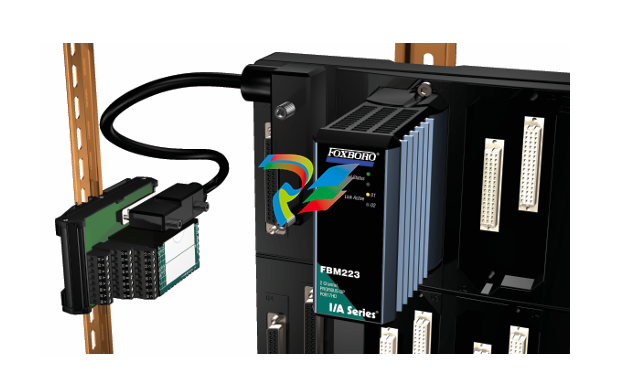
The FBM223 PROFIBUS-DP™ Communication Interface Module provides an interface between
PROFIBUS-DP slave devices and the I/A Series® system.
FEATURES
Key features of the FBM223 module are:
Conforms to PROFIBUS-DP Fieldbus
specifications
Provides full support for all device variables and
diagnostic messages
Integrates PROFIBUS slave device data into an
I/A Series control database
The FBM223 and its associated termination
assembly (TA) are suitable for installation in
Class 1. Division 2 and Zone 2 locations.
OVERVIEW
The PROFIBUS-DP Communication Interface Module
(FBM223) provides an interface between
PROFIBUS-DP slave devices — such as motor
drives, I/O modules, and field I/O devices — and the
I/A Series system.
PROFIBUS is a vendor-independent, open fieldbus
standard for a wide range of applications in process
automation and manufacturing. Vendor
independence and openness are guaranteed by the
PROFIBUS Fieldbus standard EN 50170. which
specifies the functional, electrical, and mechanical
characteristics for a serial transmission bus.
Physical PROFIBUS-DP wiring is in accordance with
Electronic Industrial Association (EIA) standard RS
485.
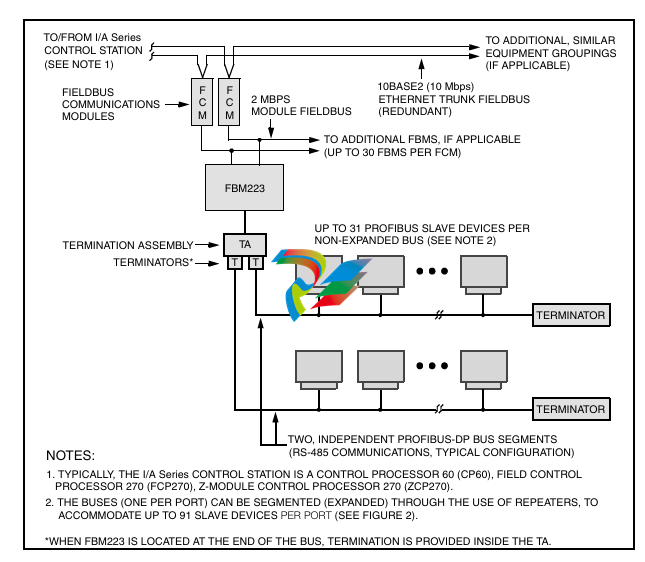
In addition to the general PROFIBUS-DP
configuration shown in Figure 1. several other
configurations are possible, including those using
repeaters and intrinsic safety protective devices.
Figure 2 shows how a bus can be expanded into
multiple segments through the use of repeaters, thus
providing support for a greater number of slave
devices.
FBM223 communicates with the PROFIBUS I/O
devices on a master/slave basis. As master, the
FBM223 initializes each data communication
exchange. The slave devices can only acknowledge
received messages, or send messages to the master
when requested to do so.
PROFIBUS-DP TECHNOLOGY
“DP” (in PROFIBUS-DP) represents the
communication profile that is most often used with
PROFIBUS — decentralized periphery. It is optimized
for speed, efficiency, and low connection cost, and is
designed especially for communication between
automation systems (such as the I/A Series control
system) and distributed field devices.
GSD FILES
A GSD file identifies a PROFIBUS-DP device. It
contains information specific to each device and
specifies parameters such as baud rates, timing
information and supported options such as
diagnostics and data length. A GSD file, provided by
the device manufacturer, is available for each device
type.
The data transmission method used with
PROFIBUS-DP is in accordance with EIA standard
RS-485. a proven serial communication technology
used in universal applications in process control and
manufacturing automation. Applications for RS-485
include all areas in which high transmission speed
and simple, inexpensive installation are required. The
physical communication medium consists of twisted
pair shielded copper cable containing a single
conductor pair. Active bus terminators, required at
either end of the bus or bus segment, typically exist
within the bus connectors or within the devices
themselves.
The I/A Series system uses the information in the
GSD file to set up communication to the slave
device. A configurator, available on the operator
station (UNIX® or Windows® based) allows the
importation of such files for establishing supported
options and for validating the values set by the user
NETWORK EXPANSION
Without the use of repeaters (non-expanded bus
configuration) up to 31 slave stations can exist on a
PROFIBUS-DP bus. Depending on the selected data
transfer rate, cabling distances up to 1200 m
(3960 ft) are possible without the use of repeaters
(see Table 1).
The use of repeaters provides for expansion of the
bus, allowing a greater number of slave devices per
FBM223 port, up to 91.
For a given system, with the use of repeaters the
maximum number of slave devices supported on an
FBM223 port is dependent on the amount of I/O that
is configured per device for access by the FBM223.
FBM CAPACITY
For the complete specification of number of devices
supported versus maximum I/O per device, refer to
the PROFIBUS-DP Communication Interface Module
(FBM223) User’s Guide (B0400FE).
From the I/A Series control station to which the
FBM223 is connected (refer to Figure 1), up to 100
connections per FBM223 port can be made to the
I/O data being accessed (read or written) by the
FBM223 over PROFIBUS.
A connection may be to:
An analog input or output value (integer or
floating point)
A string input or output
A single digital input or output value
Multiple (packed) digital input or output values
(packed in groups of up to 32 digital points per
connection).
Thus an I/A Series control station can access up to
100 analog I/O values, or 3200 digital I/O values, or a
combination of digital, analog, and string I/O, via
each of the two ports of the FBM223. The frequency
of access to FBM223 data by a control station may
be as fas
FIELDBUS COMMUNICATION
TERMINATION ASSEMBLY
The Fieldbus Communications Module (FCM) or the
Field Control Processor (FCP) interfaces to the
redundant 2 Mbps module Fieldbus used by the
FBMs. The FBM223 accepts communication from
either path (A or B) of the 2 Mbps Fieldbus — should
one path fail or be switched at the system level, the
-
 CTI 2559-TC 8-Channel Thermocouple Input Module
 -
 CTI 2556-A 16-Channel Isolated Thermocouple Input Module
 -
 CTI 2556 16-Channel Isolated Thermocouple Input Module
 -
 CTI 2551-A 8-Channel Isolated Thermocouple Input Module
 -
 CTI 2559-RTD 8-Channel RTD Input Module
 -
 CTI 2557-A 16-Channel RTD Input Module
 -
 CTI 2557 16-Channel RTD Input Module
 -
 CTI 2552-A 8-Channel Isolated RTD Input Module
 -
 CTI 2534 8-Point Form-C Relay Output Module
 -
 CTI 2532 16-Point Form-A Relay Output Module
 -
 CTI 2531 32-Point Form-A Relay Output Module
 -
 CTI 2530 8-Point Form-C Relay Output Module
 -
 CTI 2562 8-Channel Analog Output Module
 -
 CTI 2560-A 8-Channel Isolated Analog Output Module
 -
 CTI 2501 8in/4out Analog Module
 -
 CTI 2558 8-Channel Analog Input Module
 -
 CTI 2555-A 16-Channel Analog Input Module
 -
 CTI 2550-A 8-Channel Isolated Analog Input Module
 -
 CTI 2599 8/16/32-Point AC Output Module
 -
 CTI 2598-8 8-Point AC Output Module
 -
 CTI 2598 8/16-Point AC Output Module
 -
 CTI 2597 8/16/32-Point DC Output Module
 -
 CTI 2596-8 8-Point DC Output Module
 -
 CTI 2596 8/16-Point DC Output Module
 -
 CTI 2595 16-Point TTL/Word Output Module
 -
 CTI 2591-EF 16-Point Isolated 11-146 VDC Output with Front Panel Accessible Fuses
 -
 CTI 2591-A 16-Point Isolated 11-146 VDC Output Module
 -
 CTI 2590-EF 16-Point Isolated 20-132 VAC Output with Front Panel Accessible Fuses
 -
 CTI 2590-A 16-Point Isolated Discrete 20-132 VAC Output Module
 -
 CTI 2589-B 8/16/32-Point Universal Discrete Input Module
 -
 CTI 2589-A 8/16/32-Point Universal Discrete Input Module
 -
 CTI 2588-8 8-Point Universal Discrete Input Module
 -
 CTI 2585 16-Point TTL/Word Input Module
 -
 CTI 2582 16-Point Isolated 125 VDC Input Module
 -
 CTI 2581 16-Point Isolated 12-56 VDC Input Module
 -
 CTI 2580 16-Point Isolated 95-132 VAC Input Module
 -
 CTI 2500-TAP RS485 Network Tap
 -
 CTI 2500-RIO-B RS485 Remote Base Controller
 -
 CTI 2500-RIO-A RS485 Remote Base Controller
 -
 CTI 2500-RBC Profibus Remote Base Controller
 -
 CTI 2515-A 100-Watt AC/DC Power Supply with Redundancy Support
 -
 CTI 2515 100-Watt AC Power Supply (MATURE - replaced by 2515-A)
 -
 CTI 2513-A 75-Watt DC Power Supply with Redundancy Support
 -
 CTI 2513 75-Watt 24VDC Power Supply
 -
 CTI 2512-A 75-Watt AC/DC Power Supply with Redundancy Support
 -
 CTI 2512 75-Watt AC/DC Power Supply
 -
 CTI 2510 125 VDC Power Supply
 -
 CTI 2500-SSB Single Slot Blank Front Panel
 -
 CTI 2500-R11-A Eleven-Slot Redundant Base
 -
 CTI 2500P-R16 Sixteen-Slot Base with High-Speed Channel
 -
 CTI 2500P-R8 Eight-Slot Base with High-Speed Channel
 -
 CTI 2500P-R4 Four-Slot Base with High-Speed Channel
 -
 CTI 2541 Redundant Processor Manager Module
 -
 CTI 2577 Profibus DP Slave Adapter
 -
 CTI 2573-MOD Serial Interface Adapter with MODBUS
 -
 CTI 2572-AF Fast Ethernet TCP/IP Adapter with Optical Fiber Connection
 -
 CTI 2572-A Fast Ethernet TCP/IP Adapter
 -
 CTI 2572 Ethernet TCP/IP Adapter
 -
 CTI 2572-B Fast Ethernet TCP/IP Adapter
 -
 CTI 2576 DeviceNet™ Scanner Module (MATURE)
 -
 CTI 2500P-ECC1 Ethernet Communications Coprocessor
 -
 CTI 2500P-JACP Janus Application Coprocessor
 -
 CTI 2500P-ACP1 Application Coprocessor (MATURE - replaced by 2500P-JACP)
 -
 CTI 2500P-J450 Janus PAC with 2MB Project Memory
 -
 CTI 2500-C400 CPU with 3072K User Memory
 -
 CTI 2500-C300 CPU with 512K User Memory
 -
 CTI 2500-C200 CPU with 256K User Memory
 -
 CTI 2500-C100 CPU with 128K User Memory
 -
 CTI 2500P-J750 Janus PAC with 3MB Project Memory
 -
 Shinkawa WHF3006M Displacement Converter
 -
Shinkawa JBP-220 (P-24-94A / P-24-94B) Circuit Board Module
-
 SHINKAWA WKN-142K5 2-WIRE VIBRATION TRANSDUCER
 -
Shinkawa FRP-321 (P-26-54A / P-26-54B) Circuit Board Module
-
 Shinkawa IOP-160 (P-25-72A / P-25-72B) Circuit Board Module
 -
 Shinkawa PK-147B-1 / PK-147A-1 Circuit Board Module
 -
 Shinkawa CPP-91A Circuit Board Module
 -
 Shinkawa FRP-177 PCB Module
 -
 Shinkawa CPP-127 (P-26-74A / P-26-74B) Circuit Board Module
 -
Shinkawa FRP-227 (P-24-86A / P-24-86B) Circuit Board Module
-
 Shinkawa MDP-104 (P-25-83A / P-25-83B) Circuit Board Controller
 -
 Shinkawa VK-143P2 High-precision eddy current sensor driver/signal conditioner
 -
 Shinkawa FRP-226 (P-24-86A / P-24-86B) Circuit Board Module
 -
Shinkawa CPP-107A P-22-99A P-22-99B Circuit Board Module
-
 SHINKAWA VW-202AL-8 Axial Displacement Sensor
 -
Shinkawa VL-202A08L-1A42 Vibration Sensor Transducer Probe
-
Shinkawa VL-202A08L-1A42 Vibration Sensor Transducer Probe
-
 Shinkawa FRP-209A & FRP-206 Wire Bonder Circuit Board Module
 -
 Shinkawa MGP-72 MGP72 P-26-50A P-26-50B Circuit Board Module
 -
 Shinkawa FRP-249 P-25-1A P-25-1B Circuit Board Module
 -
Shinkawa FRP-320 P-26-54A P-26-54B Circuit Board Module
-
Shinkawa FRP-282 P-24-35A P-24-35B Circuit Board Module
-
 Shinkawa FRP-338 P-26-54A P-26-54B Circuit Board Module
 -
 GE IS200AEPBH1B IS200AEPBH1B‑REV‑AA Pitch-Charger Control PCB Board
 -
 GE IS200EDEXG1ADA EX2100 SCR Trigger Control Board
 -
 GE 151X1207CK01SA01 IS200EDEXG1A EX2100 SCR
 -
 GE 151X1233DD02SA02 IS200AEPBH1B - Variant for pitch control charger assembly
 -
 GE 151X1233DB01SA01 IS200AEPBH1B - 10kW Wind Power Converter
 -
 GE 151X1233DB01SA01R | IS200AEPBH1B 10KW Converter
 -
GE 151X1233DD01SA02 Pitch Battery Charger (109W6931P001)
-
GE 151X1233DD01SA02 Pitch Battery Charger Assy IS200AEPBH1B
-
 GE 151X1233DB02SA02 Rev A IS200AEPBH1B Wind Turbine Converter
 -
 GE 151X1207CK02SA02 SCR 4400 V 1850 A IS200EDEXG1ADA General Electric EX2100
 -
 Triconex 3723X 32-Channel TMR Analog Input Module with HART
 -
 SHINKAWA VM-21G SIGNAL CONDITIONER SOCKET
 -
SHINKAWA VM-21R REVOLUTION SIGNAL CONDITIONER
-
SHINKAWA VM-21T DISPLACEMENT INPUT THRUST SIGNAL CONDITIONER
-
SHINKAWA VM-21D 6-WIRE LVDT SIGNAL CONDITIONER
-
 SHINKAWA VM-21P 3-WIRE LVDT SIGNAL CONDITIONER
 -
SHINKAWA VM-21A VIBRATION SIGNAL CONDITIONER
-
SHINKAWA VM-21K DISPLACEMENT INPUT VIBRATION SIGNAL CONDITIONER
-
 SHINKAWA VM-25S01 CONDITION MONITORING SYSTEM
 -
SHINKAWA VM-25 CONDITION MONITORING SYSTEM
-
SHINKAWA VM-772B DEVICE CONFIG
-
SHINKAWA VM-771B MCL VIEW
-
 SHINKAWA VM-76B INSTRUMENT RACK
 -
SHINKAWA VM-75B POWER SUPPLY MODULE
-
 SHINKAWA VM-742B NETWORK COMMUNICATION MODULE
 -
 SHINKAWA VM-741B LOCAL COMMUNICATION & PHASE MARKER MODULE
 -
SHINKAWA VM-722B 9-CHANNEL RELAY MODULE
-
SHINKAWA VM-707B AERODERIVATIVE GAS TURBINE MONITOR MODULE
-
 SHINKAWA VM-706B ROD DROP MONITOR MODULE
 -
 SHINKAWA VM-705B 18-CHANNEL TEMPERATURE MONITOR MODULE
 -
SHINKAWA VM-704B TEMPERATURE MONITOR MODULE
-
 SHINKAWA VM-702B ABSOLUTE VIBRATION MONITOR MODULE
 -
SHINKAWA VM-701B VIBRATION / DISPLACEMENT MONITOR MODULE
-
 SHINKAWA MODEL VM-5X INTERFACE UNIT
 -
 SHINKAWA MODEL VM-5W2 DUAL POWER SUPPLY INSTRUMENT RACK
 -
 SHINKAWA MODEL VM-5H4 INSTRUMENT RACK (for VM-5Z5.6.7)