Woodward ESDR 4 Current Differential Protection Relay
ESDR 4
Current Differential Protection Relay
The ESDR 4 is a three-phase current differential protection relay for generators and motors (protected object).
The currents flowing in the individual lines are each measured using a current transformer on both sides of the
protected object. They form the protection area boundary or zone. All two or three-phase short circuits and line
to-earth faults within this protection area are detected by the ESDR 4 as fault currents which initiate tripping.The
unit does not trip if fault currents occur outside the protection zone. In this way, a selective protection is guaran
teed.
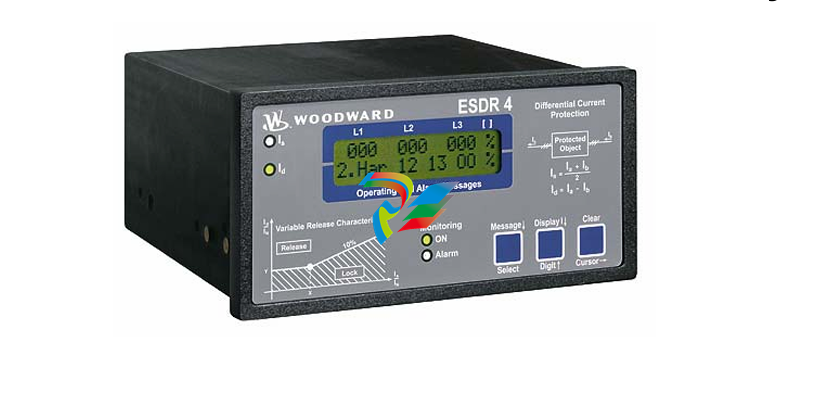
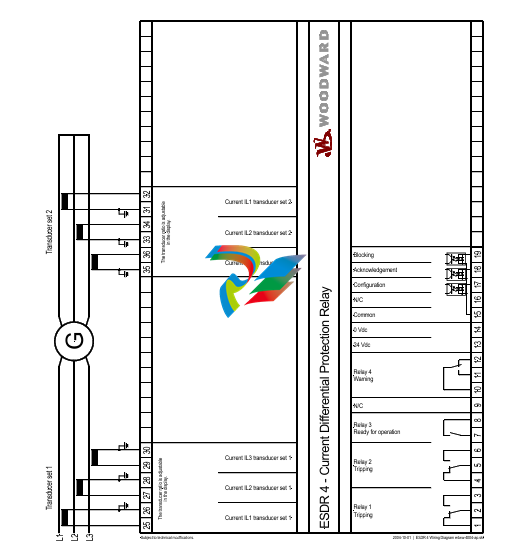
The unit monitors six (6) measured currents via isolated inputs. The unit calculates internally the restraint current
(Is) and the differential current (Id) separately for each phase. The actual values of the calculated parameters (Dif
ferential current Id und Restraint current IS) are shown on the display either as absolute values or as a percentage
of the generator rated current (selectable in locked input mode).
Theoretically the currents Ia and Ib are equal, both in fault-free operation and outside the protection zone (Figure
4-1-a).The difference is zero and the differential protection does not initiate. However, in practice current differ
entials do occur (= spurious currents), even in fault-free operation. They result, for example, from summation or
phase angle errors in the CTs, which are influenced by deviating burden values. These spurious currents remain
small inside the operating range, but increase with increasing load and are especially high when one or more CTs
become saturated (e.g. in the case of an external short circuit). In order to prevent a tripping of the relay due to
spurious currents, the trigger threshold is not held statically constant but increases in relation to the restraint cur
rent Is. Spurious currents need to be taken into account when adjusting the trip characteristic.
When a fault occurs inside the protection area (Figure 4-1-b), unequal currents flow in the CTs, which result in a
current differential. If this exceeds the differential protection threshold, the relay will trip.
Monitoring of the Differential Current
The monitoring of the differential current is carried out in two stages..
The first monitoring level serves as a warning and can be enabled or disabled. Should the adjustable warning
characteristic be exceeded, a text appears in the display and a relay contact is enabled. The pick-up time and the
dropout delay of the relay output are adjustable. The warning stage of the monitoring is auto-resetting.
The second stage of monitoring (main stage) serves to initiate tripping. In contrast to the first stage, it offers the
possibility to monitor the overstepping of an adjustable tripping characteristic (Id < In) and additionally, a fixed
tripping-threshold of 100%, relative to the generator rated current (Id > In). The trigger-delay for each limit value
may be independently adjusted, thus allowing a shorter triggering time at higher differential currents. When one
or both tripping characteristics are exceeded, a text display is initiated and two relay contacts are energized. The
tripping characteristics possess a 2% hysterisis relative to the generator rated current. .
The signal relay is only automatically reset if the function "automatic reset relay" in the Entry field on the screen
is configured to "on". Otherwise, the resetting is carried out by pressing the "Clear" button on the front of the
unit or via the discrete input terminal 18 "reset".
The two monitoring levels can also be used to change the characteristics of the control function (stage 1: small
value and a long time; stage 2: high value and a short time)
Tripping Characteristic
The following figure shows the tripping and warning characteristics (with sample values for X12. Y1.and Y2). It
represents the tripping and warning thresholds (Y) relative to the restraint current (X) The positions of the corner
points are determined by the coordinates P (X12/Y2) and P (X12/Y1). The selection of these positions is depend
ent on the generator being protected. The following gives the ranges of tripping and warning thresholds:
IS / IN
IS / IN
IS / IN
0 to X12
X12 to 5 × IN
> 5 × IN
The threshold Id is independent of the restraint current..
The threshold Id is dependent on the restraint current. A change of 100% in the
restraint current causes an increase of 10% in the tripping threshold.
The threshold Id stays constant at 85%.
Different characteristics can be chosen for the first and second monitoring levels, whereby the horizontal position
(X-coordinate) is valid for both stages. The vertical position (Y-coordinate) can be chosen separately for each
monitoring level. This results in a fixed difference in thresholds of the first and second monitioring levels for
each restraint current Is.
Control Inputs
Configuration
Terminal 17
Acknowledgement
Terminal 18
Blocking
Terminal19
Relays
Tripping (relay 1)
Terminals 1/2/3
Tripping (relay 2)
Terminals 4/5/6
Warning (relay 4)
Terminals 11/12/13
Ready for operation
(relay 3)
Terminals 7/8
When this input is energized, the unit locks into Configuration mode and stays in this
-
 DEIF RMF-112D Frequency relay
 -
 DEIF RMC-142D Current relay
 -
 DEIF RMC-132D Current relay
 -
 DEIF RMC-131D Current relay
 -
 DEIF RMC-122D Current relay
 -
 DEIF RMC-121D Current relay
 -
 DEIF RMC-111D Current relay
 -
 DEIF MVR-V211 Busbar Protection
 -
 DEIF MVR-T257 Transformer Differential Protection
 -
 DEIF MVR-T256 Transformer Differential Protection
 -
 DEIF MVR-T216 Transformer Differential Protection
 -
DEIF MVR-T215 Transformer Protection
-
 DEIF MVR-M257 Motor Differential Protection
 -
 DEIF MVR-M255 Motor Protection
 -
 DEIF MVR-M215 Motor Protection
 -
 DEIF MVR-M210 Motor Protection
 -
 DEIF MVR-G257 Generator Differential Protection
 -
 DEIF MVR-G215 Generator Protection
 -
 DEIF MVR-F255 Directional Feeder Protection
 -
 DEIF MVR-F215 Directional Feeder Protection
 -
DEIF MVR-F210 Feeder Protection
-
 DEIF MVR-F205 Directional Feeder Protection
 -
 DEIF MVR-F201 Basic Feeder Protection
 -
DEIF MVR-200 series Medium Voltage Relay
-
 DEIF MDR-2 Multi-differential relay
 -
 DEIF LMR-122D Loss of mains relay
 -
 DEIF LMR-111D Loss of mains relay
 -
 DEIF APU-4 Advanced G59 and G99 protection unit
 -
 DEIF iE 650 PLC - The most robust programmable automation controller available
 -
 DEIF iE 350 PLC - Programmable Automation PLC Controller
 -
 DEIF iE 250 PLC Versatile and modular intelligent energy PLC controller
 -
 DEIF PPM-3 EDG Protection and Power Management
 -
 DEIF AGC 3X 4198000234E AUTOMATIC GENSET CONTROLLER
 -
 SAUTER ASF123 Damper actuator with spring return
 -
SAUTER ASF122 Damper actuator with spring return
-
SAUTER ASF113F122 Damper actuator with spring return
-
SAUTER ASF113F120 Damper actuator with spring return
-
SAUTER ASF112F122 Damper actuator with spring return
-
SAUTER ASF112F120 Damper actuator with spring return
-
 SAUTER ASM 124/134 series - ASM134F130 Damper actuator
 -
SAUTER ASM 134 series - ASM134SF132 Damper actuator
-
SAUTER ASM 124/134 series - ASM124SF132 Damper actuator
-
SAUTER ASM 124/134 series - ASM124F122 Damper actuator
-
SAUTER ASM 124/134 series - ASM124F120 Damper actuator
-
 SAUTER Valve actuator ASM 105S/115S series ASM115SF152
 -
SAUTER Valve actuator ASM 105S/115S series ASM105SF152
-
SAUTER Valve actuator ASM 105S/115S series ASM115SF132
-
SAUTER Valve actuator ASM 105/115 series ASM105SF132
-
 SAUTER Valve actuator ASM 105/115 series ASM115F122
 -
SAUTER Valve actuator ASM 105/115 series ASM115F120
-
SAUTER Valve actuator ASM 105/115 series ASM105F122
-
SAUTER Valve actuator ASM 105/115 series ASM105F120
-
SAUTER Valve actuator ASM 105/115 series ASM105F10
-
 SAUTER AKF113S Rotating actuator AKF 112/113 series
 -
SAUTER AKF113F122 Rotating actuator AKF 112/113 series
-
SAUTER AKF113F120 Rotating actuator AKF 112/113 series
-
SAUTER AKF112F122 Rotating actuator AKF 112/113 series
-
SAUTER AKF112F120 Rotating actuator AKF 112/113 series
-
 SAUTER AKM115SAF332: Smart Actuator for ball valve, BACnet/IP
 -
 SAUTER AKM115SAF232 Rotating Actuator AKM 115SA Smart Actuator
 -
 SAUTER AKM115SF152 Rotating Actuator AKM 105S/115S Series
 -
SAUTER AKM115SF132 Rotating Actuator AKM 105S/115S Series
-
SAUTER AKM105SF132 Rotating Actuator AKM 105S/115S Series
-
 SAUTER AKM115F122 Rotating actuator AKM 105/115 series
 -
 SAUTER Rotating actuator AKM 105/115 series AKM115F120
 -
SAUTER Rotating actuator AKM 105/115 series AKM105F122
-
SAUTER Rotating actuator AKM 105/115 series AKM105F120
-
 SAUTER Continuous actuator for unit valves, with stroke AXS215S
 -
 SAUTER Linear valve actuator AXT/AXS series AXT211
 -
SAUTER Linear valve actuator AXT/AXS series AXT201
-
 SAUTER Linear valve actuator AXM/AXF series AXF217S
 -
SAUTER Linear valve actuator AXM/AXF series AXM217S
-
SAUTER AXM217SF404 is an electric actuator for unit valves.
-
SAUTER AXM217SF402 is an electric actuator for unit valves.
-
SAUTER Linear valve actuator AXM/AXF series AXM217
-
 SAUTER Linear valve actuator AVF 124/125 series AVF125S
 -
SAUTER Linear valve actuator AVF 124/125 series AVF124S
-
SAUTER Linear valve actuator AVF 124/125 series AVF124S
-
 SAUTER AVM322S-R Linear valve actuator AVM 234S series
 -
SAUTER AVM322-R Linear valve actuator AVM 234S series
-
SAUTER AVM322SF132 Linear valve actuator AVM 234S series
-
 SAUTER AVM321SF132 Linear Valve Actuator
 -
 GE Power Conversion P112-6053 Advanced Micro Controller (AMC2)
 -
GE Power Conversion P111-6053 Advanced Micro Controller (AMC2)
-
 GE Power Conversion P110-6053 Advanced Micro Controller (AMC2)
 -
 GE Power Conversion P122-6052 Advanced Micro Controller (AMC2)
 -
GE Power Conversion P121-6052 Advanced Micro Controller (AMC2)
-
 GE Power Conversion P112-6152 Advanced Micro Controller (AMC2)
 -
GE Power Conversion P110-6152 Advanced Micro Controller (AMC2)
-
GE Power Conversion P112-6052 Advanced Micro Controller (AMC2)
-
GE P106-6052 AMC2 Advanced Micro Controller Unit
-
SAUTER AVF234SF232 Linear valve actuator AVM 234S series
-
SAUTER AVF234SF132 Linear valve actuator AVM 234S series
-
 SAUTER Linear valve actuator AVM 234S series AVM234SF132-6
 -
SAUTER Linear valve actuator AVM 234S series AVM234SF132-5
-
SAUTER Linear valve actuator AVM 234S series AVM234SF132
-
SAUTER Linear valve actuator AVM215SF132-7
-
SAUTER Linear valve actuator AVM215SF132R
-
 Linear valve actuator AVM 115SA Smart Actuator AVM115SAF332
 -
Linear valve actuator AVM 115SA Smart Actuator AVM115SAF232
-
 SAUTER Linear valve actuator AVM 105S/115S series AVM115SF132
 -
SAUTER Linear valve actuator AVM 105S/115S series AVM105SF132
-
 SAUTER AVM115F901 Linear Valve Actuator
 -
SAUTER AVM115F122 Linear Valve Actuator
-
SAUTER AVM115F120 Linear Valve Actuator
-
SAUTER AVM105F122 Linear Valve Actuator
-
 SAUTER AVM105F120 Linear Valve Actuator
 -
 SAUTER AVM105F100 Linear Valve Actuator
 -
 AEROTECH SM Series High-Performance Stepper Motors
 -
 AEROTECH BLMSC Series Linear Motors
 -
 AEROTECH Custom Linear Motors
 -
 AEROTECH BMS Series Brushless, Slotless Rotary Motors
 -
 AEROTECH BM Series Brushless Rotary Motors
 -
 AEROTECH BLMX Series Linear Motors
 -
 AEROTECH BLMH Series Linear Motors
 -
 AEROTECH BLM Series Linear Motors
 -
 AEROTECH BLMC Series Linear Motors
 -
 AEROTECH BLMUC-143 Linear motor forcer with thermistor
 -
AEROTECH BLMUC-111 Linear motor forcer with thermistor
-
AEROTECH BLMUC-95 Linear motor forcer with thermistor
-
AEROTECH BLMUC-79 Linear motor forcer with thermistor
-
AEROTECH BLMUC Series Linear Motors
-
 AEROTECH Automation1 FLEX Distributed Amplifier Multi-Axis Servo Control System
 -
 AEROTECH Automation1 HXA4 6-Axis Hexapod Servo Drive
 -
 AEROTECH Automation1 iHXA4 6-Axis Hexapod Servo Drive with Motion Controller
 -
 AEROTECH Modular System Control Console
 -
 AEROTECH TV Series Transformers
 -
 AEROTECH TM Series Transformers