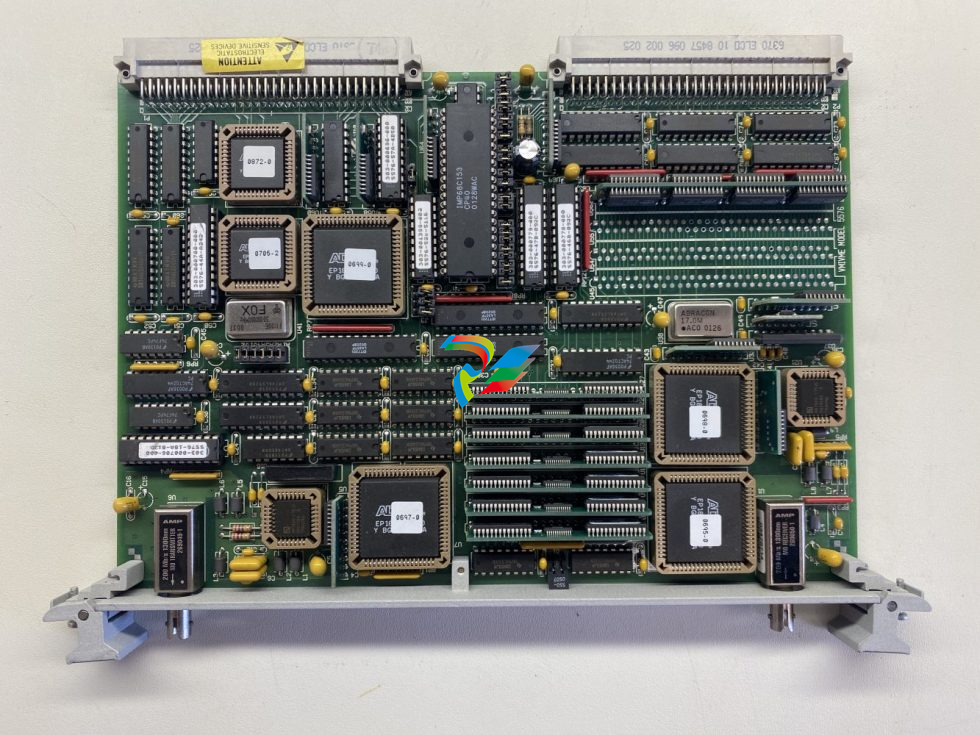
GE VMIVME-5576 Fiber-Optic Reflective Memory with Interrupts
VMIVME-5576
Fiber-Optic Reflective Memory with Interrupts
High-speed, easy-to-use fiber-optic network (170 Mbaud serially)
Data written to memory in one node is also written to memory in all nodes on
the network
Up to 2.000 m between nodes and up to 256 nodes
Data transferred at 6.2 Mbyte/s without redundant transfer
Data transferred at 3.2 Mbyte/s with redundant transfer
Any node on the network can generate an interrupt in any other node on the
network or in all network nodes with a single command
Error detection
Redundant transmission mode for suppressing errors
No processor overhead
No processor involvement in the operation of the network
Up to 1 Mbyte of Reflective Memory
A24:A32:D32:D16:D8 memory access
Single 6U VMEbus board
INTRODUCTION
VMIVME-5576 is a
high-performance, multidrop VME-to-VME network. Data is
transferred by writing to on-board global RAM. The data is
automatically sent to the location in memory on all Reflective
Memory boards on the network.
PRODUCT OVERVIEW
—
The Reflective Memory
concept provides a very fast and efficient way of sharing data
across distributed computer systems.
VMIC’s VMIVME-5576 Reflective Memory interface
allows data to be shared between up to 256 independent
systems (nodes) at rates up to 6.2 Mbyte/s. Each Reflective
Memory board may be configured with 256 Kbyte to 1 Mbyte
of on-board SRAM. The local SRAM provides fast Read
access times to stored data. Writes are stored in local SRAM
and broadcast over a high-speed fiber-optic data path to other
Reflective Memory nodes. The transfer of data between nodes
is software transparent, so no I/O overhead is required.
Transmit and Receive FIFOs buffer data during peak data
rates to optimize CPU and bus performance to maintain high
data throughput.
The Reflective Memory also allows interrupts to one or
more nodes by writing to a byte register. These interrupt (three
level, user definable) signals may be used to synchronize a
system process, or used to follow any data that may have
preceded it. The interrupt always follows the data to ensure the
reception of the data before the interrupt is acknowledged.
The VMIVME-5576 requires no initialization unless
interrupts are being used. If interrupts are used, vectors and
interrupt levels must be written to on-board registers and the
interrupts armed.
Each node on the system has a unique identification
number between 0 and 255. The node number is established
during hardware system integration by placement of jumpers
on the board. This node number can be read by software by
accessing an on-board register. In some applications, this node
number would be useful in establishing the function of the
node.
LINK ARBITRATION — The VMIVME-5576 system
is a fiber-optic daisy chain ring as shown in Figure 2. Each
transfer is passed from node to node until it has gone all the
way around the ring and reaches the originating node. Each
node retransmits all transfers that it receives except those that
it had originated. Nodes are allowed to insert transfers
between transfers passing through.
INTERRUPT TRANSFERS — In addition to
transferring data between nodes, the VMIVME-5576 will
allow any processor in any node to generate an interrupt on
any other node. These interrupts would generally be used to
indicate to the receiving node that new data has been sent and
is ready for processing. These interrupts are also used to
indicate that processing of old data is completed and the
receiving node is ready for new data.
Three interrupts are available. The user may define the
function, priority, and vector for each interrupt. Any
processor can generate an interrupt on any other node on the
network. In addition, any processor on the network can
generate an interrupt on all nodes on the network. Interrupts
are generated by simply writing to a single VMIVME-5576
register.
All data and interrupt command transfers contain the
node number of the node that originated the transfer. This
information is used primarily so the originating node can
remove the transfer from the network after the transfer has
traversed the ring. The node identification is also used by
nodes receiving interrupt commands. When a node receives
an interrupt command for itself, it places the identification
number of the originating node in a FIFO. Up to 512
interrupts can be stacked in the FIFO. During the interrupt
service routine, the identification of the interrupting node can
be read from the FIFO.
ERROR MANAGEMENT — Errors are detected by
the VMIVME-5576 with the use of the error detection
facilities of the TAXI chipset and additional parity encoding
and checking. The error rate of the VMIVME-5576 is a
function of the rate of errors produced in the optical portion
of the system. This optical error rate depends on the length
and type of fiber-optic cable.
Assuming an optical error rate of 10-12. the error rate of
the VMIVME-5576 is 10-10 transfers/transfer. However, the
rate of undetectable errors is less than 10-20 transfers/transfer.
When a node detects an error, the erroneous transfer is
removed from the system and a VMEbus interrupt is
generated, if armed.
The VMIVME-5576 can be operated in a redundant
transfer mode in which each transfer is transmitted twice. In
this mode of operation, the first of the two transfers is used
unless an error is detected in which case the second transfer
is used. In the event that an error is detected in both transfers,
the node removes the transfer from the system. The
probability of both transfers containing an error is 10-20. or
about one error every 372.000 years at maximum data rate.
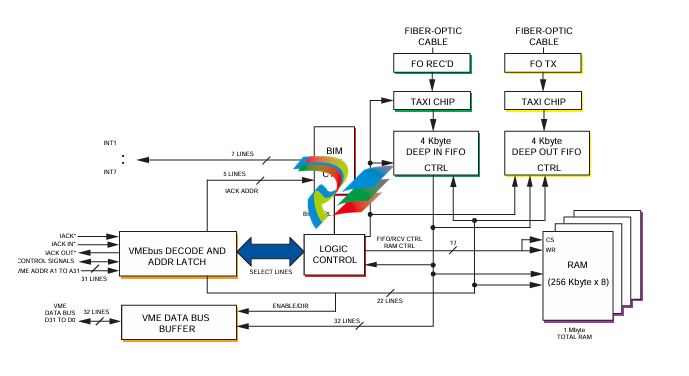
PROTECTION AGAINST LOST DATA — Data
received by the node from the fiber-optic cable is error
checked and placed in a receive FIFO. Arbitration with
accesses from the VMEbus then takes place and the data is
written to the node’s SRAM and to the node’s transmit FIFO.
Data written to the board from the VMEbus is placed directly
into SRAM and into the transmit FIFO. Data in the transmit
FIFO is transmitted by the node over the fiber-optic cable to
the next node. Data could be lost if either FIFO were allowed
to become full.
The product is designed to prevent either FIFO becoming
full and overflowing. It is important to note the only way that
data can start to accumulate in FIFOs is for data to enter the
node at a rate greater than 6.2 or 3.2 Mbyte/s in redundant
mode. Since data can enter from the fiber and from the
VMEbus, it is possible to exceed these rates. If the transmit
FIFO becomes half-full, a bit in the Status Register is set and,
if armed, an interrupt is generated. This condition is an
indication to the software in the node that writes to the
Reflective Memory should be suspended until the FIFO
becomes less than half-full. If the half-full indication is
ignored and the transmit FIFO becomes full, then writes to the
Reflective Memory will be acknowledged with a bus error.
With VMEbus writes being blocked by the bus error, data
cannot overflow in the receive FIFO.
NETWORK MONITOR — There is a bit in a Status
Register that can be used to verify that data is traversing the
ring (that is, the ring is not broken). This can also be used to
measure network latency.
SPECIFICATIONS
Memory Size: 256 Kbyte, 512 Kbyte, or 1 Mbyte
Access Time:
400 ns (worst-case arbitration)
200 ns (best-case arbitration)
TRANSFER SPECIFICATION
Transfer Rate:
6.2 Mbyte/s (longword accesses) without redundant
transfer
3.2 Mbyte/s (longword accesses) with redundant transfer
COMPATIBILITY
VMEbus: This product complies with the VMEbus
specification (ANSI/IEEE STD 1014-1987. IEC 821 and
297), with the following mnemonics:
A32: A24: D32/D16/D08 (EO): Slave: 39/3D:09/0D
Form factor: 6U
Memory: Addressable on 256 Kbyte boundaries for
256 Kbyte memory option
Addressable on 512 Kbyte boundaries for 512 Kbyte
memory option
Addressable on 1 Mbyte boundary for 1 Mbyte memory
option
INTERCONNECTION
Cable Requirements: Two fiber-optic cables
Cable Length: 2.000 m maximum between nodes
Configuration: Daisy chain ring up to 256 nodes
PHYSICAL/ENVIRONMENTAL
Temperature Range: 0 to 55 °C, operating-40 to 85 °C, storage
Relative Humidity: 20 to 80 percent, noncondensing
Power Requirements: 5.0 A maximum at +5 VDC
MTBF: 142.400 hours (217F)
DATA TRANSFERS
Data written into the Reflective Memory is broadcast to
all nodes on the network without further involvement of the
sending or receiving nodes. Data is transferred from memory
locations on the sending nodes to corresponding memory
locations on the receiving nodes.
A functional block diagram of the VMIVME-5576 is
shown in Figure 1.
TRADEMARKS
The VMIC logo is a registered trademark of VMIC.
Other registered trademarks are the property of their
respective owners.
-
 CTI 2500-ADP2-DISC Discrete Wiring Adapter for Series 500
 -
 CTI 2500-ADP1 Analog Wiring Adapter for Series 500
 -
 CTI 2500C-RADP-RS485 Remote Base Controller Adapter for Series 500
 -
 CTI 2500C-RADP-RBC Profibus RBC Adapter for Series 500
 -
 CTI 2500C-PADP-120V 120VAC 50W Power Supply for Series 500
 -
 CTI 2500-RADP RBC Adapter for Series 500
 -
 CTI 2500-R4500 520/530/DBC Adapter for Series 500 - MATURE
 -
 CTI 2500-PADP Power Supply Adapter for Series 500
 -
 CTI 2500-IADP I/O Adapter for Series 500
 -
 CTI 2500-VP15A-N4-W7 15" Flat-Panel PC with Windows® 7 Embedded
 -
 CTI 2500S-27-1750 Slice I/O, Ethernet, RS232/485. 900MHz, 2DIO / 4UAI / 2AI
 -
 CTI 2500S-26-1750 Slice I/O, Ethernet, RS232/485. 900MHz, 8DIO / 2UAI
 -
 CTI 2500S-23-1750 Slice I/O, Ethernet, RS232/485. 900MHz, 4DI / 4DO / 2UAI / 2AO
 -
 CTI 2500S-27-1550 Slice I/O, RS232/485. 2DIO / 4UAI / 2AI
 -
 CTI 2500S-26-1550 Slice I/O, RS232/485. 8DIO / 2UAI
 -
 CTI 2500S-23-1550 Slice I/O, RS232/485. 4DI / 4DO / 2UAI / 2AO
 -
 CTI 2500S-27-1050 Slice I/O, Ethernet, 2DIO / 4UAI / 2AI
 -
 CTI 2500S-26-1050 Slice I/O, Ethernet, 8DIO / 2UAI
 -
 CTI 2500S-23-1050 Slice I/O, Ethernet, 4DI / 4DO / 2UAI / 2AO
 -
 CTI 2500C-32F-CJC 32-Pin Field Wiring Connector with Cold Junction Compensation
 -
 CTI 2500C-32F 32-Pin Field Wiring Connector
 -
 CTI 2500C-8-TC Eight Thermocouple Inputs
 -
 CTI 2500C-8-RTD Eight RTD Inputs
 -
 CTI 2500C-8-RL-FC 8 Form-C Relay Outputs
 -
 CTI 2500C-8-IDO-24V 8 Isolated 24VDC Outputs
 -
 CTI 2500C-8-IDO-120V 8 Isolated 120VAC Outputs
 -
 CTI 2500C-16-DO-24V Sixteen 24VDC Digital Outputs
 -
 CTI 2500C-16-DO-120V Sixteen 120VAC Digital Outputs
 -
.png) CTI 500C-16-IDI-24V Sixteen Isolated 24V AC/DC Digital Inputs
CTI 500C-16-IDI-24V Sixteen Isolated 24V AC/DC Digital Inputs -
 CTI 2500C-16-IDI-120V Sixteen Isolated 120V AC/DC Digital Inputs
 -
 CTI 2500C-16-DIDO-SIM Sixteen Digital Input and Output SImulator
 -
 CTI 2500C-16-DI-24V Sixteen 24V AC/DC Digital Inputs
 -
 CTI 2500C-16-DI-120V Sixteen 120V AC/DC Digital Inputs
 -
 CTI 2500C-RBC-RS485 RS485 Remote Base Controller
 -
 CTI 2500C-RBC-PRF Profibus Remote Base Controller
 -
 CTI 2500C-PS-24V-35 35-Watt DC Power Supply
 -
 CTI 2500C-PS-120V-35 35-Watt AC Power Supply
 -
 CTI 2500C-R8 Eight-Slot Base
 -
 CTI 2500C-R4 Four-Slot Base
 -
 CTI 2500C-R16 Sixteen-Slot Base
 -
 CTI 2500C-2572-B Fast Ethernet TCP/IP Adapter
 -
 CTI 2500C-J750 Compact Janus PAC with 3MB Project Memory
 -
 CTI 2500C-C300 CPU with 512K User Memory
 -
 CTI 2500C-C200 CPU with 256K User Memory
 -
 CTI 2500C-C100 CPU with 128K User Memory
 -
 CTI 2500C-8-AO 8 Analog Outputs
 -
 CTI 2500C-8-AI 8 Analog Inputs
 -
 CTI 2559-FCAL Precision Calibration Connector
 -
 CTI 2559-FPC 40-Position Screw-Terminal Connector
 -
 CTI 2500-RFC PLC to RF Modem Cable
 -
 CTI 2500-40F 40-Position Standard Screw-Terminal Connector
 -
 CTI 2505 Vibration Sensor Interface Module
 -
 CTI 2554-A 4-Channel Isolated High Speed Counter Module
 -
 CTI 2553-A 2-Channel Mag Meter Input Module
 -
 CTI 2502 2-Channel High Speed Counter Input Module
 -
 CTI 2559-TC 8-Channel Thermocouple Input Module
 -
 CTI 2556-A 16-Channel Isolated Thermocouple Input Module
 -
 CTI 2556 16-Channel Isolated Thermocouple Input Module
 -
 CTI 2551-A 8-Channel Isolated Thermocouple Input Module
 -
 CTI 2559-RTD 8-Channel RTD Input Module
 -
 CTI 2557-A 16-Channel RTD Input Module
 -
 CTI 2557 16-Channel RTD Input Module
 -
 CTI 2552-A 8-Channel Isolated RTD Input Module
 -
 CTI 2534 8-Point Form-C Relay Output Module
 -
 CTI 2532 16-Point Form-A Relay Output Module
 -
 CTI 2531 32-Point Form-A Relay Output Module
 -
 CTI 2530 8-Point Form-C Relay Output Module
 -
 CTI 2562 8-Channel Analog Output Module
 -
 CTI 2560-A 8-Channel Isolated Analog Output Module
 -
 CTI 2501 8in/4out Analog Module
 -
 CTI 2558 8-Channel Analog Input Module
 -
 CTI 2555-A 16-Channel Analog Input Module
 -
 CTI 2550-A 8-Channel Isolated Analog Input Module
 -
 CTI 2599 8/16/32-Point AC Output Module
 -
 CTI 2598-8 8-Point AC Output Module
 -
 CTI 2598 8/16-Point AC Output Module
 -
 CTI 2597 8/16/32-Point DC Output Module
 -
 CTI 2596-8 8-Point DC Output Module
 -
 CTI 2596 8/16-Point DC Output Module
 -
 CTI 2595 16-Point TTL/Word Output Module
 -
 CTI 2591-EF 16-Point Isolated 11-146 VDC Output with Front Panel Accessible Fuses
 -
 CTI 2591-A 16-Point Isolated 11-146 VDC Output Module
 -
 CTI 2590-EF 16-Point Isolated 20-132 VAC Output with Front Panel Accessible Fuses
 -
 CTI 2590-A 16-Point Isolated Discrete 20-132 VAC Output Module
 -
 CTI 2589-B 8/16/32-Point Universal Discrete Input Module
 -
 CTI 2589-A 8/16/32-Point Universal Discrete Input Module
 -
 CTI 2588-8 8-Point Universal Discrete Input Module
 -
 CTI 2585 16-Point TTL/Word Input Module
 -
 CTI 2582 16-Point Isolated 125 VDC Input Module
 -
 CTI 2581 16-Point Isolated 12-56 VDC Input Module
 -
 CTI 2580 16-Point Isolated 95-132 VAC Input Module
 -
 CTI 2500-TAP RS485 Network Tap
 -
 CTI 2500-RIO-B RS485 Remote Base Controller
 -
 CTI 2500-RIO-A RS485 Remote Base Controller
 -
 CTI 2500-RBC Profibus Remote Base Controller
 -
 CTI 2515-A 100-Watt AC/DC Power Supply with Redundancy Support
 -
 CTI 2515 100-Watt AC Power Supply (MATURE - replaced by 2515-A)
 -
 CTI 2513-A 75-Watt DC Power Supply with Redundancy Support
 -
 CTI 2513 75-Watt 24VDC Power Supply
 -
 CTI 2512-A 75-Watt AC/DC Power Supply with Redundancy Support
 -
 CTI 2512 75-Watt AC/DC Power Supply
 -
 CTI 2510 125 VDC Power Supply
 -
 CTI 2500-SSB Single Slot Blank Front Panel
 -
 CTI 2500-R11-A Eleven-Slot Redundant Base
 -
 CTI 2500P-R16 Sixteen-Slot Base with High-Speed Channel
 -
 CTI 2500P-R8 Eight-Slot Base with High-Speed Channel
 -
 CTI 2500P-R4 Four-Slot Base with High-Speed Channel
 -
 CTI 2541 Redundant Processor Manager Module
 -
 CTI 2577 Profibus DP Slave Adapter
 -
 CTI 2573-MOD Serial Interface Adapter with MODBUS
 -
 CTI 2572-AF Fast Ethernet TCP/IP Adapter with Optical Fiber Connection
 -
 CTI 2572-A Fast Ethernet TCP/IP Adapter
 -
 CTI 2572 Ethernet TCP/IP Adapter
 -
 CTI 2572-B Fast Ethernet TCP/IP Adapter
 -
 CTI 2576 DeviceNet™ Scanner Module (MATURE)
 -
 CTI 2500P-ECC1 Ethernet Communications Coprocessor
 -
 CTI 2500P-JACP Janus Application Coprocessor
 -
 CTI 2500P-ACP1 Application Coprocessor (MATURE - replaced by 2500P-JACP)
 -
 CTI 2500P-J450 Janus PAC with 2MB Project Memory
 -
 CTI 2500-C400 CPU with 3072K User Memory
 -
 CTI 2500-C300 CPU with 512K User Memory
 -
 CTI 2500-C200 CPU with 256K User Memory
 -
 CTI 2500-C100 CPU with 128K User Memory
 -
 CTI 2500P-J750 Janus PAC with 3MB Project Memory
 -
 Shinkawa WHF3006M Displacement Converter
 -
Shinkawa JBP-220 (P-24-94A / P-24-94B) Circuit Board Module
-
 SHINKAWA WKN-142K5 2-WIRE VIBRATION TRANSDUCER
 -
Shinkawa FRP-321 (P-26-54A / P-26-54B) Circuit Board Module