GE Fanuc Automation VMIVME-7750 Specifications
Based VME Single Board
Computer
Features:
• Up to 1.26 GHz Pentium® III processor with 512 Kbyte
advanced transfer cache
• Up to 512 Mbyte PC133 SDRAM using a single SODIMM
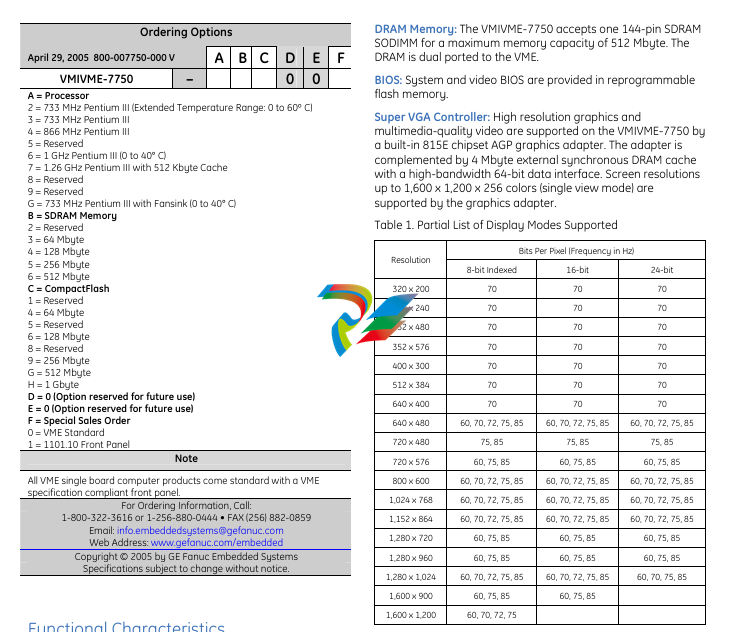
• Internal AGP SVGA controller with 4 Mbyte display cache
• Dual Etherne
• 133 MHz system bus via Intel® 815E chipset
t controllers supporting 10BaseT and 100BaseTX
• interfaces
• Remote Ethernet boo
ting
•
• PMC expansion site
Operating system support for Windows® XP, Wind
VxWorks®, Solaris™, QNX®, LynxOS®, and Linux®
ows 2000.
GE Fanuc Automation VMIVME-7750 Specifications
GE Fanuc Automation VMIVME-7750 Specifications
Intel® Pentium® III Processor
Based VME Single Board
Computer
Features:
• Up to 1.26 GHz Pentium® III processor with 512 Kbyte
advanced transfer cache
• Up to 512 Mbyte PC133 SDRAM using a single SODIMM
• Internal AGP SVGA controller with 4 Mbyte display cache
• Dual Etherne
• 133 MHz system bus via Intel® 815E chipset
t controllers supporting 10BaseT and 100BaseTX
• interfaces
• Remote Ethernet boo
ting
•
• PMC expansion site
Operating system support for Windows® XP, Wind
VxWorks®, Solaris™, QNX®, LynxOS®, and Linux®
ows 2000.
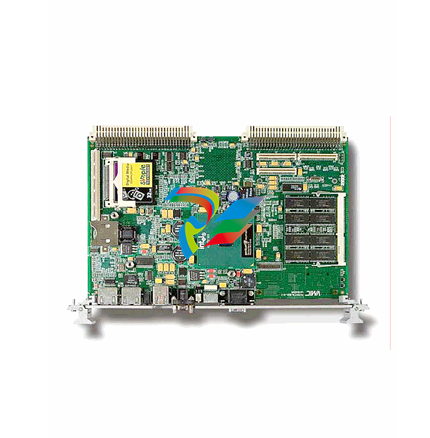
Functional Characteristics
Microprocessor: The VMIVME-7750 brings the Intel Pentium III
processor to VME, offering processor speeds up to 1.26 GHz. The
Pentium III processor has 32-bit addressing and a 64-bit data
bus. Its superscalar architecture allows three instructions to be
executed per clock cycle. A dynamic branch prediction unit,
separate instruction and data caches, and MMX™ technology
also increase the processor’s performance. The Pentium III
processor also provides 256 Kbyte (1.26 GHz has 512 Kbyte) of
advanced transfer cache (on-die, full speed level 2 cache) using
dual independent bus architecture for high bandwidth and
performance. This L2 cache operates at the same clock
frequency as the processor, thus improving performance
Ethernet Controller: The VMIVME-7750 supports Ethernet LANs
with two Intel Ethernet controllers (one 82559 and the other
internal to Intel’s chipset ICH2). 10BaseT and 100BaseTX options
are supported via two RJ45 connectors. Remote LAN booting is
supported.
Remote Ethernet Booting: The VMIVME-7750 utilizes Lanworks
Technologies, Inc.’s BootWare®. BootWare provides the ability to
remotely boot the VMIVME-7750 using NetWare, TCP/IP, or RPL
network protocols.
BootWare Features:
• NetWare, TCP/IP, RPL network protocol support
• Unparalleled boot sector virus protection
• Detailed boot configuration screens
• Comprehensive diagnostics
• Optional disabling of local boots
• Dual-boot option lets users select network or local booting
Serial Ports: Two 16550-compatible serial ports are featured on
the VMIVME-7750 front panel. The serial channel has a 16-b
FIFO to support baud rates up to 115 Kbaud. Requires two
micro-DB-9 to
standard DB-9 adapters, GE Fanuc P/N 360
010050-001.
Keyboard and Mouse Ports: The VMIVME-7750 has a comb
PS/2 keyb
oard and mouse connector. A Y-adapter cable is
included.
Flash Memory: The VMIVME-7750 provides up to 1 Gbyte of IDE
CompactFlash memory accessible through the secondary ID
port. The VMIVME-7750 BIOS includes a
board to boot from the Flash memory.
n option to allow the
Timers: The VMIVME-7750 provides the user with two 16-bit
timers and two 32-bit timers (in addition to system timers).
These timers are mapped i
software programmable.
n I/O space, and are completely
Watchdog Timer: The VMIVME-7750 provides a software
programmable watchdog timer. The watchdog timer is enabled
under software control. Once the watchdog timer is enabled,
software must access the timer within the specified timer period
or a timeout will occur. A user jumper allows the timeout to
cause a reset. Independent of the jumper, software can enable
the watchdog timeout to caus
e a nonmaskable interrupt (NMI)
or a VMEbus SYSFAIL.
Nonvolatile SRAM: The VMIVME-7750 provides 32 Kbyte of
nonvolatile SRAM. The contents of the SRAM are pres
+5V power is interrupted or removed from the unit.
PMC Expansion Site: The VMIVME-7750 supports IEEE P1386
common mezzanine card specification with a 5V PCI mezzanin
card (PMC) expansion site. The PMC site provides for standard
I/O out the VMEbus front panel. An optional I/
O connection to
the VMEbus P2 connection can be provided.
Contact GE Fanuc Embedded Systems for more informa
concerning PMC modules and compatibility.
Universal Serial Bus (USB): The VMIVME-7750 provides a front
panel dual connection hub host controller for the USB.
Supported USB features include: isochronous data transfers,
asynchronous messaging, self-identification an
of peripherals, and dynamic (hot) attachment.
d configuration
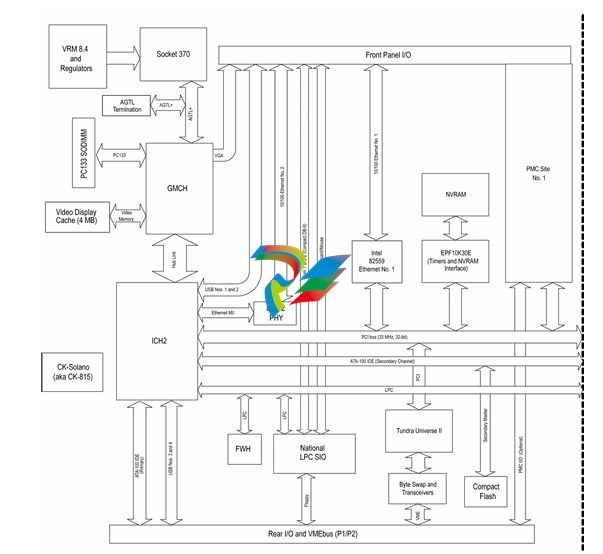
VMEbus Interface: The VMIVME-7750 VMEbus interface is based
on the Universe IIB hi
gh performance PCI-to-VME interface from
Newbridge/Tundra.
System Controller: The VMEbus system controller capabilities
allow the board to operate as a slot 1 controller, or it may be
disabled when another board is acting as the system contro
The system controller may be p
rogrammed to provide the
following modes of
Round Robin (RRS)
Single Level (S
GL)
Priority (PRI)
The system controller provides a SYSCLK driver, IACK* daisy
chain driver, and a VMEbus access timeout timer. The system
controller also provides an arbitration timeout if BBSY* is not
seen within a specified period after a BGOUT* signal is issued.
This period is programmable for 16 or 256 µs.
yte
ined
E
erved when
e
tion
ller.
VMEbus Requester: The microprocessor can request and gain
control of the bus using any of the VMEbus request lines (BR3*
to BR0*) under software control. The requester can be
programmed to operate in any of the following modes:
Release-On-Request (ROR)
Release-When-Done (RWD)
VMEbus Capture and Hold (BCAP)
Mailboxes: The VMEbus interface provides four 32-bit
mailboxes, which are accessible from both the microprocessor
and the VMEbus providing interprocessor communication. The
mailboxes have the ability to interrupt the microprocessor when
accessed by VMEbus.
Interrupt Handler: The interrupt handler monitors, and can be
programmed to respond to any or all VMEbus IRQ* lines. All
normal-process VMEbus-related interrupts can be mapped to
PCI INTA# or SERR# interrupts. These include:
Mailbox interrupts
VMEbus interrupts
VMEbus interrupter IACK cycle (acknowledgment of
VMIVME-7750 VMEbus-issued interrupts)
All error processing VMEbus-related interrupts can be mapped
to PCI INTA# or SERR#. Note: PCI SERR# initiates a SBC NMI.
These include:
ACFAIL* interrupt
BERR* interrupt
SYSFAIL* interrupt
The interrupt handler has a corresponding STATUS/ID register
for each IRQ* interrupt. Once the handler receives an IRQ*, it
requests the VMEbus and, once granted, it performs an IACK
cycle for that level. Once the IACK cycle is complete and the
STATUS/ID is stored in the corresponding ID register, an
appropriate interrupt status bit is set in an internal status
register, and a PCI interrupt is generated. The PCI interrupt can
be mapped to PCI INTA# or SERR#.
Interrupter: Interrupts can be issued under software control on
any or all of the seven VMEbus interrupt lines (IRQ7* to IRQ1*). A
common ID register is associated with all interrupt lines. During
the interrupt acknowledge cycle, the interrupter issues the ID to
the interrupt handler.
The interrupter can be programmed to generate a PCI INTA# or
SERR# interrupt when a VMEbus interrupt handler
acknowledges a software-generated VMEbus interrupt.
Byte Swapping: The Intel 80x86 family of processors use little
endian format. To accommodate other VMEbus modules that
transfer data in big-endian format such as the 680x0 processor
family, the VMIVME-7750 incorporates byte-swapping
hardware. This provides independent byte swapping for both
the master and slave interfaces. Both master and slave
interface byte swapping are under software control.
The VMIVME-7750 supports high throughput DMA transfers of
bytes, words, and longwords in both master and slave
configurations.
If endian conversion is not needed, we offer a special “bypass”
mode that can be used to further enhance throughput. (Not
available for byte transfers.)
Master Interface: MA32:MBLT32:MBLT64
(A32:A24:A16:D32:D16:D8 (EO):BLT32)
The VMEbus master interface provides nine separate memory
windows into VMEbus resources. Each window has separate
configuration registers for mapping PCI transfers to the VMEbus
(that is, PCI base address, window size, VMEbus base address,
VMEbus access type, VMEbus address/data size, etc.). The
maximum/minimum window sizes for the nine windows are as
follows:
Window
Minimum Size
0. 4
Maximum Size
4 Kbyte
1 to 3. 5 to 7
4 Gbyte
64 Kbyte
Special Cycle
4 Gbyte
64 Mbyte
64 Mbyte
Slave Interface: Memory Access
SAD032:SD32:SBLT32:SBLT64
(A32:A24:A16:D32:D16:D8 (EO): BLT32)
The VMEbus slave interface provides eight separate memory
windows into PCI resources. Each window has separate
configuration registers for mapping VMEbus transfers to the PCI
bus (that is, VMEbus base address, window size, PCI base
address, VMEbus access type, VMEbus address/data size, etc.).
The maximum/minimum window sizes for the eight windows
are as follows:
Window
Minimum Size
0. 4
Maximum Size
4 Kbyte
4 Gbyte
1 to 3. 5 to 7
64 Kbyte
4 Gbyte
In addition, each window can be programmed to operate in
coupled or decoupled mode. In decoupled mode, the window
utilizes a write-posting FIFO and/or a read prefetching FIFO for
increased system performance. In coupled mode, the FIFOs are
bypassed and VMEbus transactions are directly coupled to the
PCI bus (that is, transfers on VMEbus are not completed until
they are completed on the PCI bus).
Enhanced Bus Error Handling: Enhancements over the
Universe chip’s bus error handling features are provided. A latch
and register are provided to allow the SBC to read the VMEbus
address that caused the bus error in all modes. The Universe
chip’s support is limited to decoupled mode.
Support for bus cycle timeout and assertion of bus error is
provided. The board may be configured to assert bus error upon
timeout regardless of its status as system controller. The
Universe chip asserts bus error only if it is system controller. In
addition, this board may be configured to assert an interrupt
upon bus cycle timeout.
Operating System and Software Support
The VMIVME-7750 provides embedded features beyond PC/AT
functionality. These features are supported by GE Fanuc
Embedded Systems software products aimed at developers
who are incorporating GE Fanuc Embedded Systems SBCs, I/O
boards, and workstations into systems. Windows XP/Windows
2000 and VxWorks are the most common operating systems
supported by GE Fanuc Embedded Systems software products.
Windows XP/Windows 2000: The IOWorks® software family is a
set of software components that can work together or
separately to provide a total development environment for any
application in a Windows XP/ Windows 2000 OS.
VMISFT-9422 VMEbus Access™ for Windows XP/Windows
2000: The VMEbus Access product is specifically designed for
accessing the advanced VMEbus Access architecture of the
VMIVME-7750. Running on Windows XP/Windows 2000. VMEbus
Access is both sophisticated and easy to use.
The function library, VMEbus toolset and open architecture
VMEbus Access offers make it one of the most powerful
products on the market today. It provides compatibility with
existing GE Fanuc Embedded Systems VME PC platforms and
compatibility within the future VME PC platforms GE Fanuc
Embedded Systems creates.
The VMEbus Access development package gives you everything
you need to develop applications for your VME operations. This
package includes the VMEmanager™ function library and four
utilities that enable you to easily configure a VMEbus,
dynamically monitor VMEbus activities, manage VMEbus data,
and use DDE-client applications.
VMEbus Access provides powerful tools for developing,
debugging and monitoring VMEbus applications and increasing
VMEbus performance. The flexible design of VMEbus Access
enables you to incorporate it as a standalone solution or use it
to open your VMEbus operations to the IOWorks product suite.
VMEbus Access manipulates the hardware behind the scenes.
With VMEbus Access, you can develop applications in or use
existing applications developed in most programming
environments. For example, VMEbus Access enables your
VMEbus to recognize applications developed in these popular
programming environments:
• IOWorks Manager™
• LabVIEW
• Citect
• Wonderware InTouch
• Visual IOWorks®
•
• Visual Basic®
Visual C++®
VxWorks OS Support — VMISFT-7418 Board Support Package:
The VMISFT-7418 is a Wind River Systems, Inc.’s certified board
support package (BSP) for GE Fanuc Embedded Systems’ series
of VME Pentium processor-based computers, which is require
to run the VxWorks OS. With the SBC, VxWorks, the BSP, and
other VME equipment from GE Fanuc Embedded Syste
implementations can be created for a wide variety of
applications, including real time factory automation, sim
instrumentat
ms,
ulation,
ion and control, and process control and
ware
nuc
rts,
ards. The
g-endian and little-endian devices to
7xxx SBC boards without requiring any
ge:
ilitary
aris OS provides POSIX
ivers
s
ent based on industry-wide
rted I/O board and new
2 and -12VDC are specified with the
operating temperature is available for the following
C)
measured at outside of heatsink is to be
%, noncondensing
rfa
(3 to 0), ROR, RWD, BCAP
dle
r: , IRQ7* to IRQ1*
r:
le (4 to 1.024 µs)
signaling, types 1 and 2
TBF: 118.633 hours (Bellcore)
monitoring.
The BSP is linked with VxWorks OS, thus allowing soft
applications created with Wind River Systems, Inc.’s
development system to load and run on the particular GE Fa
Embedded Systems SBC hardware being used. Serial po
parallel ports, keyboard, text mode video, and Ethernet
transceivers are all supported, as well as floppy and IDE hard
disk drives that can be connected to the computer bo
BSP provides Flash boot, NVRAM and timer support.
The BSP allows VxWorks applications to have access to th
VMEbus. When hardware includes single cycle and block
transfers using DMA devices, they are supported by the BSP,
are interprocessor communications with mailbox registers.
VMEbus interrupt handling and error handling are supported
Since the VMEbus environment often contains a mixture of
devices from various manufacturers, the byte-swapping fea
is provided to allow bi
share data correctly.
QNX OS Support — VMISFT-7417 Board Support Package:
VMISFT-7417 BSP provides QNX support and includes a VMEb
manager, user API and configuration files needed to run the
QNX BSP on GE Fanuc Embedded Systems’ VMIVME-7xxx SBC
products. This BSP provides customizable VMEbus access. Usin
the QNX OS on the VMIVME-7xxx SBCs provides a computing
platform suitable for real time applications. QNX provides the
applications programmer with a real time extensible POSIX OS.
GE Fanuc Embedded Systems’ VMISFT-7417 is designed to tailo
QNX’s x86 OS to the VMIVME-7xxx platform. This combination
provides a self-hosted development environment which runs
entirely on the VMIVME
external host systems.
Solaris OS Support — VMISFT-7416 Board Support Packa
VMISFT-7416 BSP includes everything necessary to allow
installation of the Solaris Intel edition OS (available separately
from Sun Microsystems, Inc.) onto the VMIVME-7750 SBC. This
BSP includes a nexus driver for VMEbus access. It allows m
and telecommunications and other applications to take
advantage of Sun Microsystems, Inc.’s Solaris OS on a VME
based Intel SBC. This BSP and the Sol
compliant real time characteristics.
LynxOS x86 OS Support — VMISFT-7419 Board Support
Package: The VMISFT-7419 BSP includes all of the device dr
and configuration tables needed to install the LynxOS x86
development system (available separately from Lynx Real-Time
Systems, Inc.) onto GE Fanuc Embedded Systems VMIVME-7750.
Using the LynxOS on the GE Fanuc Embedded Systems SBC
provides a computing platform suitable for hard real time
applications. LynxOS provides the applications programmer
with a stable development environm
standards such as POSIX and Motif.
I/O Support — VMISFT-9450 IOWorks Board Drivers: This
driver supports GE Fanuc Embedded Systems’ extensive line o
VME I/O boards and is available for Windows XP/Windows 2000
and VxWorks. IOWorks board drivers take advantage of all the
key benefits and features of each suppo
I/O boards are constantly being added.
IOWorks board drivers contain both a C++ class library and a C
function library that provide a common interface to GE Fan
Embedded Systems I/O products for reading, writing and
configuring. You do not need to know the details of how an
individual board is programmed. For instance, you can use the
SetAttributes function on any supported GE Fanuc Embedded
Systems board; the WriteAnalog function controls the output
from any GE Fanuc Embedded Systems analog output board
the GetScanMode function retrieves the scan mode for any
GE Fanuc Embedded Systems analog board.
Physical/Environmental Specif
Dimensions: single slot Eurocard format
Height 9.2 in. (233.4mm)
Depth 6.3 in. (160mm)
Thickness 0.8 in. (20
Power Requirements:
+5VDC (±5 percent), 6A (typical), 7A maximum
+12VDC (±5 percent), 105mA (typical), 200mA maximu-12VDC (±5 percent), 50mA (typical), 75mA maximum
Note: The currents at +1
serial connectors open.
Operating Temperature: 0 to 50° C
Extended
options:
A=2 (733 MHz, 0 to 60° C)
A=9 (1.26 GHz, 0 to 55°
A=6 (1 GHz, 0 to 40° C)
(Air flow requirement as
greater than 350 LFM)
Storage Temperature: -25 to 80° C
Relative Humidity: 10% to 90
VMEbus Inte ce:
DTB Master: BLT32/BLT64. A32/D32. A24/D32. A16/D32
DTB Slave: BLT32/BLT64. A32/D32. A24/D32. A16/D32
Requester: Programmable, BR
Interrupt Han r: IH(1 to 7) D8(O)
Interrupte Programmable
Arbite SGL, PRI, RRS
BTO: Programmab
Compliance: Rev. C.1
PMC Expansion Site Connector: 5V
32-bit PCI bus, 33 MHz maximum
Compatible Products
The VMIVME-7750 can be used with a number of GE Fanuc
Embedded Systems PMC and VME products.
Floppy/Hard Disk: GE Fanuc Embedded Systems produces
floppy/hard drive modules to support the built-in IDE and floppy
controller ports.The VMIVME-7452 provides hard disk storage
and a 3.5-inch 1.44 Mbyte floppy drive. Contact Sales for
availability. The unit fits into a standard VME 6U single slot form
factor. The VMIACC-0562 converts P2 IDE/Floppy signals to 40-
and 34-pin headers for use at the rear of the VME backplane.
PMC Capability: GE Fanuc Embedded Systems supports PMC
via the PMC expansion sites. These expansion sites allows the
VMIVME-7750 to take advantage of the many commercially
available PMC boards available from third-party sources.
CD-ROM Support: Since much of today’s advanced software is
delivered on CD-ROM, the VMIVME-7455 provides CD-ROM
capability within a single 6U VME slot.
VME: The VMIVME-7750 enables access to GE Fanuc Embedded
Systems’ wealth of VME products. If you have real world control,
monitoring and real time networking requirements, GE Fanuc
Embedded Systems has a solution for you. Today’s system
requirements demand state of the art solutions. Our advanced
I/O features such as built-in-test, self-test, isolation, digital
autocalibration, and intelligent DSP processing give our
customers those solutions.
The I/O Solution for Your I/O Problem: GE Fanuc Embedded
Systems’ experience in supplying high performance
deterministic controllers for multiple markets has led to the
development of IOWorks software with features, benefits and
capabilities to solve nearly any I/O problem. From PLC
alternatives to data servers that support the seamless
interconnection of dissimilar systems, GE Fanuc Embedded
Systems has the solution for simple to complex, high speed,
deterministic requirements. IOWorks PC platforms, target, OS
and I/O independency provide the flexibility for solutions shown
in Figure 1.
Trademarks
MMX is a trademark and Intel and Pentium are registered
trademarks of Intel Corporation. Visual Basic, Visual C++, and
Windows are registered trademarks of Microsoft Corporation.
Other registered trademarks are the property of their respective
owners.
-
 CTI 2559-TC 8-Channel Thermocouple Input Module
 -
 CTI 2556-A 16-Channel Isolated Thermocouple Input Module
 -
 CTI 2556 16-Channel Isolated Thermocouple Input Module
 -
 CTI 2551-A 8-Channel Isolated Thermocouple Input Module
 -
 CTI 2559-RTD 8-Channel RTD Input Module
 -
 CTI 2557-A 16-Channel RTD Input Module
 -
 CTI 2557 16-Channel RTD Input Module
 -
 CTI 2552-A 8-Channel Isolated RTD Input Module
 -
 CTI 2534 8-Point Form-C Relay Output Module
 -
 CTI 2532 16-Point Form-A Relay Output Module
 -
 CTI 2531 32-Point Form-A Relay Output Module
 -
 CTI 2530 8-Point Form-C Relay Output Module
 -
 CTI 2562 8-Channel Analog Output Module
 -
 CTI 2560-A 8-Channel Isolated Analog Output Module
 -
 CTI 2501 8in/4out Analog Module
 -
 CTI 2558 8-Channel Analog Input Module
 -
 CTI 2555-A 16-Channel Analog Input Module
 -
 CTI 2550-A 8-Channel Isolated Analog Input Module
 -
 CTI 2599 8/16/32-Point AC Output Module
 -
 CTI 2598-8 8-Point AC Output Module
 -
 CTI 2598 8/16-Point AC Output Module
 -
 CTI 2597 8/16/32-Point DC Output Module
 -
 CTI 2596-8 8-Point DC Output Module
 -
 CTI 2596 8/16-Point DC Output Module
 -
 CTI 2595 16-Point TTL/Word Output Module
 -
 CTI 2591-EF 16-Point Isolated 11-146 VDC Output with Front Panel Accessible Fuses
 -
 CTI 2591-A 16-Point Isolated 11-146 VDC Output Module
 -
 CTI 2590-EF 16-Point Isolated 20-132 VAC Output with Front Panel Accessible Fuses
 -
 CTI 2590-A 16-Point Isolated Discrete 20-132 VAC Output Module
 -
 CTI 2589-B 8/16/32-Point Universal Discrete Input Module
 -
 CTI 2589-A 8/16/32-Point Universal Discrete Input Module
 -
 CTI 2588-8 8-Point Universal Discrete Input Module
 -
 CTI 2585 16-Point TTL/Word Input Module
 -
 CTI 2582 16-Point Isolated 125 VDC Input Module
 -
 CTI 2581 16-Point Isolated 12-56 VDC Input Module
 -
 CTI 2580 16-Point Isolated 95-132 VAC Input Module
 -
 CTI 2500-TAP RS485 Network Tap
 -
 CTI 2500-RIO-B RS485 Remote Base Controller
 -
 CTI 2500-RIO-A RS485 Remote Base Controller
 -
 CTI 2500-RBC Profibus Remote Base Controller
 -
 CTI 2515-A 100-Watt AC/DC Power Supply with Redundancy Support
 -
 CTI 2515 100-Watt AC Power Supply (MATURE - replaced by 2515-A)
 -
 CTI 2513-A 75-Watt DC Power Supply with Redundancy Support
 -
 CTI 2513 75-Watt 24VDC Power Supply
 -
 CTI 2512-A 75-Watt AC/DC Power Supply with Redundancy Support
 -
 CTI 2512 75-Watt AC/DC Power Supply
 -
 CTI 2510 125 VDC Power Supply
 -
 CTI 2500-SSB Single Slot Blank Front Panel
 -
 CTI 2500-R11-A Eleven-Slot Redundant Base
 -
 CTI 2500P-R16 Sixteen-Slot Base with High-Speed Channel
 -
 CTI 2500P-R8 Eight-Slot Base with High-Speed Channel
 -
 CTI 2500P-R4 Four-Slot Base with High-Speed Channel
 -
 CTI 2541 Redundant Processor Manager Module
 -
 CTI 2577 Profibus DP Slave Adapter
 -
 CTI 2573-MOD Serial Interface Adapter with MODBUS
 -
 CTI 2572-AF Fast Ethernet TCP/IP Adapter with Optical Fiber Connection
 -
 CTI 2572-A Fast Ethernet TCP/IP Adapter
 -
 CTI 2572 Ethernet TCP/IP Adapter
 -
 CTI 2572-B Fast Ethernet TCP/IP Adapter
 -
 CTI 2576 DeviceNet™ Scanner Module (MATURE)
 -
 CTI 2500P-ECC1 Ethernet Communications Coprocessor
 -
 CTI 2500P-JACP Janus Application Coprocessor
 -
 CTI 2500P-ACP1 Application Coprocessor (MATURE - replaced by 2500P-JACP)
 -
 CTI 2500P-J450 Janus PAC with 2MB Project Memory
 -
 CTI 2500-C400 CPU with 3072K User Memory
 -
 CTI 2500-C300 CPU with 512K User Memory
 -
 CTI 2500-C200 CPU with 256K User Memory
 -
 CTI 2500-C100 CPU with 128K User Memory
 -
 CTI 2500P-J750 Janus PAC with 3MB Project Memory
 -
 Shinkawa WHF3006M Displacement Converter
 -
Shinkawa JBP-220 (P-24-94A / P-24-94B) Circuit Board Module
-
 SHINKAWA WKN-142K5 2-WIRE VIBRATION TRANSDUCER
 -
Shinkawa FRP-321 (P-26-54A / P-26-54B) Circuit Board Module
-
 Shinkawa IOP-160 (P-25-72A / P-25-72B) Circuit Board Module
 -
 Shinkawa PK-147B-1 / PK-147A-1 Circuit Board Module
 -
 Shinkawa CPP-91A Circuit Board Module
 -
 Shinkawa FRP-177 PCB Module
 -
 Shinkawa CPP-127 (P-26-74A / P-26-74B) Circuit Board Module
 -
Shinkawa FRP-227 (P-24-86A / P-24-86B) Circuit Board Module
-
 Shinkawa MDP-104 (P-25-83A / P-25-83B) Circuit Board Controller
 -
 Shinkawa VK-143P2 High-precision eddy current sensor driver/signal conditioner
 -
 Shinkawa FRP-226 (P-24-86A / P-24-86B) Circuit Board Module
 -
Shinkawa CPP-107A P-22-99A P-22-99B Circuit Board Module
-
 SHINKAWA VW-202AL-8 Axial Displacement Sensor
 -
Shinkawa VL-202A08L-1A42 Vibration Sensor Transducer Probe
-
Shinkawa VL-202A08L-1A42 Vibration Sensor Transducer Probe
-
 Shinkawa FRP-209A & FRP-206 Wire Bonder Circuit Board Module
 -
 Shinkawa MGP-72 MGP72 P-26-50A P-26-50B Circuit Board Module
 -
 Shinkawa FRP-249 P-25-1A P-25-1B Circuit Board Module
 -
Shinkawa FRP-320 P-26-54A P-26-54B Circuit Board Module
-
Shinkawa FRP-282 P-24-35A P-24-35B Circuit Board Module
-
 Shinkawa FRP-338 P-26-54A P-26-54B Circuit Board Module
 -
 GE IS200AEPBH1B IS200AEPBH1B‑REV‑AA Pitch-Charger Control PCB Board
 -
 GE IS200EDEXG1ADA EX2100 SCR Trigger Control Board
 -
 GE 151X1207CK01SA01 IS200EDEXG1A EX2100 SCR
 -
 GE 151X1233DD02SA02 IS200AEPBH1B - Variant for pitch control charger assembly
 -
 GE 151X1233DB01SA01 IS200AEPBH1B - 10kW Wind Power Converter
 -
 GE 151X1233DB01SA01R | IS200AEPBH1B 10KW Converter
 -
GE 151X1233DD01SA02 Pitch Battery Charger (109W6931P001)
-
GE 151X1233DD01SA02 Pitch Battery Charger Assy IS200AEPBH1B
-
 GE 151X1233DB02SA02 Rev A IS200AEPBH1B Wind Turbine Converter
 -
 GE 151X1207CK02SA02 SCR 4400 V 1850 A IS200EDEXG1ADA General Electric EX2100
 -
 Triconex 3723X 32-Channel TMR Analog Input Module with HART
 -
 SHINKAWA VM-21G SIGNAL CONDITIONER SOCKET
 -
SHINKAWA VM-21R REVOLUTION SIGNAL CONDITIONER
-
SHINKAWA VM-21T DISPLACEMENT INPUT THRUST SIGNAL CONDITIONER
-
SHINKAWA VM-21D 6-WIRE LVDT SIGNAL CONDITIONER
-
 SHINKAWA VM-21P 3-WIRE LVDT SIGNAL CONDITIONER
 -
SHINKAWA VM-21A VIBRATION SIGNAL CONDITIONER
-
SHINKAWA VM-21K DISPLACEMENT INPUT VIBRATION SIGNAL CONDITIONER
-
 SHINKAWA VM-25S01 CONDITION MONITORING SYSTEM
 -
SHINKAWA VM-25 CONDITION MONITORING SYSTEM
-
SHINKAWA VM-772B DEVICE CONFIG
-
SHINKAWA VM-771B MCL VIEW
-
 SHINKAWA VM-76B INSTRUMENT RACK
 -
SHINKAWA VM-75B POWER SUPPLY MODULE
-
 SHINKAWA VM-742B NETWORK COMMUNICATION MODULE
 -
 SHINKAWA VM-741B LOCAL COMMUNICATION & PHASE MARKER MODULE
 -
SHINKAWA VM-722B 9-CHANNEL RELAY MODULE
-
SHINKAWA VM-707B AERODERIVATIVE GAS TURBINE MONITOR MODULE
-
 SHINKAWA VM-706B ROD DROP MONITOR MODULE
 -
 SHINKAWA VM-705B 18-CHANNEL TEMPERATURE MONITOR MODULE
 -
SHINKAWA VM-704B TEMPERATURE MONITOR MODULE
-
 SHINKAWA VM-702B ABSOLUTE VIBRATION MONITOR MODULE
 -
SHINKAWA VM-701B VIBRATION / DISPLACEMENT MONITOR MODULE
-
 SHINKAWA MODEL VM-5X INTERFACE UNIT
 -
 SHINKAWA MODEL VM-5W2 DUAL POWER SUPPLY INSTRUMENT RACK
 -
 SHINKAWA MODEL VM-5H4 INSTRUMENT RACK (for VM-5Z5.6.7)