GE Fanuc Automation VMIVME-7750 Specifications
Based VME Single Board
Computer
Features:
• Up to 1.26 GHz Pentium® III processor with 512 Kbyte
advanced transfer cache
• Up to 512 Mbyte PC133 SDRAM using a single SODIMM
• Internal AGP SVGA controller with 4 Mbyte display cache
• Dual Etherne
• 133 MHz system bus via Intel® 815E chipset
t controllers supporting 10BaseT and 100BaseTX
• interfaces
• Remote Ethernet boo
ting
•
• PMC expansion site
Operating system support for Windows® XP, Wind
VxWorks®, Solaris™, QNX®, LynxOS®, and Linux®
ows 2000.
GE Fanuc Automation VMIVME-7750 Specifications
GE Fanuc Automation VMIVME-7750 Specifications
Intel® Pentium® III Processor
Based VME Single Board
Computer
Features:
• Up to 1.26 GHz Pentium® III processor with 512 Kbyte
advanced transfer cache
• Up to 512 Mbyte PC133 SDRAM using a single SODIMM
• Internal AGP SVGA controller with 4 Mbyte display cache
• Dual Etherne
• 133 MHz system bus via Intel® 815E chipset
t controllers supporting 10BaseT and 100BaseTX
• interfaces
• Remote Ethernet boo
ting
•
• PMC expansion site
Operating system support for Windows® XP, Wind
VxWorks®, Solaris™, QNX®, LynxOS®, and Linux®
ows 2000.
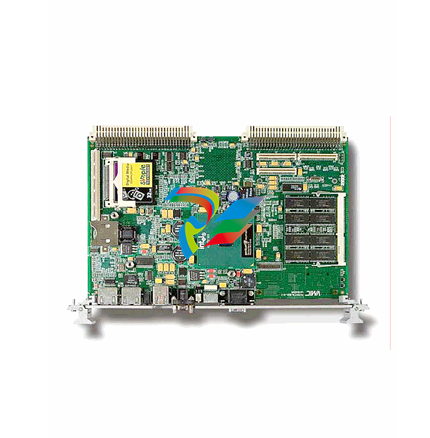
Functional Characteristics
Microprocessor: The VMIVME-7750 brings the Intel Pentium III
processor to VME, offering processor speeds up to 1.26 GHz. The
Pentium III processor has 32-bit addressing and a 64-bit data
bus. Its superscalar architecture allows three instructions to be
executed per clock cycle. A dynamic branch prediction unit,
separate instruction and data caches, and MMX™ technology
also increase the processor’s performance. The Pentium III
processor also provides 256 Kbyte (1.26 GHz has 512 Kbyte) of
advanced transfer cache (on-die, full speed level 2 cache) using
dual independent bus architecture for high bandwidth and
performance. This L2 cache operates at the same clock
frequency as the processor, thus improving performance
Ethernet Controller: The VMIVME-7750 supports Ethernet LANs
with two Intel Ethernet controllers (one 82559 and the other
internal to Intel’s chipset ICH2). 10BaseT and 100BaseTX options
are supported via two RJ45 connectors. Remote LAN booting is
supported.
Remote Ethernet Booting: The VMIVME-7750 utilizes Lanworks
Technologies, Inc.’s BootWare®. BootWare provides the ability to
remotely boot the VMIVME-7750 using NetWare, TCP/IP, or RPL
network protocols.
BootWare Features:
• NetWare, TCP/IP, RPL network protocol support
• Unparalleled boot sector virus protection
• Detailed boot configuration screens
• Comprehensive diagnostics
• Optional disabling of local boots
• Dual-boot option lets users select network or local booting
Serial Ports: Two 16550-compatible serial ports are featured on
the VMIVME-7750 front panel. The serial channel has a 16-b
FIFO to support baud rates up to 115 Kbaud. Requires two
micro-DB-9 to
standard DB-9 adapters, GE Fanuc P/N 360
010050-001.
Keyboard and Mouse Ports: The VMIVME-7750 has a comb
PS/2 keyb
oard and mouse connector. A Y-adapter cable is
included.
Flash Memory: The VMIVME-7750 provides up to 1 Gbyte of IDE
CompactFlash memory accessible through the secondary ID
port. The VMIVME-7750 BIOS includes a
board to boot from the Flash memory.
n option to allow the
Timers: The VMIVME-7750 provides the user with two 16-bit
timers and two 32-bit timers (in addition to system timers).
These timers are mapped i
software programmable.
n I/O space, and are completely
Watchdog Timer: The VMIVME-7750 provides a software
programmable watchdog timer. The watchdog timer is enabled
under software control. Once the watchdog timer is enabled,
software must access the timer within the specified timer period
or a timeout will occur. A user jumper allows the timeout to
cause a reset. Independent of the jumper, software can enable
the watchdog timeout to caus
e a nonmaskable interrupt (NMI)
or a VMEbus SYSFAIL.
Nonvolatile SRAM: The VMIVME-7750 provides 32 Kbyte of
nonvolatile SRAM. The contents of the SRAM are pres
+5V power is interrupted or removed from the unit.
PMC Expansion Site: The VMIVME-7750 supports IEEE P1386
common mezzanine card specification with a 5V PCI mezzanin
card (PMC) expansion site. The PMC site provides for standard
I/O out the VMEbus front panel. An optional I/
O connection to
the VMEbus P2 connection can be provided.
Contact GE Fanuc Embedded Systems for more informa
concerning PMC modules and compatibility.
Universal Serial Bus (USB): The VMIVME-7750 provides a front
panel dual connection hub host controller for the USB.
Supported USB features include: isochronous data transfers,
asynchronous messaging, self-identification an
of peripherals, and dynamic (hot) attachment.
d configuration
VMEbus Interface: The VMIVME-7750 VMEbus interface is based
on the Universe IIB hi
gh performance PCI-to-VME interface from
Newbridge/Tundra.
System Controller: The VMEbus system controller capabilities
allow the board to operate as a slot 1 controller, or it may be
disabled when another board is acting as the system contro
The system controller may be p
rogrammed to provide the
following modes of
Round Robin (RRS)
Single Level (S
GL)
Priority (PRI)
The system controller provides a SYSCLK driver, IACK* daisy
chain driver, and a VMEbus access timeout timer. The system
controller also provides an arbitration timeout if BBSY* is not
seen within a specified period after a BGOUT* signal is issued.
This period is programmable for 16 or 256 µs.
yte
ined
E
erved when
e
tion
ller.
VMEbus Requester: The microprocessor can request and gain
control of the bus using any of the VMEbus request lines (BR3*
to BR0*) under software control. The requester can be
programmed to operate in any of the following modes:
Release-On-Request (ROR)
Release-When-Done (RWD)
VMEbus Capture and Hold (BCAP)
-
 CTI 2559-TC 8-Channel Thermocouple Input Module
 -
 CTI 2556-A 16-Channel Isolated Thermocouple Input Module
 -
 CTI 2556 16-Channel Isolated Thermocouple Input Module
 -
 CTI 2551-A 8-Channel Isolated Thermocouple Input Module
 -
 CTI 2559-RTD 8-Channel RTD Input Module
 -
 CTI 2557-A 16-Channel RTD Input Module
 -
 CTI 2557 16-Channel RTD Input Module
 -
 CTI 2552-A 8-Channel Isolated RTD Input Module
 -
 CTI 2534 8-Point Form-C Relay Output Module
 -
 CTI 2532 16-Point Form-A Relay Output Module
 -
 CTI 2531 32-Point Form-A Relay Output Module
 -
 CTI 2530 8-Point Form-C Relay Output Module
 -
 CTI 2562 8-Channel Analog Output Module
 -
 CTI 2560-A 8-Channel Isolated Analog Output Module
 -
 CTI 2501 8in/4out Analog Module
 -
 CTI 2558 8-Channel Analog Input Module
 -
 CTI 2555-A 16-Channel Analog Input Module
 -
 CTI 2550-A 8-Channel Isolated Analog Input Module
 -
 CTI 2599 8/16/32-Point AC Output Module
 -
 CTI 2598-8 8-Point AC Output Module
 -
 CTI 2598 8/16-Point AC Output Module
 -
 CTI 2597 8/16/32-Point DC Output Module
 -
 CTI 2596-8 8-Point DC Output Module
 -
 CTI 2596 8/16-Point DC Output Module
 -
 CTI 2595 16-Point TTL/Word Output Module
 -
 CTI 2591-EF 16-Point Isolated 11-146 VDC Output with Front Panel Accessible Fuses
 -
 CTI 2591-A 16-Point Isolated 11-146 VDC Output Module
 -
 CTI 2590-EF 16-Point Isolated 20-132 VAC Output with Front Panel Accessible Fuses
 -
 CTI 2590-A 16-Point Isolated Discrete 20-132 VAC Output Module
 -
 CTI 2589-B 8/16/32-Point Universal Discrete Input Module
 -
 CTI 2589-A 8/16/32-Point Universal Discrete Input Module
 -
 CTI 2588-8 8-Point Universal Discrete Input Module
 -
 CTI 2585 16-Point TTL/Word Input Module
 -
 CTI 2582 16-Point Isolated 125 VDC Input Module
 -
 CTI 2581 16-Point Isolated 12-56 VDC Input Module
 -
 CTI 2580 16-Point Isolated 95-132 VAC Input Module
 -
 CTI 2500-TAP RS485 Network Tap
 -
 CTI 2500-RIO-B RS485 Remote Base Controller
 -
 CTI 2500-RIO-A RS485 Remote Base Controller
 -
 CTI 2500-RBC Profibus Remote Base Controller
 -
 CTI 2515-A 100-Watt AC/DC Power Supply with Redundancy Support
 -
 CTI 2515 100-Watt AC Power Supply (MATURE - replaced by 2515-A)
 -
 CTI 2513-A 75-Watt DC Power Supply with Redundancy Support
 -
 CTI 2513 75-Watt 24VDC Power Supply
 -
 CTI 2512-A 75-Watt AC/DC Power Supply with Redundancy Support
 -
 CTI 2512 75-Watt AC/DC Power Supply
 -
 CTI 2510 125 VDC Power Supply
 -
 CTI 2500-SSB Single Slot Blank Front Panel
 -
 CTI 2500-R11-A Eleven-Slot Redundant Base
 -
 CTI 2500P-R16 Sixteen-Slot Base with High-Speed Channel
 -
 CTI 2500P-R8 Eight-Slot Base with High-Speed Channel
 -
 CTI 2500P-R4 Four-Slot Base with High-Speed Channel
 -
 CTI 2541 Redundant Processor Manager Module
 -
 CTI 2577 Profibus DP Slave Adapter
 -
 CTI 2573-MOD Serial Interface Adapter with MODBUS
 -
 CTI 2572-AF Fast Ethernet TCP/IP Adapter with Optical Fiber Connection
 -
 CTI 2572-A Fast Ethernet TCP/IP Adapter
 -
 CTI 2572 Ethernet TCP/IP Adapter
 -
 CTI 2572-B Fast Ethernet TCP/IP Adapter
 -
 CTI 2576 DeviceNet™ Scanner Module (MATURE)
 -
 CTI 2500P-ECC1 Ethernet Communications Coprocessor
 -
 CTI 2500P-JACP Janus Application Coprocessor
 -
 CTI 2500P-ACP1 Application Coprocessor (MATURE - replaced by 2500P-JACP)
 -
 CTI 2500P-J450 Janus PAC with 2MB Project Memory
 -
 CTI 2500-C400 CPU with 3072K User Memory
 -
 CTI 2500-C300 CPU with 512K User Memory
 -
 CTI 2500-C200 CPU with 256K User Memory
 -
 CTI 2500-C100 CPU with 128K User Memory
 -
 CTI 2500P-J750 Janus PAC with 3MB Project Memory
 -
 Shinkawa WHF3006M Displacement Converter
 -
Shinkawa JBP-220 (P-24-94A / P-24-94B) Circuit Board Module
-
 SHINKAWA WKN-142K5 2-WIRE VIBRATION TRANSDUCER
 -
Shinkawa FRP-321 (P-26-54A / P-26-54B) Circuit Board Module
-
 Shinkawa IOP-160 (P-25-72A / P-25-72B) Circuit Board Module
 -
 Shinkawa PK-147B-1 / PK-147A-1 Circuit Board Module
 -
 Shinkawa CPP-91A Circuit Board Module
 -
 Shinkawa FRP-177 PCB Module
 -
 Shinkawa CPP-127 (P-26-74A / P-26-74B) Circuit Board Module
 -
Shinkawa FRP-227 (P-24-86A / P-24-86B) Circuit Board Module
-
 Shinkawa MDP-104 (P-25-83A / P-25-83B) Circuit Board Controller
 -
 Shinkawa VK-143P2 High-precision eddy current sensor driver/signal conditioner
 -
 Shinkawa FRP-226 (P-24-86A / P-24-86B) Circuit Board Module
 -
Shinkawa CPP-107A P-22-99A P-22-99B Circuit Board Module
-
 SHINKAWA VW-202AL-8 Axial Displacement Sensor
 -
Shinkawa VL-202A08L-1A42 Vibration Sensor Transducer Probe
-
Shinkawa VL-202A08L-1A42 Vibration Sensor Transducer Probe
-
 Shinkawa FRP-209A & FRP-206 Wire Bonder Circuit Board Module
 -
 Shinkawa MGP-72 MGP72 P-26-50A P-26-50B Circuit Board Module
 -
 Shinkawa FRP-249 P-25-1A P-25-1B Circuit Board Module
 -
Shinkawa FRP-320 P-26-54A P-26-54B Circuit Board Module
-
Shinkawa FRP-282 P-24-35A P-24-35B Circuit Board Module
-
 Shinkawa FRP-338 P-26-54A P-26-54B Circuit Board Module
 -
 GE IS200AEPBH1B IS200AEPBH1B‑REV‑AA Pitch-Charger Control PCB Board
 -
 GE IS200EDEXG1ADA EX2100 SCR Trigger Control Board
 -
 GE 151X1207CK01SA01 IS200EDEXG1A EX2100 SCR
 -
 GE 151X1233DD02SA02 IS200AEPBH1B - Variant for pitch control charger assembly
 -
 GE 151X1233DB01SA01 IS200AEPBH1B - 10kW Wind Power Converter
 -
 GE 151X1233DB01SA01R | IS200AEPBH1B 10KW Converter
 -
GE 151X1233DD01SA02 Pitch Battery Charger (109W6931P001)
-
GE 151X1233DD01SA02 Pitch Battery Charger Assy IS200AEPBH1B
-
 GE 151X1233DB02SA02 Rev A IS200AEPBH1B Wind Turbine Converter
 -
 GE 151X1207CK02SA02 SCR 4400 V 1850 A IS200EDEXG1ADA General Electric EX2100
 -
 Triconex 3723X 32-Channel TMR Analog Input Module with HART
 -
 SHINKAWA VM-21G SIGNAL CONDITIONER SOCKET
 -
SHINKAWA VM-21R REVOLUTION SIGNAL CONDITIONER
-
SHINKAWA VM-21T DISPLACEMENT INPUT THRUST SIGNAL CONDITIONER
-
SHINKAWA VM-21D 6-WIRE LVDT SIGNAL CONDITIONER
-
 SHINKAWA VM-21P 3-WIRE LVDT SIGNAL CONDITIONER
 -
SHINKAWA VM-21A VIBRATION SIGNAL CONDITIONER
-
SHINKAWA VM-21K DISPLACEMENT INPUT VIBRATION SIGNAL CONDITIONER
-
 SHINKAWA VM-25S01 CONDITION MONITORING SYSTEM
 -
SHINKAWA VM-25 CONDITION MONITORING SYSTEM
-
SHINKAWA VM-772B DEVICE CONFIG
-
SHINKAWA VM-771B MCL VIEW
-
 SHINKAWA VM-76B INSTRUMENT RACK
 -
SHINKAWA VM-75B POWER SUPPLY MODULE
-
 SHINKAWA VM-742B NETWORK COMMUNICATION MODULE
 -
 SHINKAWA VM-741B LOCAL COMMUNICATION & PHASE MARKER MODULE
 -
SHINKAWA VM-722B 9-CHANNEL RELAY MODULE
-
SHINKAWA VM-707B AERODERIVATIVE GAS TURBINE MONITOR MODULE
-
 SHINKAWA VM-706B ROD DROP MONITOR MODULE
 -
 SHINKAWA VM-705B 18-CHANNEL TEMPERATURE MONITOR MODULE
 -
SHINKAWA VM-704B TEMPERATURE MONITOR MODULE
-
 SHINKAWA VM-702B ABSOLUTE VIBRATION MONITOR MODULE
 -
SHINKAWA VM-701B VIBRATION / DISPLACEMENT MONITOR MODULE
-
 SHINKAWA MODEL VM-5X INTERFACE UNIT
 -
 SHINKAWA MODEL VM-5W2 DUAL POWER SUPPLY INSTRUMENT RACK
 -
 SHINKAWA MODEL VM-5H4 INSTRUMENT RACK (for VM-5Z5.6.7)