FOXBORO Z-Module Control Processor 270 (ZCP270)
Fiber cables are connected so that splitter/combiners
pass inbound traffic from a switch to both modules,
and pass outbound traffic from the primary module
to a switch.
Each splitter/combiner pair mounts in an assembly
that either mounts in a chassis assembly for 19-inch
racks or fastens to the DIN rail in the enclosure. The
splitter/combiner is a passive device that does not
require electrical power.
ENHANCED COMMUNICATIONS
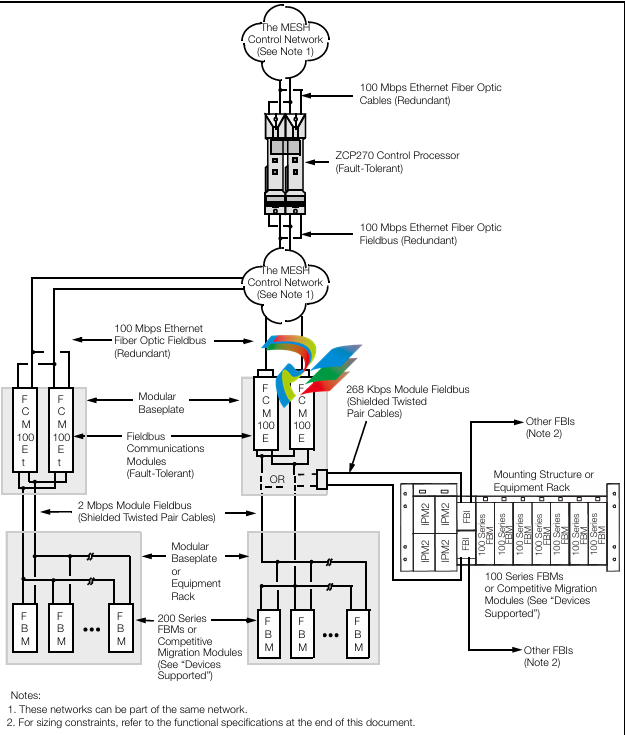
The Foxboro Evo architecture uses an Ethernet
control network with 100 Mbps data
communications between the ZCP270s and the
Ethernet switches (see Figure 2).
The ZCP270 can also communicate with serial and
Ethernet devices, such as PLCs, via Field Device
System Integrators and FCM100Ets/FCM100Es. This
allows connection to new device interfaces without
any changes to the controller software.
ON-LINE IMAGE UPDATE
For fault-tolerant ZCP270 modules, on-line image
update replaces the executable image (operating
system) of a running ZCP270 with a newer image
without having to shut down the equipment being
controlled by the ZCP270. New product
enhancements can be brought on-line in
1.5 seconds for heavily loaded controllers; less for
lightly loaded controllers.
Because the ZCP270 contains its executable image
in internal flash memory, and has sufficient RAM to
hold a new executable image at the same time, on
line image updates are now much easier to perform.
TIME SYNCHRONIZATION, SOE, TDRA
The Foxboro Evo system supports time
synchronization using either an externally maintained
optional source of Universal Coordinated Time (UTC)
from GPS satellites or an internal source using
proprietary software. ZCP270s and their FCM100Ets
receiving time updates via the external time source
synchronize their FBMs to 1 ms. For more
information, refer to PSS 21S-1C2 B3.
Time stamping is used for alarm messages, values
sent to the historian, and the new Sequence Of
Events (SOE) and Transient Data Recorder and
Analyzer (TDRA) features.
SOE data are discrete points that are time stamped
at the FBM, optionally to 1 ms, and sent to the
workstation on a change basis. TDRA data are
analog points that are time stamped at the FBM and
sent to the workstation every 10 ms. These new
features are supported by client software in the
workstation. To support SOE and TDRA, the
FCM100Et must be installed on the same network as
the workstation collecting the data. For information
on this software, refer to PSS 21S-2B9 B4 and
PSS 21S-2B10 B4
SOFTWARE FEATURES
The ZCP270 performs regulatory, logic, timing, and
sequential control, as well as data acquisition, alarm
detection, and alarm notification. Process variables
are controlled using time-proven algorithms
(mathematical computations performing specific
functions). The algorithms are contained in functional
control blocks, which are configured by on-site
process engineers to implement the desired control
strategies. The versatility of the algorithms, coupled
with the variety of FBMs available, provides control
capabilities suited to a broad range of process
applications. Control strategies ranging from simple
feedback and cascade loops to highly sophisticated
feedforward, nonlinear, and complex characterization
control schemes are readily implemented.
The ZCP270 also provides the following features:
Infrared communications with the controller
enables you to set and read the controller
letterbug via the Letterbug Configurator.
Alarm enhancements to the function blocks:
re-alarming on changes to alarm priority,
re-alarming based upon a configurable time delay
deadband, and alarm suppression based upon
time.
Optional UTC external time synchronization.
Improved controller performance.
Optional self-hosting mode (I/A Series software
v8.4-v8.8 or Control Core Services v9.0 or later)
allows the ZCP270 to start up and run, executing
its configured control scheme using the
checkpoint file stored in flash memory. This
allows the ZCP270 to boot itself with a valid
control database even if its host workstation is
not present.
Self-Hosting Feature, Available with 200 Series
FBMs Only
The self-hosting feature is recommended only for use
in ZCP270s which are used with 200 Series FBMs.
All of the information necessary to reboot 200 Series
FBMs is included in non-volatile flash memory on the
ZCP270. However, the flash memory on the
100 Series FBMs and related products on the 268k
fieldbus does not include this information, and they
require the workstation host to be present to reboot.
More details on the self-hosting feature are available
in DIN Rail Mounted FBM Subsystem User’s Guide
(B0400FA).
DEVICES SUPPORTED
The ZCP270 with FCM100Ets supports the following
devices:
All 200 series FBMs (FBM201. FBM202. and so
forth)
Field Device Systems Integrator (FDSI) modules
Intrinsically Safe I/O Subsystem (ISCM)
DCS Fieldbus Modules for Siemens APACS+™
Systems
DCS Fieldbus Modules for Westinghouse
WDPF® Systems.
DCS Fieldbus Modules for Fisher's PROVOX®
Series 20 Migration with HART.
DCS Fieldbus Modules for Honeywell® TDC
2000 Systems with HART.
The ZCP270 with FCM100Es supports the following
devices on the 2 Mbps module Fieldbus:
All 200 Series FBMs (FBM201. FBM202. and so
forth) - both Compact or standard types
-
 CTI 2559-TC 8-Channel Thermocouple Input Module
 -
 CTI 2556-A 16-Channel Isolated Thermocouple Input Module
 -
 CTI 2556 16-Channel Isolated Thermocouple Input Module
 -
 CTI 2551-A 8-Channel Isolated Thermocouple Input Module
 -
 CTI 2559-RTD 8-Channel RTD Input Module
 -
 CTI 2557-A 16-Channel RTD Input Module
 -
 CTI 2557 16-Channel RTD Input Module
 -
 CTI 2552-A 8-Channel Isolated RTD Input Module
 -
 CTI 2534 8-Point Form-C Relay Output Module
 -
 CTI 2532 16-Point Form-A Relay Output Module
 -
 CTI 2531 32-Point Form-A Relay Output Module
 -
 CTI 2530 8-Point Form-C Relay Output Module
 -
 CTI 2562 8-Channel Analog Output Module
 -
 CTI 2560-A 8-Channel Isolated Analog Output Module
 -
 CTI 2501 8in/4out Analog Module
 -
 CTI 2558 8-Channel Analog Input Module
 -
 CTI 2555-A 16-Channel Analog Input Module
 -
 CTI 2550-A 8-Channel Isolated Analog Input Module
 -
 CTI 2599 8/16/32-Point AC Output Module
 -
 CTI 2598-8 8-Point AC Output Module
 -
 CTI 2598 8/16-Point AC Output Module
 -
 CTI 2597 8/16/32-Point DC Output Module
 -
 CTI 2596-8 8-Point DC Output Module
 -
 CTI 2596 8/16-Point DC Output Module
 -
 CTI 2595 16-Point TTL/Word Output Module
 -
 CTI 2591-EF 16-Point Isolated 11-146 VDC Output with Front Panel Accessible Fuses
 -
 CTI 2591-A 16-Point Isolated 11-146 VDC Output Module
 -
 CTI 2590-EF 16-Point Isolated 20-132 VAC Output with Front Panel Accessible Fuses
 -
 CTI 2590-A 16-Point Isolated Discrete 20-132 VAC Output Module
 -
 CTI 2589-B 8/16/32-Point Universal Discrete Input Module
 -
 CTI 2589-A 8/16/32-Point Universal Discrete Input Module
 -
 CTI 2588-8 8-Point Universal Discrete Input Module
 -
 CTI 2585 16-Point TTL/Word Input Module
 -
 CTI 2582 16-Point Isolated 125 VDC Input Module
 -
 CTI 2581 16-Point Isolated 12-56 VDC Input Module
 -
 CTI 2580 16-Point Isolated 95-132 VAC Input Module
 -
 CTI 2500-TAP RS485 Network Tap
 -
 CTI 2500-RIO-B RS485 Remote Base Controller
 -
 CTI 2500-RIO-A RS485 Remote Base Controller
 -
 CTI 2500-RBC Profibus Remote Base Controller
 -
 CTI 2515-A 100-Watt AC/DC Power Supply with Redundancy Support
 -
 CTI 2515 100-Watt AC Power Supply (MATURE - replaced by 2515-A)
 -
 CTI 2513-A 75-Watt DC Power Supply with Redundancy Support
 -
 CTI 2513 75-Watt 24VDC Power Supply
 -
 CTI 2512-A 75-Watt AC/DC Power Supply with Redundancy Support
 -
 CTI 2512 75-Watt AC/DC Power Supply
 -
 CTI 2510 125 VDC Power Supply
 -
 CTI 2500-SSB Single Slot Blank Front Panel
 -
 CTI 2500-R11-A Eleven-Slot Redundant Base
 -
 CTI 2500P-R16 Sixteen-Slot Base with High-Speed Channel
 -
 CTI 2500P-R8 Eight-Slot Base with High-Speed Channel
 -
 CTI 2500P-R4 Four-Slot Base with High-Speed Channel
 -
 CTI 2541 Redundant Processor Manager Module
 -
 CTI 2577 Profibus DP Slave Adapter
 -
 CTI 2573-MOD Serial Interface Adapter with MODBUS
 -
 CTI 2572-AF Fast Ethernet TCP/IP Adapter with Optical Fiber Connection
 -
 CTI 2572-A Fast Ethernet TCP/IP Adapter
 -
 CTI 2572 Ethernet TCP/IP Adapter
 -
 CTI 2572-B Fast Ethernet TCP/IP Adapter
 -
 CTI 2576 DeviceNet™ Scanner Module (MATURE)
 -
 CTI 2500P-ECC1 Ethernet Communications Coprocessor
 -
 CTI 2500P-JACP Janus Application Coprocessor
 -
 CTI 2500P-ACP1 Application Coprocessor (MATURE - replaced by 2500P-JACP)
 -
 CTI 2500P-J450 Janus PAC with 2MB Project Memory
 -
 CTI 2500-C400 CPU with 3072K User Memory
 -
 CTI 2500-C300 CPU with 512K User Memory
 -
 CTI 2500-C200 CPU with 256K User Memory
 -
 CTI 2500-C100 CPU with 128K User Memory
 -
 CTI 2500P-J750 Janus PAC with 3MB Project Memory
 -
 Shinkawa WHF3006M Displacement Converter
 -
Shinkawa JBP-220 (P-24-94A / P-24-94B) Circuit Board Module
-
 SHINKAWA WKN-142K5 2-WIRE VIBRATION TRANSDUCER
 -
Shinkawa FRP-321 (P-26-54A / P-26-54B) Circuit Board Module
-
 Shinkawa IOP-160 (P-25-72A / P-25-72B) Circuit Board Module
 -
 Shinkawa PK-147B-1 / PK-147A-1 Circuit Board Module
 -
 Shinkawa CPP-91A Circuit Board Module
 -
 Shinkawa FRP-177 PCB Module
 -
 Shinkawa CPP-127 (P-26-74A / P-26-74B) Circuit Board Module
 -
Shinkawa FRP-227 (P-24-86A / P-24-86B) Circuit Board Module
-
 Shinkawa MDP-104 (P-25-83A / P-25-83B) Circuit Board Controller
 -
 Shinkawa VK-143P2 High-precision eddy current sensor driver/signal conditioner
 -
 Shinkawa FRP-226 (P-24-86A / P-24-86B) Circuit Board Module
 -
Shinkawa CPP-107A P-22-99A P-22-99B Circuit Board Module
-
 SHINKAWA VW-202AL-8 Axial Displacement Sensor
 -
Shinkawa VL-202A08L-1A42 Vibration Sensor Transducer Probe
-
Shinkawa VL-202A08L-1A42 Vibration Sensor Transducer Probe
-
 Shinkawa FRP-209A & FRP-206 Wire Bonder Circuit Board Module
 -
 Shinkawa MGP-72 MGP72 P-26-50A P-26-50B Circuit Board Module
 -
 Shinkawa FRP-249 P-25-1A P-25-1B Circuit Board Module
 -
Shinkawa FRP-320 P-26-54A P-26-54B Circuit Board Module
-
Shinkawa FRP-282 P-24-35A P-24-35B Circuit Board Module
-
 Shinkawa FRP-338 P-26-54A P-26-54B Circuit Board Module
 -
 GE IS200AEPBH1B IS200AEPBH1B‑REV‑AA Pitch-Charger Control PCB Board
 -
 GE IS200EDEXG1ADA EX2100 SCR Trigger Control Board
 -
 GE 151X1207CK01SA01 IS200EDEXG1A EX2100 SCR
 -
 GE 151X1233DD02SA02 IS200AEPBH1B - Variant for pitch control charger assembly
 -
 GE 151X1233DB01SA01 IS200AEPBH1B - 10kW Wind Power Converter
 -
 GE 151X1233DB01SA01R | IS200AEPBH1B 10KW Converter
 -
GE 151X1233DD01SA02 Pitch Battery Charger (109W6931P001)
-
GE 151X1233DD01SA02 Pitch Battery Charger Assy IS200AEPBH1B
-
 GE 151X1233DB02SA02 Rev A IS200AEPBH1B Wind Turbine Converter
 -
 GE 151X1207CK02SA02 SCR 4400 V 1850 A IS200EDEXG1ADA General Electric EX2100
 -
 Triconex 3723X 32-Channel TMR Analog Input Module with HART
 -
 SHINKAWA VM-21G SIGNAL CONDITIONER SOCKET
 -
SHINKAWA VM-21R REVOLUTION SIGNAL CONDITIONER
-
SHINKAWA VM-21T DISPLACEMENT INPUT THRUST SIGNAL CONDITIONER
-
SHINKAWA VM-21D 6-WIRE LVDT SIGNAL CONDITIONER
-
 SHINKAWA VM-21P 3-WIRE LVDT SIGNAL CONDITIONER
 -
SHINKAWA VM-21A VIBRATION SIGNAL CONDITIONER
-
SHINKAWA VM-21K DISPLACEMENT INPUT VIBRATION SIGNAL CONDITIONER
-
 SHINKAWA VM-25S01 CONDITION MONITORING SYSTEM
 -
SHINKAWA VM-25 CONDITION MONITORING SYSTEM
-
SHINKAWA VM-772B DEVICE CONFIG
-
SHINKAWA VM-771B MCL VIEW
-
 SHINKAWA VM-76B INSTRUMENT RACK
 -
SHINKAWA VM-75B POWER SUPPLY MODULE
-
 SHINKAWA VM-742B NETWORK COMMUNICATION MODULE
 -
 SHINKAWA VM-741B LOCAL COMMUNICATION & PHASE MARKER MODULE
 -
SHINKAWA VM-722B 9-CHANNEL RELAY MODULE
-
SHINKAWA VM-707B AERODERIVATIVE GAS TURBINE MONITOR MODULE
-
 SHINKAWA VM-706B ROD DROP MONITOR MODULE
 -
 SHINKAWA VM-705B 18-CHANNEL TEMPERATURE MONITOR MODULE
 -
SHINKAWA VM-704B TEMPERATURE MONITOR MODULE
-
 SHINKAWA VM-702B ABSOLUTE VIBRATION MONITOR MODULE
 -
SHINKAWA VM-701B VIBRATION / DISPLACEMENT MONITOR MODULE
-
 SHINKAWA MODEL VM-5X INTERFACE UNIT
 -
 SHINKAWA MODEL VM-5W2 DUAL POWER SUPPLY INSTRUMENT RACK
 -
 SHINKAWA MODEL VM-5H4 INSTRUMENT RACK (for VM-5Z5.6.7)